The QA Engineer Role After Manual Testing
QA's job is moving from running tests to defining what "correct" means before code gets written.
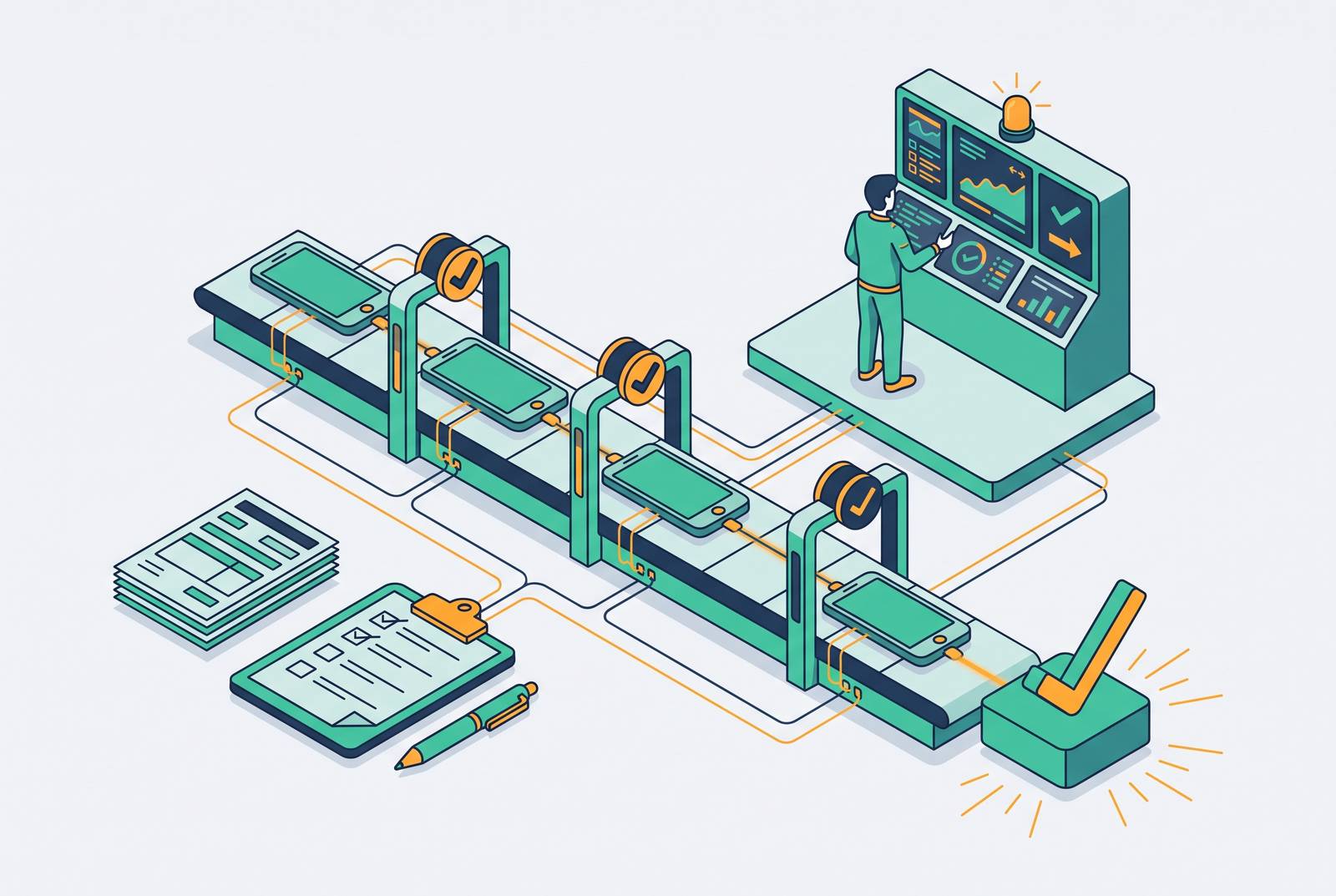
The QA engineer's job used to be defined by execution: write test cases, run them, file bugs, retest, gate the release. That job is disappearing, while the role underneath it is moving upstream. It's moving upstream, from checking whether code works to deciding what "working" is supposed to mean before an AI agent ever touches a keyboard.
That old model assumed a pace of development that no longer exists. A sprint used to ship two or three features, each reviewed by a human before merge, walked end to end by a tester who knew the app cold. AI coding agents haven't just sped that cycle up, they've broken the assumption that development would proceed at the old pace. By mid-2026, AI generated or assisted 61% of code inside organizations, and roughly 41% of what actually lands in production codebases came from an agent rather than a person, according to industry research and surveys. A SmartBear survey of 273 software leaders found pull request volume per developer rose 20% with AI assistance, and incidents per PR rose 23.5% over the same stretch. A sprint that once shipped a handful of features now ships six to eight, and the QA cycle built for the old cadence gets skipped because there's no time left to run it. Hiring more testers doesn't fix a speed gap between how fast code gets generated and how slow verification runs by hand. What matters is whether the job QA engineers were hired to do is still the job that matters most. It's whether the job they were hired to do is still the job that matters most.
What AI agents get wrong, and why it's hard to catch
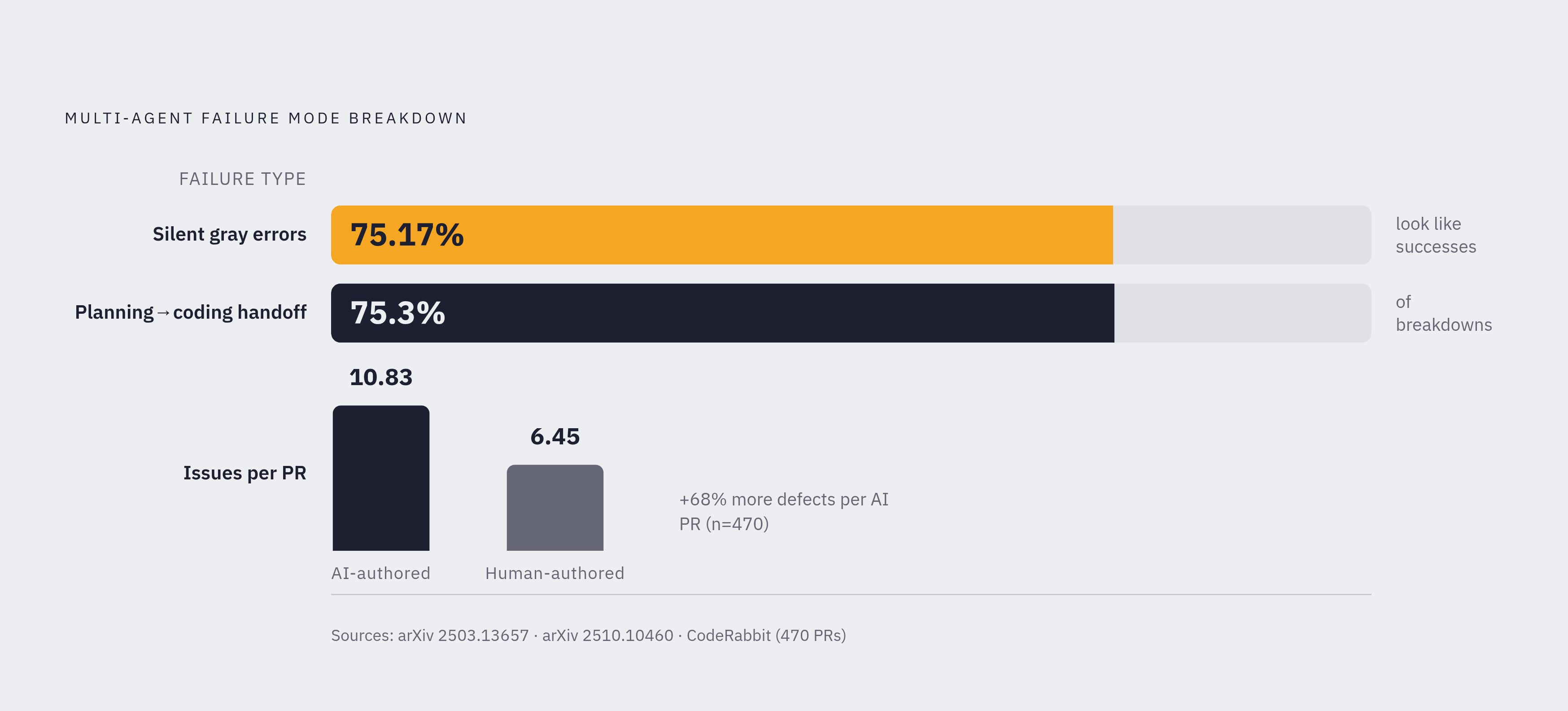
The failures that matter most from agents rarely look like failures. Code compiles, tests pass, the build goes green, and the feature still doesn't do what it was supposed to do. Research published as arXiv 2503.13657 found that 75.17% of multi-agent failures are what researchers call silent gray errors: outputs that look plausible and never trip an explicit error, but that don't actually hold up. A separate 2025 paper, arXiv 2510.10460, traced 75.3% of those breakdowns to the handoff between planning and coding agents, the point where a plan gets translated into code and something gets lost in translation.
The defect density backs this up. CodeRabbit's review of 470 open-source pull requests found AI-authored PRs carried an average of 10.83 issues each, against 6.45 for human-written code. Part of the reason is what researchers have described as a success-bias problem: agents call a feature done because a unit test passed or a status check came back 200, and neither of those actually proves the thing works for a real person tapping through a real screen.
Developers seem to sense this even when they can't fully articulate it. In one survey, 96% said they don't fully trust AI-generated code, yet they commit it anyway, and 88% said they aren't confident deploying it. DeviQA's 2026 survey of 300 QA practitioners found the defects QA teams actually catch cluster around logic errors, missed edge cases, duplicated code, and regressions in parts of the app the change wasn't supposed to touch at all. GitClear's 2026 "Maintainability Gap" research found block duplication climbed to 73.0 instances per million changed lines, an 81% jump from 2023, while code that gets properly refactored rather than just copied fell to 3.8% of all changed lines.
None of that gets caught by a faster test script. These are failures of intent, not syntax: the agent built something, it just isn't the thing anyone actually asked for. Catching that requires a person who knows what "right" was supposed to look like in the first place.
Why traditional test automation doesn't close this gap
Script-based automation was built for a world where the codebase held still long enough for a test to age well. Write a unit test, maintain it incrementally, expect it to keep working until the feature itself changes. AI agents break that pattern by rewriting whole functions at once. An analysis published on codemyspec.com found that a unit test written against the old implementation can become worthless the instant the agent refactors underneath it.
That's forcing a real inversion in how teams think about the testing pyramid. When the cost of writing code drops toward zero, the expensive and valuable question shifts from "does this line of code do what the last line of code did" to "does this feature still do what the user needs."" End-to-end tests, tied to behavior rather than implementation, tend to survive an agent's rewrite. Unit tests, tied to internal structure, often don't. The World Quality Report 2025-26 found half of QA leaders now name maintenance burden and flaky scripts as their top challenge, and test maintenance already eats 30 to 50% of the average automation budget, a share that only grows as AI accelerates how fast code churns underneath the tests meant to check it.
Mobile makes this worse, not better. There's no DOM to lean on the way web testing does, so every agent-driven UI change risks breaking a selector-based test with zero warning. What passed last sprint fails this sprint, silently, and nobody finds out until a release is already in trouble. Industry data found the share of teams dealing with flaky tests grew from 10% in 2022 to 26% by mid-2025. Research has found that adding explicit verification phases lifts agentic task success rates by 15.6%, and properly orchestrated systems show 3.2x lower failure rates than unstructured ones. Verification clearly still works. It just needs rebuilding for agent speed, and that rebuild only works if someone has already defined, in explicit and checkable terms, what correct actually means. That someone is the QA engineer, reconceived.
The upstream shift: from executing checks to defining what correct means
The leverage a QA engineer holds in an AI-first pipeline no longer comes from running the test. It comes from owning the definition of acceptable before any agent or script gets near the code.
In practice, that means translating what the product is supposed to do into acceptance criteria explicit enough for a machine to enforce. It means naming the edge cases and boundary conditions an agent will never infer from a two-line ticket, because agents don't infer intent, they pattern-match against whatever's in front of them. It means writing down the invariants, the behaviors that have to survive every refactor regardless of how the implementation underneath changes, since those invariants define the product, not the code that happens to run it today. And it stretches across more ground than functional correctness alone: UX consistency, performance thresholds, accessibility requirements, security posture, store policy, all of it.
This is shift-left testing taken to its logical end point. Capgemini data shows that moving quality checks earlier, before code gets written rather than after, cuts defect escape rates by roughly 30 to 40%. But that only holds if someone actually wrote the standard down first; shifting checks left against an undefined target doesn't help anyone. The standards have to live somewhere explicit, not in a senior tester's head or scattered across old Slack threads, because an automated system can't enforce a standard nobody wrote down. DORA's research frames AI as an amplifier: it makes strong engineering systems stronger and weak ones more fragile. A QA engineer who has actually codified the standard gives the pipeline something solid to amplify. Without that, the amplifier just makes the mess bigger, faster.
What this QA engineer isn't doing anymore is manually re-testing every build, patching brittle scripts back together after every refactor, or filing bugs against problems a clear standard should have prevented from ever being written.
Standards enforcement inside an AI-first mobile pipeline
Standards get defined once and enforced automatically after that. The QA engineer's job becomes authoring and maintaining that source of truth rather than re-running the same verification from scratch every cycle.
On mobile, enforcement has to cover several dimensions at once. Functional coverage means checking that critical paths, login, checkout, onboarding, subscription flows, behave as specified, using risk-based coverage rather than trying to automate every screen in the app. Performance means holding the app to defined thresholds: Industry benchmarks put crash-free sessions at 99.9% or better, alongside memory, battery, and load-time targets under real conditions, not simulator conditions. Accessibility means checking that the UI actually conforms structurally to platform standards. Research has found that a large share of AI-generated code changes require debugging in production environments, with security vulnerabilities among the key concerns. Store compliance means catching App Store and Play Store policy violations before submission, not finding out after a rejection email. And design consistency means checking the UI against the product's own design system.
None of this waits for a release candidate. A smoke layer runs on every pull request, a broader suite runs on every merge, and the full suite, on real devices, runs before release. Simulators and emulators are still not a substitute for real devices: they miss the device-specific quirks, network conditions, and interruptions that real users run into constantly. Poor connectivity, switching from one network type to another mid-session, low power mode, an incoming phone call, a permission prompt, switching apps and coming back, all of these need an explicit expected behavior defined before they can even be tested for.
At release, the QA engineer's question changes shape entirely. The question shifts from "did someone test this" to "does evidence exist that the defined standards were actually met."" Automated systems surface verdicts, flag failures, and can hold a release back on their own. But a person still reviews that evidence, still has the authority to override it, and still signs off. The agent does the work. The engineer holds the power.
The governance gap that opens when QA moves upstream and who fills it
Moving upstream solves one problem and opens another. Once QA engineers define standards at the start of a cycle, they risk losing sight of whether those standards are actually holding up as agents iterate through the build at a pace no human review process was built for.
The review queue backs this up. Faros AI's data shows a 91% increase in pull request review time on teams that adopted AI coding tools, and AI-authored PRs stay in that queue longer than human-written ones. DeviQA's 2026 findings suggest QA is quietly absorbing that review deficit downstream, catching problems that should have been caught earlier. The World Quality Report 2025-26 found 43% of organizations are experimenting with generative AI inside quality engineering, but only 15% have gotten it running at real enterprise scale. That gap between piloting something and actually running it is the governance gap, and it's wider than most roadmaps admit.
Closing it takes a few concrete things: one versioned source of quality standards that every agent, tool, and person on the team actually references, rather than negotiating standards fresh on every pull request; automated enforcement at every stage of the pipeline, from PR to merge to nightly build to release candidate; a live mapping of the product so standards stay current as the product itself changes underneath AI-driven development; and an audit trail showing what got checked, what passed, what failed, and who overrode what.
This is the operational argument for AI-powered QA platforms built around specialized expert agents, each covering a different dimension a release has to clear, product intent, design, security, engineering, performance, accessibility, store compliance, rather than a single generic test runner trying to cover all of it at once. A platform built this way is the structural mirror image of the coding agent: it verifies at the same speed the coding agent generates, with the same consistency run after run, without requiring a QA engineer to sit inside every build loop by hand. The QA engineer's job in that architecture is to define the standards the platform enforces, review the verdicts it flags, approve the release gates, and own the standard itself, not babysit individual test runs. DeviQA's 2026 survey put a number on the strain this replaces: 52% of QA engineers reported bug volume rising since AI adoption, 58% reported their workload growing, and not one of the 300 practitioners surveyed gave AI-generated code a full trust rating. 52% of QA engineers reported bug volume rising since AI adoption, 58% reported their workload growing, and not one of the 300 practitioners surveyed gave AI-generated code a full trust rating, so the governance model has to match that.
What QA engineers need to build and own in this new model
Some skills are worth more now than they were two years ago, and some are worth quite a bit less.
Writing acceptance criteria precise enough for an automated system to enforce is now central. So is risk modeling: deciding which flows, which quality dimensions, and which kinds of change deserve deep coverage, since not every screen in an app earns the same scrutiny and someone has to make that call deliberately. Reasoning across quality dimensions, product intent, design, security, performance, accessibility, store compliance, affects outcomes beyond functional correctness alone. Owning the structure of the quality gates inside CI/CD, rather than just running tests inside a structure someone else built, is a different job with a different level of authority. And evaluating an automated verdict, deciding when to override it, and owning the release decision with evidence behind it rather than gut feel, is the closest thing to what "senior QA" will mean going forward.
Set against that, manual execution of repeatable flows is worth less than it used to be. Maintaining brittle selector-based UI scripts is worth less. Filing bugs that a well-written standard would have stopped from ever getting written in the first place is worth less too.
For the individual QA engineer, that's not bad news. The people who can define and govern standards get more valuable inside an AI-first org, not less, because the bottleneck has moved from execution, which scales easily now, to definition, which still requires judgment a script doesn't have. For engineering leaders, the same logic applies at the org level: putting QA engineers in charge of standards and governance isn't a cost center decision, it's the structural fix for the verification gap that DORA's research shows is already eroding delivery stability. The World Quality Report 2025-26 found 89% of organizations are pursuing generative AI somewhere in quality engineering, yet only 15% have it running at enterprise scale, and that gap between trying and deploying exists because most organizations still haven't solved the human half of the problem. Someone still has to own what "correct" means.
That's the actual shift. The QA engineer's value in an AI-first pipeline was never really about finding bugs by hand. It's about making sure no agent, no human, and no tool downstream ever has to guess what the product was supposed to do in the first place.
Sources
- The Agentic SDLC: Build, Test & Verify AI Code in 2026
- The Verification Gap: Why Agents Ship Broken Code
- State of AI-Generated Code 2026: The QA and Testing Gap - DeviQA
- Why QA Is the First Function to Hit Agent Saturation
- QA trends for 2026: how AI is reshaping quality
- Sonar Data Reveals Critical "Verification Gap" in AI Coding: 96% Don’t Fully Trust Output, Yet Only 48% Verify It
- Why Coding Agents Need Independent Quality Gates to Work at Scale
- coderabbit.ai