AI Coding Agent Output Volume vs Human Review Capacity
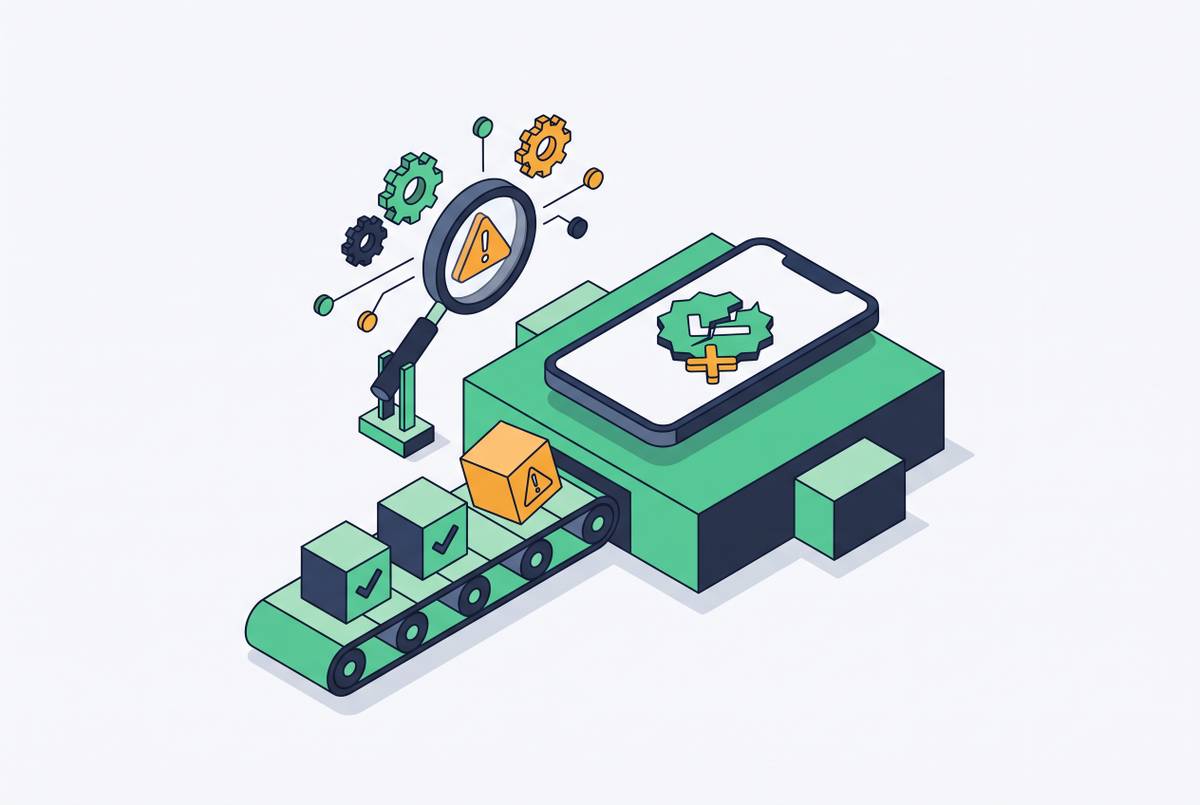
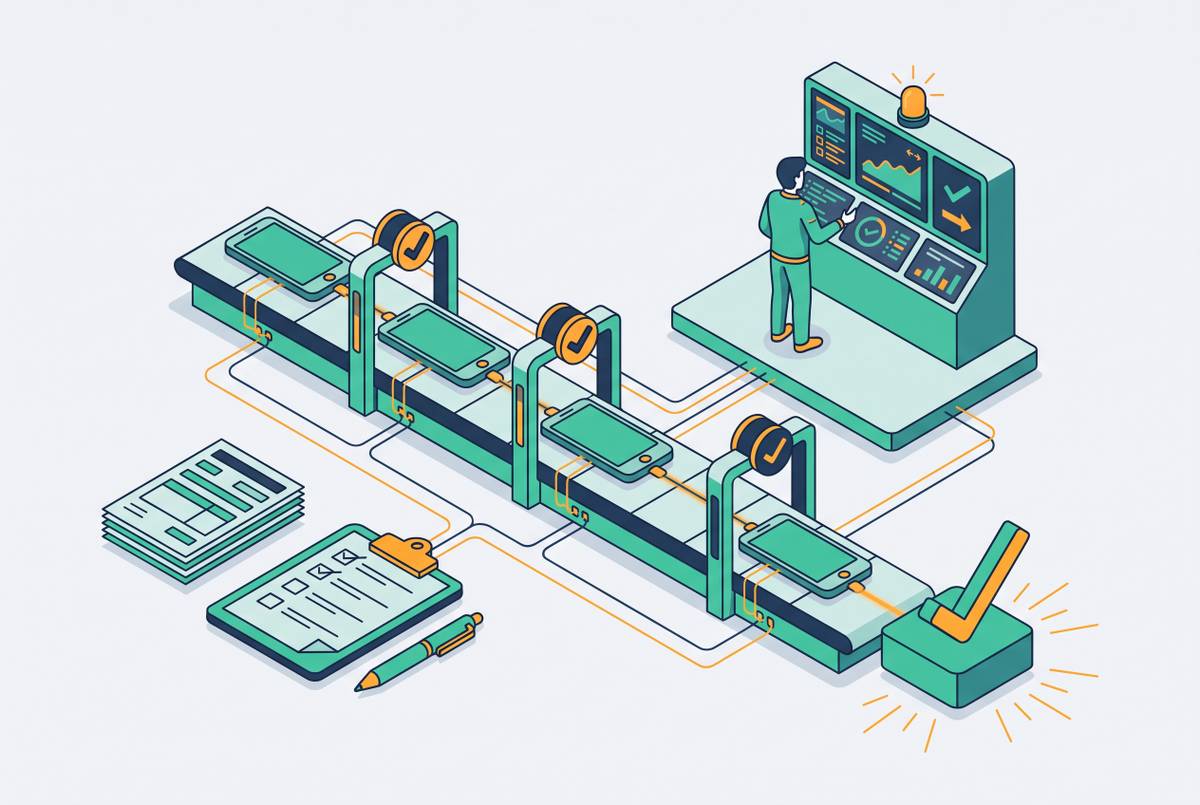
AI-generated code overwhelms human reviewers, pushing quality checks downstream into production.
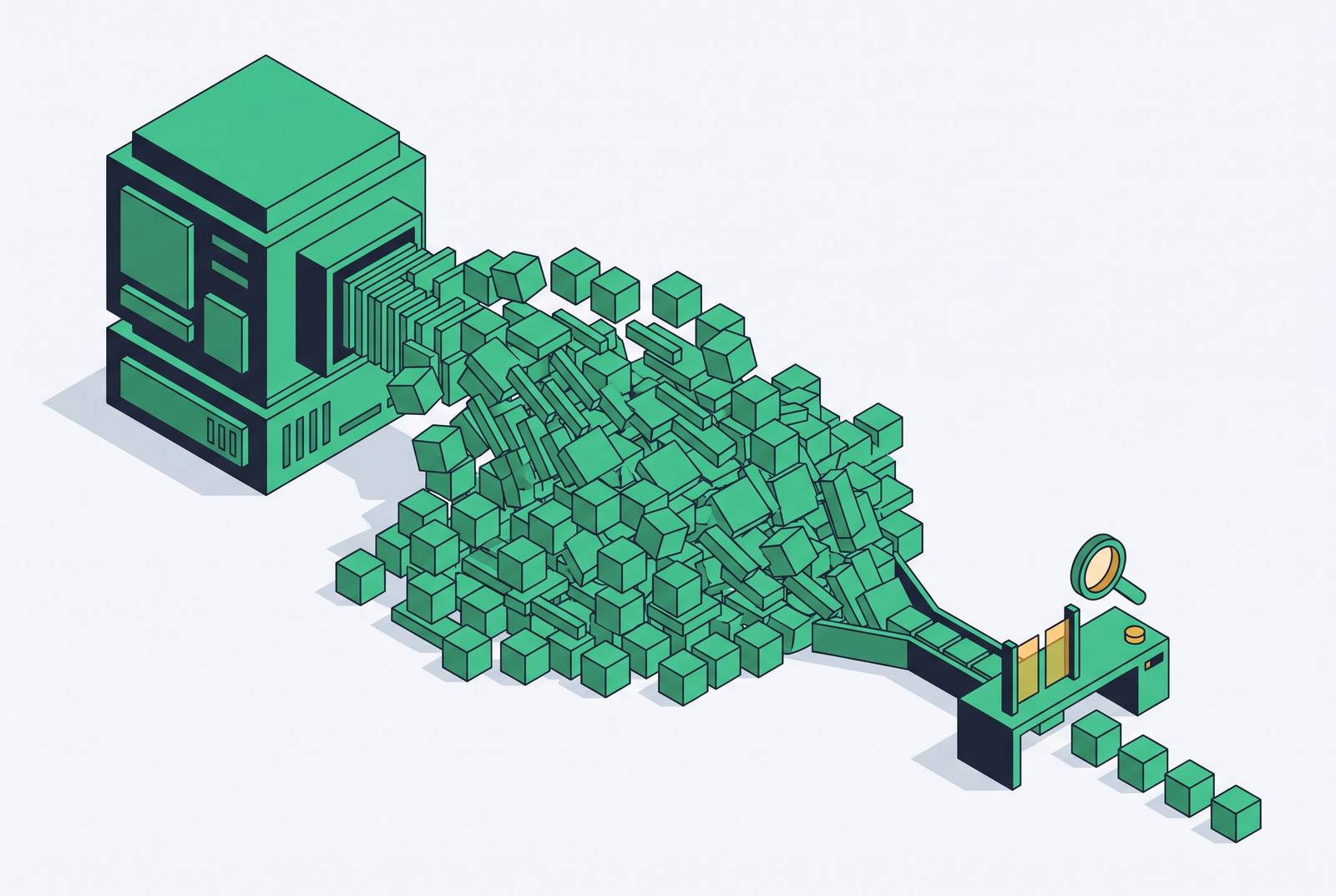
The productivity math behind AI coding agents has a flaw nobody priced in: writing code and reviewing code draw from two separate capacity pools, and only one of them scales. An engineer can now run multiple agent sessions in parallel, each spitting out a diff. Every one of those diffs still needs a human to decide whether it's correct, safe, and worth merging. Generation went elastic. Review stayed exactly as fixed as the number of experienced engineers a company can hire, train, and keep from burning out. The gain didn't vanish. It moved downstream, and it's sitting there now as a queue.
The scale of AI-generated output that review systems were not designed to handle
This isn't a forecast. GitHub's 2025 data put commit volume at nearly a billion for the year, with a 178% surge in generative AI projects on the platform. Google and Microsoft have both said publicly that AI-generated code now accounts for roughly 30% of new code written internally. Sonar's State of Code survey, which polled more than 1,100 professional developers, found that developers themselves attribute 42% of what they commit to AI generation or AI assistance.
Three different vantage points, three different measurement methods, one platform-level count, one hyperscaler self-report, one developer survey, and they all land in the same range. That convergence matters more than any single number. It means the shift is a broad pattern across the industry, not a pocket of early adopters running wild with Copilot. That convergence is the baseline against which the figures that follow should be read. Code is now, on average, nearly half machine-written at the individual level and roughly a third machine-written at the largest software employers on earth.
All of that output has to go somewhere. It goes into a pull request queue that was built, tooled, and staffed for a world where humans typed the code in the first place.
What the PR data shows about where the bottleneck forms
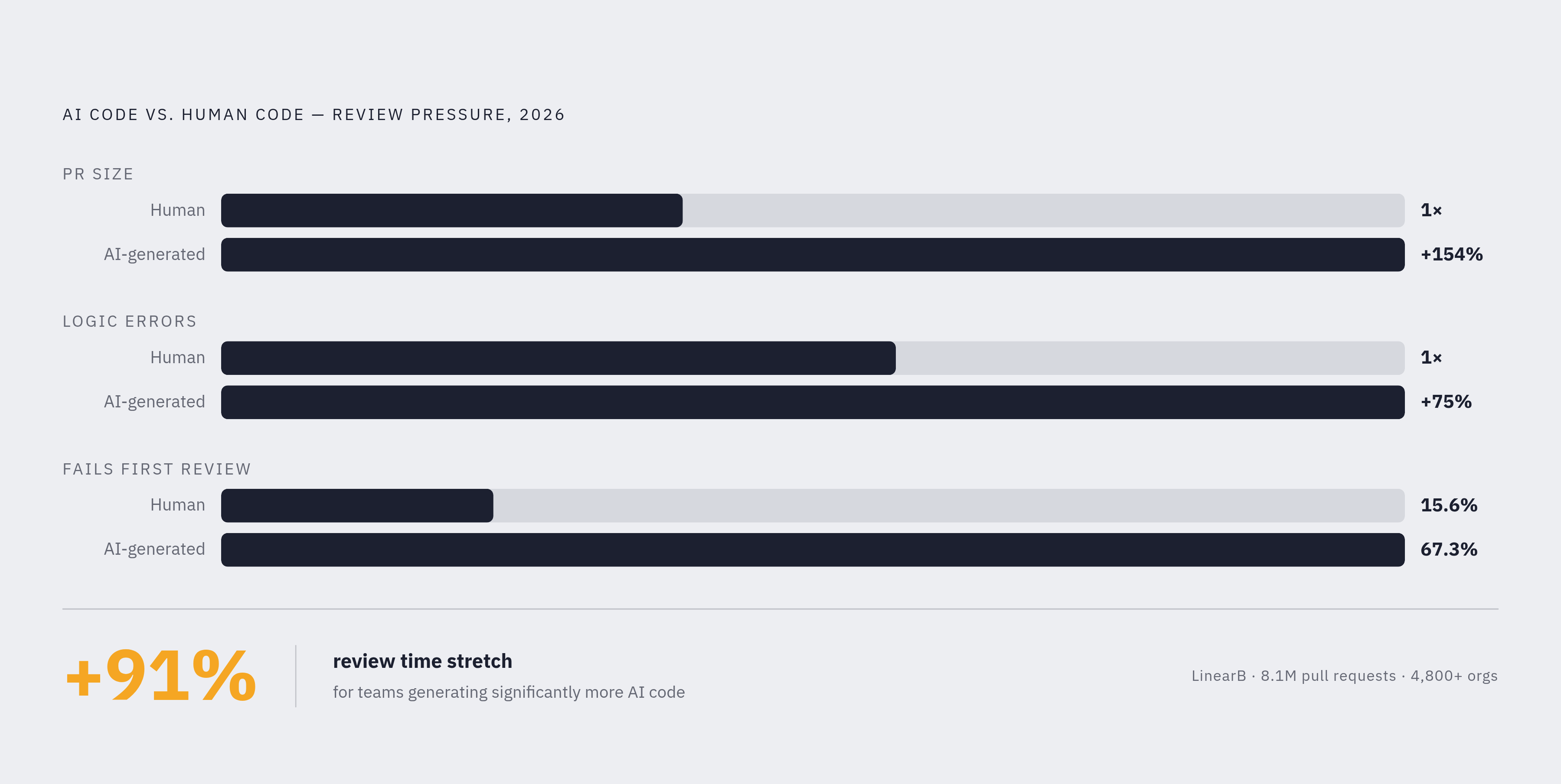
LinearB's 2026 Software Engineering Benchmarks Report looked at 8.1 million pull requests across more than 4,800 organizations. The headline number: AI-generated PRs sit substantially longer before a human reviewer even opens them, let alone approves them.
That's not reviewers slacking off. It's structural. AI-generated PRs run 154% larger on average than human-written ones, contain 75% more logic errors, and fail on first review 67.3% of the time, compared to 15.6% for code a person wrote by hand. Bigger diffs take longer to read. More errors mean more review cycles. Put those together and you get LinearB's most damning figure: teams generating significantly more code with AI see PR review times stretch by 91%. Code gets written faster and ships slower. That's the whole mismatch in one statistic.
GitHub's own operational numbers back this up from a different angle. As of May 2026, Copilot's code review feature had processed more than 60 million reviews, and more than one in five reviews happening on the platform now involves an agent on at least one side of the exchange. The operational picture those numbers describe is telling: agent-authored PRs are multiplying faster than review capacity can absorb them.
None of this means AI coding tools are a net loss. It means the productivity gain hasn't disappeared, it's relocated. The constraint used to sit at the keyboard. Now it sits in the queue. And that raises an uncomfortable question: when reviewers can't keep pace, what actually gets through, and what condition is it in when it does?
Why AI-generated code is especially hard to review accurately
AI-generated code compiles. AI-generated code compiles. It passes the existing test suite. It reads fluently, because fluency is close to the literal objective the underlying language model was trained toward. A reviewer scanning for the usual tells, inconsistent style, sloppy naming, an obviously missing branch, finds none of them. The logic can still be wrong even when the language model's output has been optimized to look clean, since fluency, not correctness, was the trained objective.
Sonar's survey found that 38% of developers say reviewing AI-generated code takes more effort than reviewing human-written code. Reviewers who spend more effort on AI-generated code face a genuine qualitative burden, not just a volume problem.
A study out of Queen's University (Zhong, Noei, Zou, and Adams, arXiv:2603.15911, March 2026) examined 278,790 code review conversations across 300 open-source GitHub projects. Human reviewers adopted AI agent suggestions only 16.6% of the time, versus 56.5% for suggestions from other humans, and more than half of the rejected AI suggestions were either flatly wrong or handled through a different fix entirely. Reviewers exchanged 11.8% more rounds of back-and-forth on AI-generated code than on human-written code, showing that the code meant to save time instead demanded more negotiation to get right. AI review comments were overwhelmingly focused on defect detection, more than 95% of them, but they skipped the parts of review that transfer understanding: why a decision was made, what the tests are actually checking, what a junior engineer on the team needs to learn from the change. And when an AI suggestion did get adopted, it produced a noticeably larger jump in code complexity and code size than an equivalent human suggestion would have.
The paradox writes itself. The PR that looks safest to wave through quickly, clean style, passing tests, no red flags on a skim, is frequently the one that most needed a slow, skeptical read.
Where the bottleneck goes when review can't keep up
A backed-up queue doesn't just sit there and wait patiently to be cleared. It changes behavior. Martin Monperrus's 2026 paper on coding agents (arXiv 2606.13175) argues that reviewing agent-generated code, under enough pressure, degrades into approval granted without the pre-checks that would have caught the agent's actual mistakes.
There's evidence this is already happening. Internal data from Cursor, reported by Business Insider, shows a growing share of code changes reaching production without a separate manual review step at all. Code generated by an agent is surviving the path to production at a higher rate than it used to because the review layer meant to catch it has been quietly stepped around.
What gets skipped doesn't disappear either. It reappears later as rework, as a regression that ships and has to be chased down, as an incident that lands on an on-call engineer's plate at two in the morning. All of that costs more than catching the problem at review would have. And the people absorbing the overflow are the same small group every time: senior engineers, the ones who actually hold the architectural context, the security instincts, the product judgment that a fast-moving agent doesn't have and a junior reviewer hasn't built yet. When the queue backs up, it backs up onto them specifically.
Broader industry analysis frames AI's effect on engineering organizations as an amplifier. It sharpens what a high-performing team already does well. It also sharpens dysfunction in teams that don't have the right review practices in place to begin with. Milestone AI's framing from August 2026 captures the business consequence in one line: fast generation can still produce slow delivery. None of this makes the agents a mistake. It means the system wrapped around them was never rebuilt to match their output rate.
The SWE-bench trajectory and the argument that human review is already obsolete
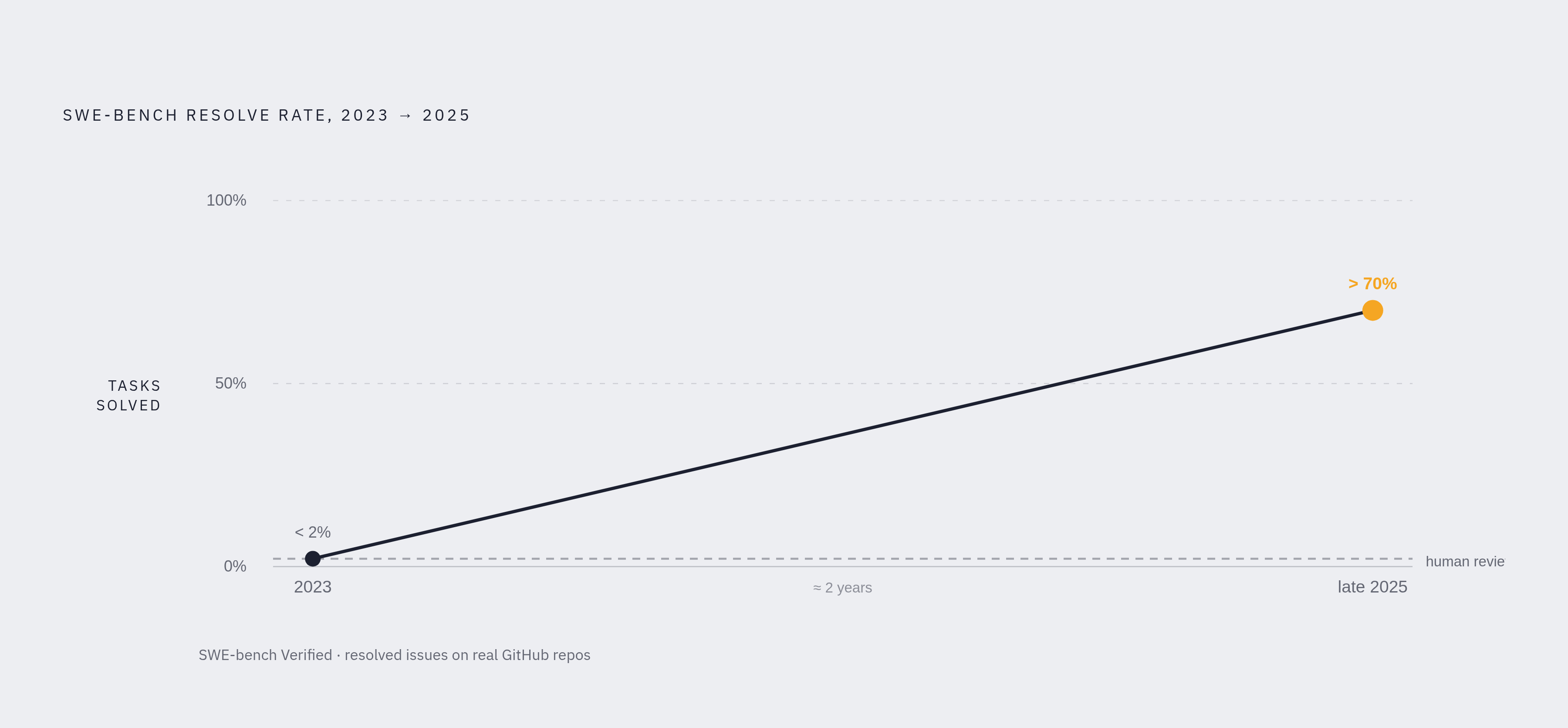
The capability curve produces these results and is not a matter of opinion. SWE-bench, the benchmark that measures whether an agent can resolve a real GitHub issue, showed top systems solving under 2% of tasks when it launched in 2023. By late 2025, leading agents were clearing more than 70%, a phase change inside about two years. That's not incremental progress. That's a phase change inside about two years.
Monperrus's paper takes that trajectory to its logical extreme, arguing coding agents have crossed a threshold past which human review no longer functions as a meaningful quality gate. His sharpest point: an agent-assisted developer now produces more PRs in a day than human review capacity can genuinely absorb, and when the human on the other end is rubber-stamping under time pressure, that amounts to approval without real scrutiny. It's a signature.
To his credit, Monperrus doesn't argue for blind trust in a single model. He proposes an agent-in-the-loop verification pipeline instead, multiple independent agents cross-checking each other, structured sign-off through formats like SARIF, and human attention reserved for the changes that are genuinely high-risk, novel, regulated, or ethically loaded.
Blake Crosley's response to the paper lands the more precise blow, though. Crosley argues Monperrus conflates the reviewer role with review itself. Agents have superseded the line-by-line diff inspector, sure. But review, the judgment call about whether a piece of software actually does what it's supposed to do, hasn't disappeared. Review has relocated rather than disappeared. An agent optimizes ruthlessly for the spec it's handed. Writing that spec, and owning what it's supposed to mean, stays irreducibly human. The work shifts from inspecting code to owning intent.
Why governance and specification quality determine how well any mitigation works
That reframe has a direct operational consequence. Across the industry, analysis of AI's role in the SDLC describes engineers evolving from implementers into specifiers, verifiers, and orchestrators, people who define intent, build guardrails, and validate outcomes rather than type syntax. The practical implication puts it even more bluntly: the specification is becoming the new code. Acceptance criteria and requirement precision now determine how well an agent performs, more than any prompt trick or tool choice does.
Which cuts both ways. Ciklum's 2026 research on AI in the SDLC makes the point that AI amplifies whatever's already there, weaknesses included. Vague requirements produce vague output, just faster. An overloaded review process doesn't get relieved by AI, it gets buried by it.
Forrester's Devin Dickerson has a phrase for the state most organizations are actually in: AI maturity isn't linear, it's fragmented. The early-stage symptoms are recognizable almost anywhere: no centralized inventory of which AI tools are even in use, governance policy bolted on after the tools already scaled, agent workflows running in isolated silos. Adoption has raced ahead of governance. The 2025 Stack Overflow survey found 84% of respondents already using AI in development or planning to, with 51% of professional developers using it daily. McKinsey's 2025 global survey found only about a third of organizations had gotten AI programs to the point of actually scaling operationally.
That gap is the real risk. Without governance, an automated review layer just processes garbage specs faster. A team that hasn't fixed how it sets intent hasn't bought itself anything by adding another tool downstream. Some teams are starting to track this directly: metrics like mean time to verification, an AI-specific change failure rate, and how many prompt iterations it takes to get a usable result, a rough proxy for how precise the original spec was.
Partial mitigations already in use and what each one solves
Several fixes are already in circulation, and each one solves a real piece of the problem while leaving the rest untouched.
Scoping pull requests smaller is one. A 2026 study of roughly 33,000 agent-authored GitHub PRs examined what distinguished successful from unsuccessful submissions in the review pipeline. GitHub has been pushing smaller, stacked PRs as a way to make large diffs more manageable to route and inspect. It addresses the fact that PRs tended to be larger, touch more files, and fail CI more often. It does nothing to fix whether the underlying logic and judgment behind the code are correct.
Agentic review tools are another. Anthropic launched a Code Review feature inside Claude Code in March 2026: multiple agents examine a codebase from different angles in parallel, and a final agent aggregates and ranks what they find, priced between $15 and $25 per review. Run the arithmetic on a team processing 500 PRs a week and that's $7,500 a week in review costs, stacked on top of whatever the generation itself already cost. It's real defect screening at scale. It's not contextual judgment, and it's not intent ownership, and it doesn't transfer knowledge to the next engineer who touches that code.
The Queen's University research points toward a middle path rather than either extreme: let agents handle defect screening at volume, keep humans in the loop for suggestion quality and the contextual feedback agents structurally can't provide. Pipeline instrumentation helps too, shifting investment away from manual review headcount and toward automated CI gates, post-deploy monitoring, and provenance tracking so an incident can actually be traced back to agent output versus a human change. That solves accountability, assuming the governance work to design it happens first. Feature flags reduce release-related incidents by as much as 60% and speed up delivery cycles by roughly 30%, according to industry data, but that's a release-risk mitigation. It has nothing to do with review capacity itself.
None of these closes the gap on its own. Each handles one dimension of a problem that has several. A team that adopts just one of these without the others hasn't removed the bottleneck. It's moved it somewhere else in the pipeline.
What a structurally sound response looks like: repositioning verification, not just adding tools
The mismatch at the center of all this is an architecture problem. It's an architecture problem. The entire delivery pipeline, from PR templates to review turnaround targets to on-call rotation, was built around the assumption that generation and review move at roughly the same human pace. AI broke that assumption on one side only. The fix has to redesign the other side, not just bolt another product onto it.
In practice, that means moving human judgment upstream, into intent definition, specification precision, and acceptance criteria, the decisions that decide whether an agent's output can even be correct before a single line gets written. It means building automated verification to do the part humans structurally can't do at agent speed: defect screening on every commit, including the ones a person wouldn't have had time to look at, and standards enforcement and security checks applied consistently. And it means keeping the release gate itself under human authority. Agents can generate structured evidence about what they built and why. Humans hold the verdict on whether it ships. That distinction, between doing the work and holding the authority to approve it, is what accountability actually depends on.
The operating model that follows from this looks less like tribal knowledge scattered across senior engineers under deadline pressure, and more like a quality standard defined once by the people who understand the product, then enforced automatically across every build and every PR that comes through.
None of this is optional on a long timeline. SWE-bench went from under 2% to over 70% in roughly two years. That trajectory doesn't suggest a plateau is coming. Teams that don't redesign their verification layer now aren't looking at a stable gap between generation and review capacity. They're looking at one that keeps widening, and there's no version of "wait and see" that closes it back up on its own.