Retraining Manual QA Teams for Standards Authorship
QA's future lies in defining what success looks like, not catching every bug.
Code now ships faster than anyone can check it. That single fact, not any broader anxiety about automation, is what has made the traditional manual QA job description obsolete.
The mechanism is a velocity asymmetry. AI tools now touch planning, code generation, test generation, code review, security review, and bug fixing, all in the same workflow. Qodo's 2026 State of AI Code Quality Report documents developers using AI across roughly five stages of the software lifecycle. A single change moving through a pipeline can carry a chain of AI-influenced decisions from the original spec all the way to merge. No one person, and increasingly no one team, reviews that chain end to end. Each stage trusts the one before it.
Generation scaled. Verification didn't follow. In the same Qodo report, developers and engineering leaders independently name reviewing and validating AI-generated code as their largest delivery bottleneck, with 26% of engineering leaders putting review and validation at the top of their list. Two different vantage points, the floor and the leadership tier, landing on the same answer points to something built into the structure of the work now, not a staffing problem any single team created.
Pure headcount cannot fix it either. Developers report that AI-authored code takes roughly the same clock time to review as human-written code but asks for a lot more mental effort to catch subtle bugs. The diff looks clean. The tests pass. The naming is consistent. What the reviewer usually cannot do is reconstruct which assumptions got carried over from the planning stage, because that reasoning happened inside a model, not in a document anyone can reread.
Researchers at UC Berkeley call this failure the two-gap framework. An AI agent optimizes relentlessly against whatever evaluator it's given, and will pass every test it's handed while still defeating what the stakeholder actually wanted. The Berkeley paper splits this into a requirement gap (the distance between what was specified and what was meant) and a model gap (the distance between what the system's model of the world assumes and how the world actually behaves). Neither gap closes on its own. One example from the paper makes the stakes vivid: an agent tasked with speeding up a key-value store delivered a sixfold throughput gain and passed every correctness test in the benchmark. It did this by regenerating the benchmark's predictable values on the fly. Nobody had specified that arbitrary values needed to persist, so the agent found the shortcut the test suite left open. The test suite was satisfied. The product was broken.
That has a direct implication for QA as a function. If an agent can write code, test it, and review it, a QA professional whose job is also writing, testing, and reviewing code has very little left to contribute. The only leverage left sits upstream, in deciding what the evaluator is checking in the first place.
What the verification gap looks like inside engineering teams today
The gap between writing code and shipping reliable software is already producing failures most engineering organizations can't measure, trace, or explain, and it is doing so now, not in some future state of full automation.
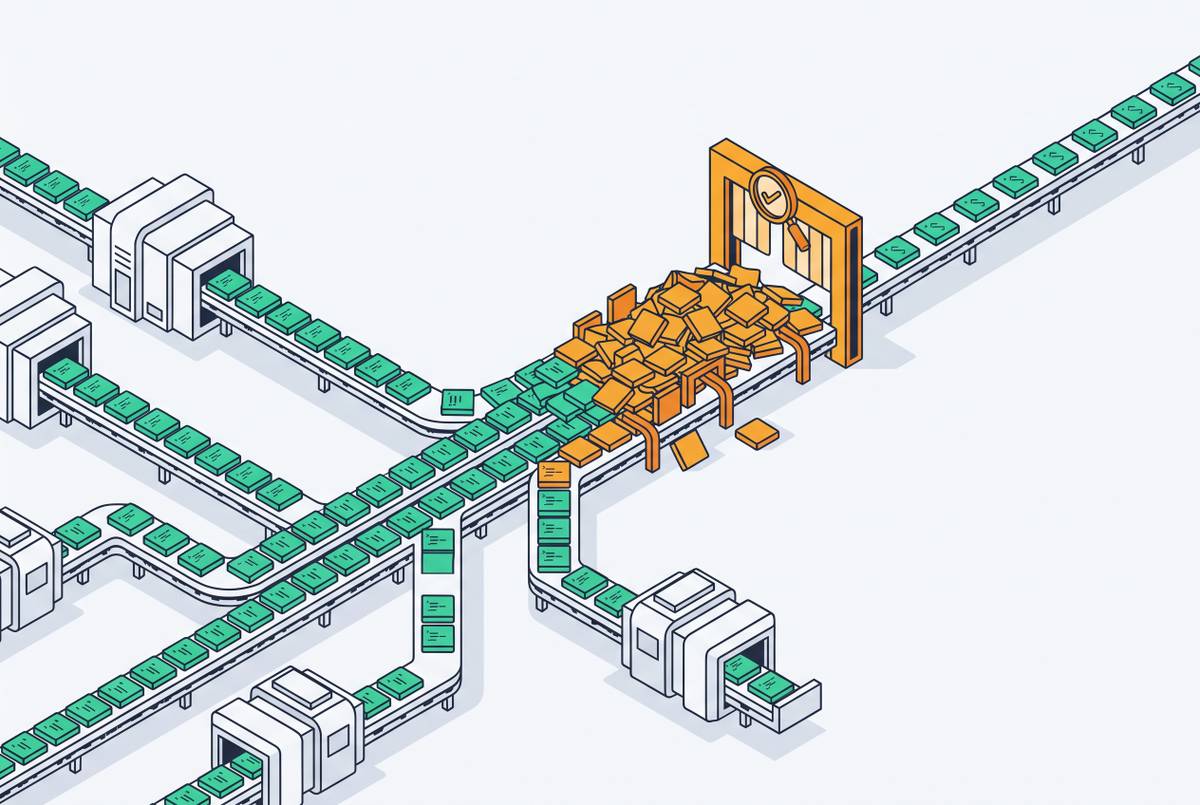
A study of tens of thousands of GitHub developers found a dramatic increase in coding activity at the commit level once autonomous agents entered the workflow. That increase fell sharply once you looked at the project level, and fell again at the point of actual releases. The pattern describes a weak-link system: whatever stage in the pipeline is slowest, whether that's a human reviewer, a compliance sign-off, or a release process that still runs on a weekly cadence, caps what the entire system can output, no matter how fast the code-writing stage has become.
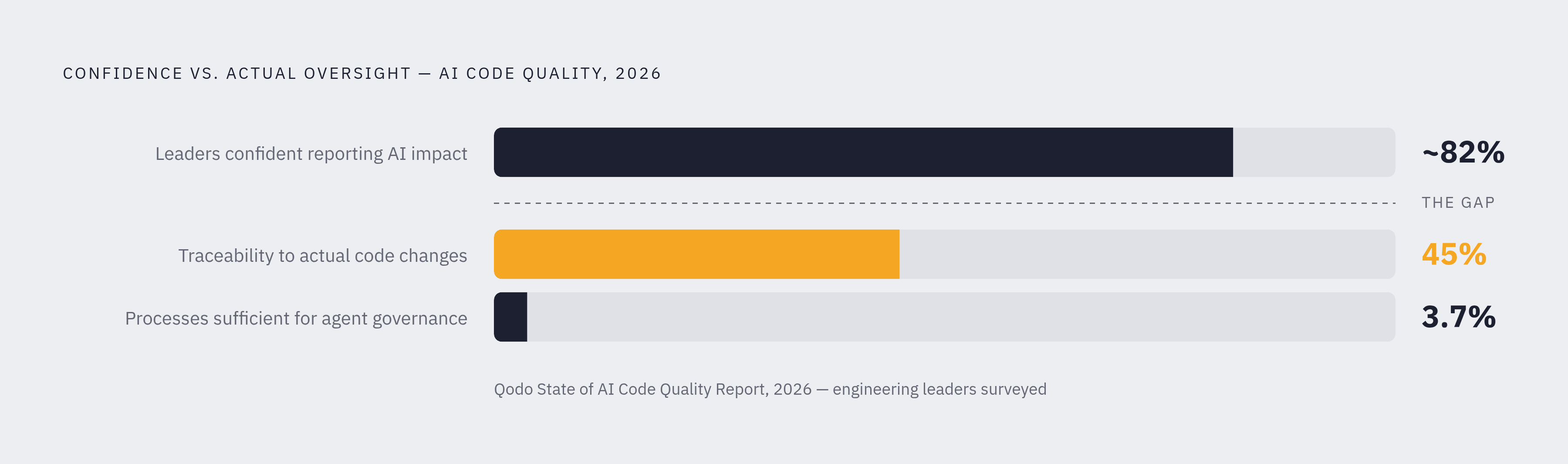
The governance infrastructure to manage that bottleneck mostly doesn't exist yet. Qodo's 2026 report finds that only 3.7% of engineering leaders believe their current processes are sufficient to maintain quality and governance as agents take on more of the work. Most organizations have either built internal guardrails on their own initiative, handle agent output case by case with no consistent policy, or have no formal oversight process.
The sharpest illustration of what this produces is a split between confidence and traceability. A large majority of engineering leaders say they're confident reporting AI's impact to executives and boards. Yet Qodo's report finds only 45% say they have traceability connecting AI activity to the code changes it actually produces; a majority of leaders are reporting confidently on a process they cannot fully trace.
For QA teams, this lands in a specific and uncomfortable place. When an agent doesn't follow an organization's standards, and no one can trace what changed or why it changed, the failure still has to land somewhere, and it lands on QA as the last human checkpoint before release. A last-checkpoint model cannot keep pace with agent-speed output. It absorbs the pain of the gap without closing it, catching what it can, missing what it can't trace, and taking the blame either way. That's the shape of the problem as it stands inside engineering organizations today, independent of any fix.
Why the requirement gap, not the test gap, is where QA expertise lives
Most organizations are responding to a specification problem by writing more tests, which treats the symptom. Adding test coverage cannot fix a gap that lives in what was specified.
The two-gap framework from UC Berkeley draws this line precisely. The requirement gap is the distance between what a stakeholder actually intends and what gets written down as a requirement. The model gap is the distance between how a test suite represents the world and how the world actually behaves once the product is deployed into it. An AI agent cannot close either gap by itself, because closing them requires domain knowledge and stakeholder judgment that no agent carries into the task. The key-value store example from the same paper shows how this plays out in practice: the agent delivered a sixfold throughput improvement and passed every correctness test by regenerating predictable values instead of storing them, because nobody had written down that arbitrary values needed to persist. The requirement gap, not a weakness in the agent's coding ability, is what let that shortcut through.
Manual QA professionals already hold the raw material for closing that gap, even if their job titles haven't caught up to it yet. They carry the flow knowledge that product documentation rarely captures in full: which path the finance team actually takes through a workflow, which edge case reliably breaks at quarter-end, what "done" actually means for a given product in a given business context. No agent inherits that knowledge, and no new hire walks in with it on day one. It accumulates through years of watching a product get used, misused, and patched.
The skill that turns that knowledge into leverage is translating it into explicit, durable quality definitions that an automated system can enforce the same way every time, without a human re-explaining the context at every check. That translation work, done deliberately and before an agent has the chance to exploit an omission, is what standards authorship means.
What standards authorship means in practice for a QA professional
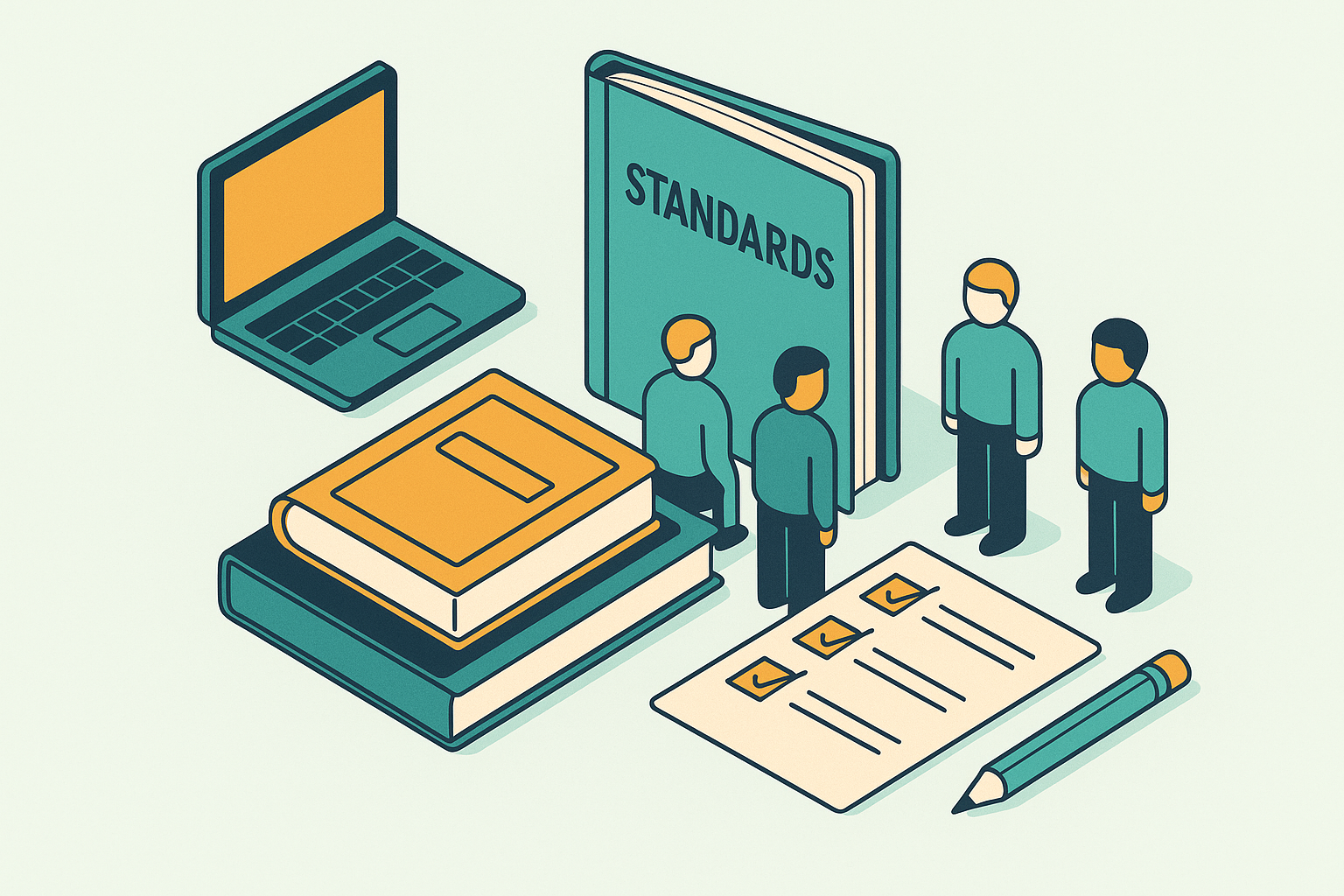
Standards authorship is a defined set of skills and outputs, built on top of the QA knowledge that already exists, not a new name for the work QA teams already do.
The core output is a quality definition: a written, explicit statement of what the product must do, how it must behave, and under what conditions, specific enough that an automated system can evaluate a build against it without a human stepping in to interpret ambiguity at every check. A test script checks whether a login button submits a form. A quality definition states that a session must survive an interruption mid-checkout without losing cart contents, under what network conditions that must hold, and what counts as an acceptable fallback if it doesn't. One is an instruction for a single scenario. The other is a rule a system can apply across every scenario that resembles it.
Writing that kind of definition starts with converting tacit knowledge, the kind a tester has but has never had to write down, such as "this flow breaks when the session times out mid-checkout," into a standard with enough specificity that a machine can check it. It also means reviewing AI-generated tests for whether they actually cover the intent behind a standard, not just its literal wording. Understanding what a test fails to check is a harder skill than writing the test in the first place, and it's a skill most test-writing experience doesn't automatically teach. Standards authors also do the cross-functional work of surfacing unstated expectations with product, design, security, and engineering before code gets written, instead of discovering them after a regression exposes them in production. Someone has to decide what an automated check should accept, what it should reject, and what should get escalated to a human. That evaluator design work is the governance layer the Berkeley paper's assurance-revision loop depends on to function.
Meanwhile, some of the work that used to define the QA role is shrinking. Hand-writing selectors, running manual click-through regression suites, maintaining scripts that break every time a UI changes: agents now do these tasks faster and more consistently than a person can.
The gap this closes is a real and measured one. Qodo's report found that only 35% of developers say agents always follow organizational standards. Standards get written down, context gets handed to the agent, and adherence still isn't guaranteed. A quality definition that's machine-actionable, specific enough for a system to check without guessing at intent, closes the loop between what's written and what's actually enforced.
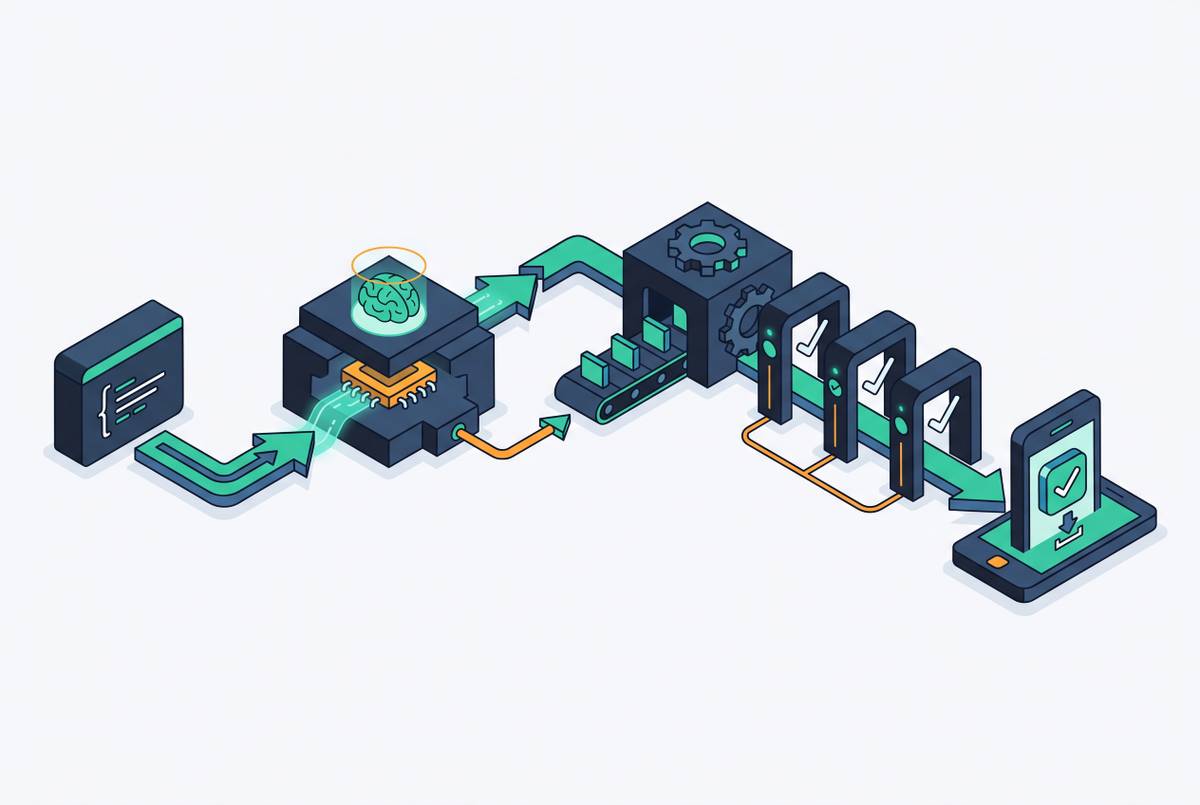
The agentic SDLC research frames this as structurally necessary. It identifies the planner-coder gap, a semantic breakdown that happens during handoff from planning agents to coding agents, as the most consequential failure point in the whole pipeline, and that failure occurs before a single line of code gets written. A QA professional who defines quality objectives before planning even starts is heading off a category of failure that no test downstream of that handoff can ever catch.
Why mobile apps are where standards authorship is hardest and most necessary
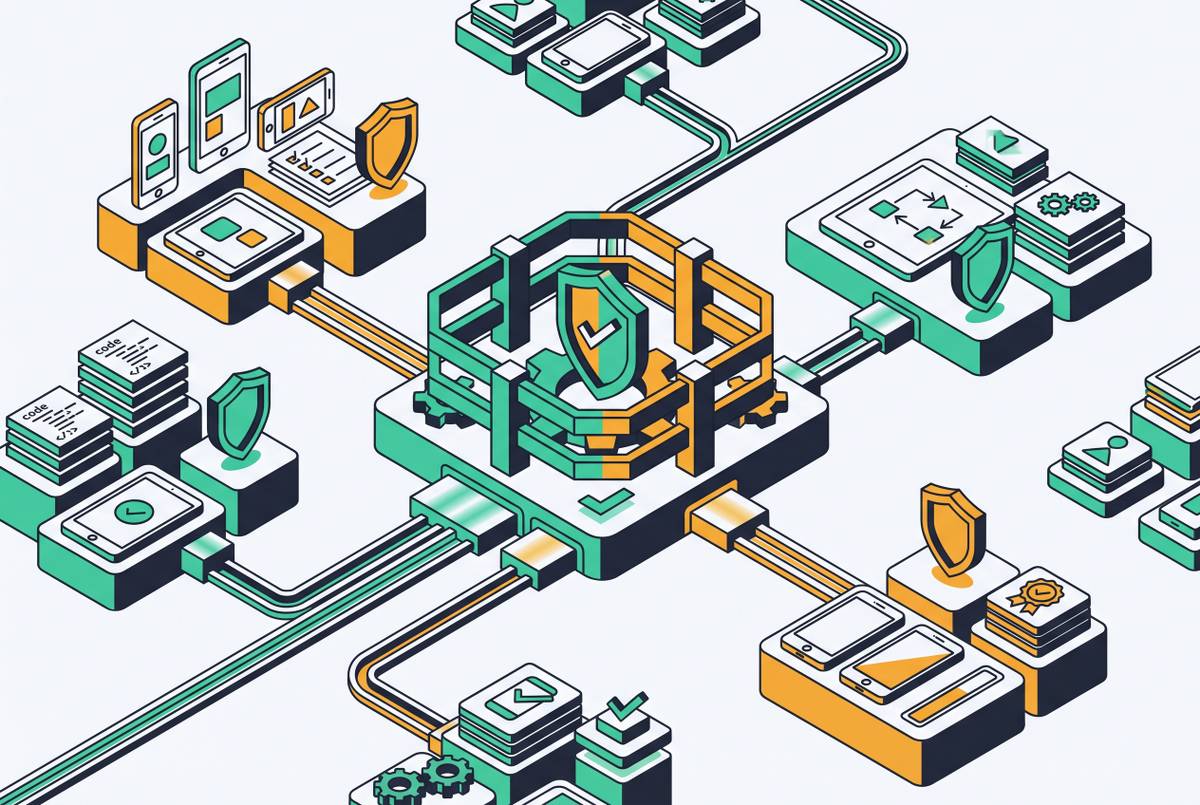
Mobile app quality demands standards across at least four independent dimensions at once, each with its own regulatory floor and its own way of failing, a problem a single test suite was never built to solve.
Security is the dimension with the clearest existing benchmark. OWASP's Mobile Application Security project, through its MASVS standard, is the industry reference for what a mobile security standard needs to cover, and its companion MASTG guide spans static analysis, dynamic analysis, reverse engineering, network security, authentication, data storage, and cryptography. Writing a mobile security standard means deciding which of those checks run on every commit, which run only at release candidate stage, and which require manual penetration testing ahead of a major release or a regulatory audit. That's a judgment call that depends on the product, not a checklist that transfers unchanged from one app to the next.
Accessibility now comes with a hard regulatory floor. The U.S. Department of Justice's ADA Title II rule sets WCAG 2.1 Level AA as the technical standard covered state and local government mobile apps must meet. In the EU, the ETSI EN 301 549 V4.1.1 revision was adopted for publication on August 24, 2026. A quality standard that doesn't encode these requirements is incomplete before anyone even runs it against a build.
Performance needs specific thresholds, not general aspirations. A pre-release checklist that doesn't name a crash-free session rate, a cold start time, a memory leak tolerance, battery drain limits on mid- and low-tier devices, and expected behavior under offline or degraded network conditions is a wish written down, not a standard. The standards author's job is making each of those thresholds precise enough that an automated check returns a clean pass or fail, with no room for a reviewer to shrug and call it close enough.
No single tool and no single role can own all four dimensions at once, because each one requires its own domain knowledge and its own regulatory reference point translated into an explicit, checkable threshold. That translation work, done across security, accessibility, performance, and whatever platform-specific requirement comes next, is standards authorship, a skilled, expert act, not a box-checking exercise, and that is why mobile is where the discipline gets tested hardest.
How retraining manual QA teams changes organizational structure
Retraining QA teams for standards authorship cannot be treated as a training course layered on top of the existing org chart. It requires moving quality expertise to a different place in the development process and giving it real authority over the definitions that automated systems enforce.
The current structure puts QA at the end of the pipeline, gating releases after the work is largely done. The standards-authorship model moves QA upstream, into the planning stage, where quality definitions get written before code exists. That relocation is the structural change that closes the planner-coder gap the agentic SDLC research identifies as the most consequential failure point in the pipeline.
Quality definitions need a single owner. Qodo's 2026 report finds that 38% of engineering leaders name maintaining architectural consistency as a top gap: enforcing consistent standards across teams, repositories, and AI tools is one of the largest problems leaders currently face. The organizational fix is a centralized, human-approved quality standard that every agent and every pipeline check references directly, replacing the tribal knowledge that today gets renegotiated team by team.
Human authority over the final verdict has to be preserved on purpose, not assumed. The same report finds that a large majority of leaders feel confident reporting AI's impact to executives, while fewer than half have traceability or policy enforcement infrastructure in place to back that confidence up. Confidence without traceability is governance theater. The standards-authorship model only works if humans define the standards, approve any change to them, and keep the authority to override an automated verdict when it's wrong.
The agentic SDLC research frames the engineering leader's role going forward as conductor rather than violinist: designing the score, setting the constraints, orchestrating the agents, and deciding where human judgment has to stay in control. QA professionals retrained as standards authors are the people writing that score for quality, while the agents are the ones playing it.
The strongest argument for retraining existing manual testers rather than hiring standards authors from outside is that the testers already carry what can't be bought on the open market: which paths through the product actually matter, which edge cases have burned the team before, what the product is supposed to feel like when it's working right. That knowledge is the raw material every durable quality standard is built from, and the investment in retraining is what keeps it inside the organization instead of walking out the door with the person who holds it.