Tribal QA Knowledge as an Organizational Risk
When experienced QA engineers leave, their undocumented knowledge walks out the door with them.
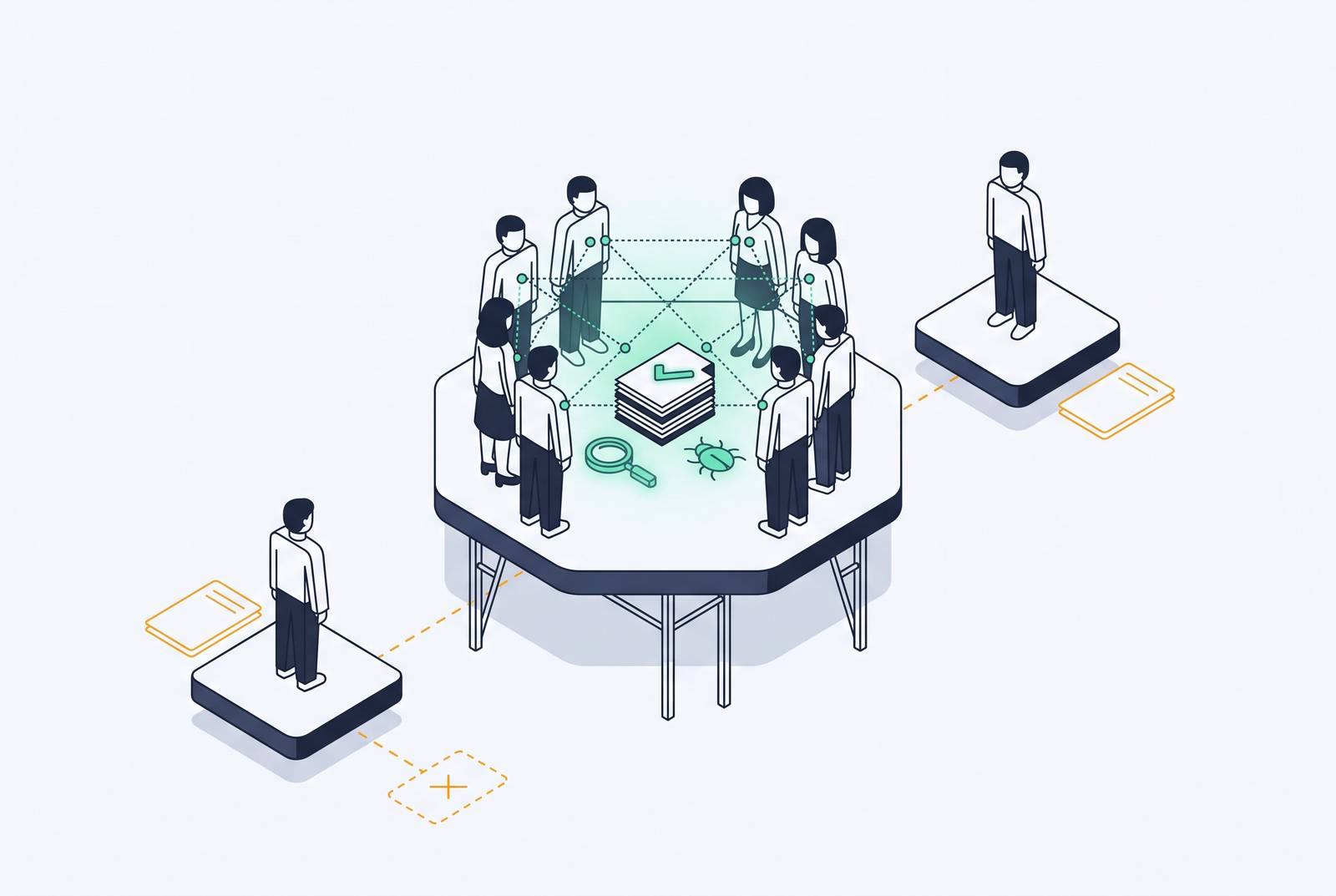
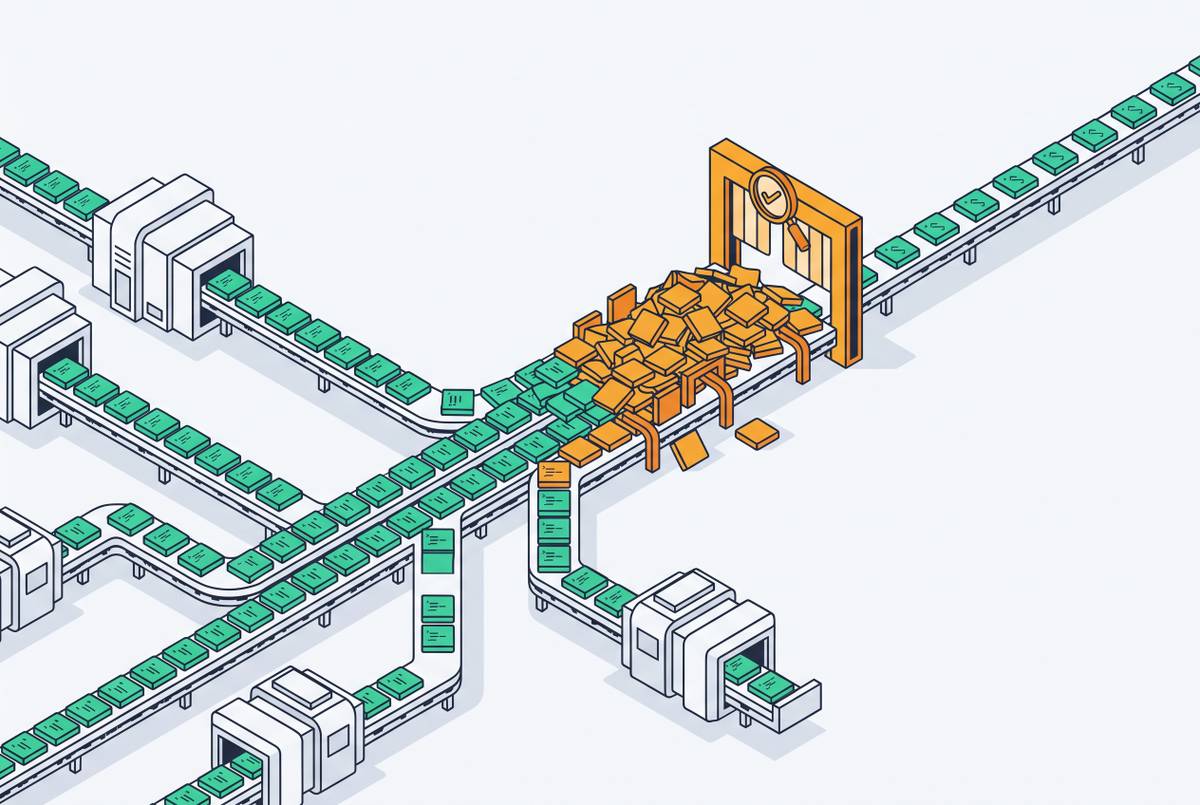
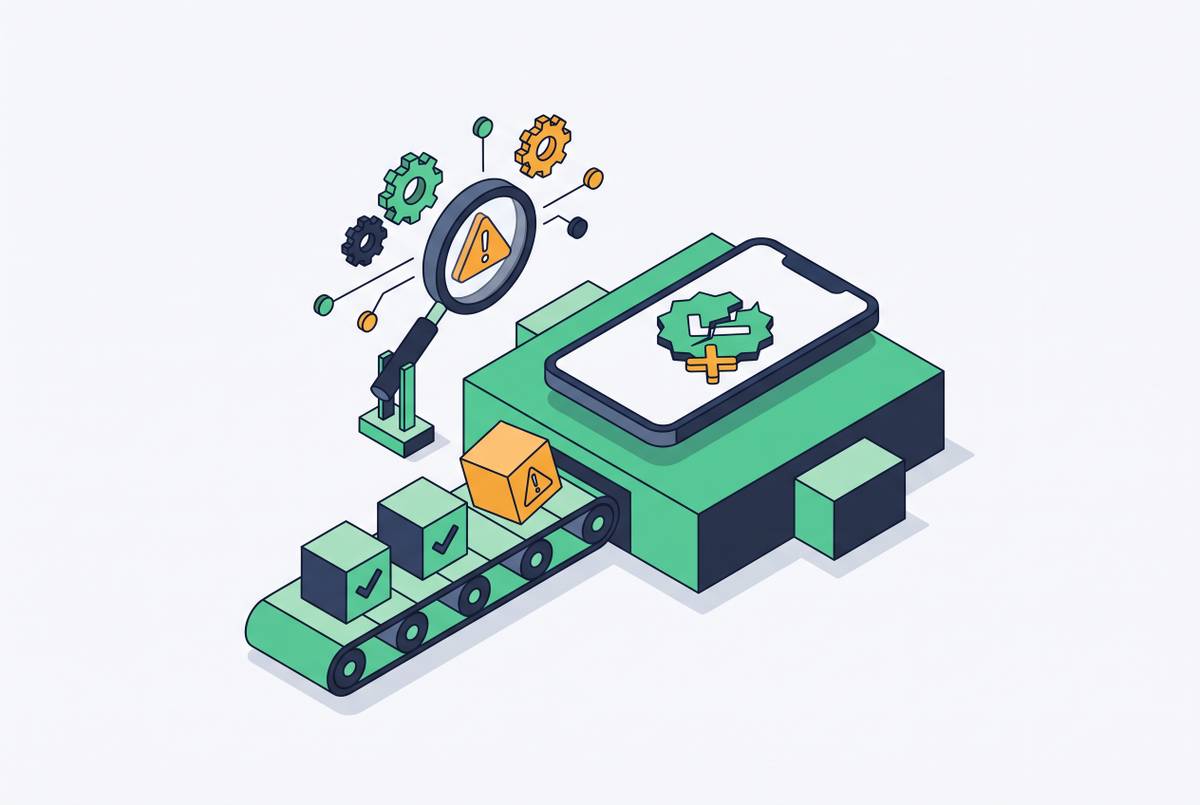
Tribal QA knowledge is the undocumented judgment that lets experienced engineers catch bugs nobody wrote down a rule for. It covers the device that needs a workaround, the crash signature that's a false alarm, and the flow that got rejected by a store reviewer two years ago for reasons nobody bothered to log. It is a real organizational risk, not a quirk of team culture, and it compounds the moment someone leaves, accelerates once AI coding agents start writing more code than any human can verify, and becomes unmanageable without a standard that gets enforced the same way every time.
"Tribal knowledge" gets used loosely, which blurs distinctions that affect how organizations diagnose and fix knowledge gaps. Tacit knowledge is personal: an engineer's internalized sense of what looks wrong, hard to put into words even when she tries. Institutional knowledge is broader still: it is the entire body of what an organization has learned, written down or not. Tribal knowledge is the narrower, more dangerous slice of both: the part that is undocumented and not shared, sitting in one person's head or one Slack thread, invisible to everyone else until it's needed.
According to Atlan's research, tribal knowledge forms through five recurring dynamics. A QA engineer fixes the same device-specific failure three times and never writes it down, because writing it down was never part of the job description. Answers get transmitted socially, through hallway conversations and informal messages, rather than through anything structured. Test suites and acceptance criteria evolve, but the documentation doesn't keep pace, so the gap between "what the test plan says" and "how the team actually validates a release" widens every quarter. What was manageable on a five-person QA team turns into a reliability risk once that team hits fifty. And, rarest but most corrosive, some knowledge stays informal on purpose, because the person holding it treats obscurity as job security. That last one is the hardest to fix, because there's no accidental gap to notice. Nobody stumbles onto it until the person is gone.
None of this looks like a problem while the person holding the knowledge is still around. The cost only gets priced in on the way out the door. A Lucid survey of knowledge workers in 2025 found that only 16% of organizations describe their workflows as extremely well-documented, which means for most QA teams, the default state of process knowledge is simply undocumented, and everyone's just working around that fact.
The QA-specific texture matters too. Atlan's 2026 framework breaks tribal QA knowledge into five distinct types, each with its own failure mode when left undocumented. Process knowledge covers the undocumented ordering or setup steps that, if skipped, cause silent failures rather than loud ones. Exception knowledge is the "this device behaves differently under low memory" fact that never made it into any test plan. Historical context is the prior rejection reason that quietly shaped an acceptance criterion nobody wrote down. Relationship knowledge is knowing which field in an analytics payload actually maps to which user-facing behavior. And interpretive knowledge is judgment calls like knowing a 20% crash spike on one screen is almost always a bad deploy rather than a real regression, so the right move is to wait before escalating.
None of this makes tribal knowledge inherently bad. Seasoned QA judgment is real expertise, earned over years of watching things break in specific ways. The problem isn't that the knowledge exists. It's that it has never been captured anywhere a teammate, a new hire, or an AI agent can actually reach it.
How attrition turns undocumented QA knowledge into organizational dependency
The dependency is invisible right up until the moment someone resigns. Then, suddenly, nobody knows which regression scenarios the departing engineer ran manually before every release, or why one particular flow got excluded from automation years ago and stayed that way.
Attrition trends are making this worse, not better. Median employee tenure has declined meaningfully over the past decade. Deloitte Insights has found that 92% of surveyed organizations don't consistently capture knowledge from employees approaching retirement. And a 2025 Enboarder survey found 76.6% of companies name institutional knowledge loss as their top offboarding concern, with HR leaders estimating the unmanaged cost can run as high as $500,000 a year.
The concentration of knowledge among a small number of contributors compounds it further. Slite's data shows that the top 1% of contributors to a typical knowledge base create 47% of all its content, so the loss of a single senior person doesn't remove an even slice of what the team knows. It removes a disproportionate one. Slite's survey also found that among teams above 50 people, 42% name undocumented tribal knowledge as their single biggest documentation challenge, ahead of everything else on the list.
Several patterns reinforce each other once this dynamic sets in. Systems go undocumented, so engineers can look at a test suite and still not agree on which scenarios are current or whether a given metric is still being validated. Every edge case, every production incident, every pre-release sanity check routes to the same person, a single point of failure dressed up as expertise. And onboarding drags, because new QA engineers can find the test plan easily enough but still can't tell which exceptions matter without asking someone, over and over.
These feed each other in a loop. When a schema or acceptance criterion doesn't carry enough context on its own, engineers route the question to whoever knows. The answer lives and dies in that one private conversation. The system stays exactly as undocumented as it was. The next new hire asks whoever knows the same thing six months later.
Inefficient processes cost surveyed DevSecOps professionals roughly seven hours a week even without a resignation triggering it. A GitLab survey found that inefficient processes cost surveyed DevSecOps professionals roughly seven hours a week, with limited knowledge sharing named as one of several contributing barriers. Tribal QA knowledge isn't the only cause of that number, but it's a documented piece of it.
In regulated industries, the dependency turns into a straightforward audit liability. Auditors don't accept "the right answer lived in someone's head" as evidence of anything. A Slack thread from a former employee doesn't count as documentation of a validated change, no matter how correct that engineer turned out to be.
Where undocumented QA knowledge surfaces as a concrete failure in mobile development
Mobile makes all of this worse, because the test surface is fragmented in ways no single document can fully capture. A vast range of Android device variants across many OEMs mean device-specific workarounds tend to live in one engineer's head and nowhere else. Layer in multiple OS versions, real-world network conditions, and user behavior that appears only in production and never in a lab, and no test matrix, however carefully built, stays complete for long. Release cadence adds pressure on top of that: Top App Store apps ship updates at a rapid cadence, which leaves no real room for a documentation sprint before each release goes out.
App store compliance turns this into a measurable cost rather than an abstract risk. Apple reviews submissions at large scale and rejects a substantial share, with performance issues, crashes, bugs, and incomplete builds among the most commonly cited rejection causes. Google similarly enforces policy compliance at scale, regularly removing violating submissions and developer accounts. Apple's 2025 guideline revisions introduced new requirements around AI and data handling, and apps built before those rules were published are encountering compliance issues on their first update submission afterward. Starting April 28, 2026, Apple will require every new submission and update to be built with Xcode 26 or later against the current SDK set, a compliance requirement that has to be actively tracked rather than assumed.
Store-rejection history, including which submissions got bounced, for what specific guideline, and what fix actually worked, almost never gets written down formally and almost always lives in one engineer's head. When that engineer moves on, the history doesn't move with them to a document. It just disappears, because that engineer's knowledge leaves with them and was never recorded.
Each of the tribal knowledge types maps onto a real mobile failure. Exception knowledge covers the device that behaves differently under certain conditions in ways the test plan never captured. Historical context covers the prior App Store rejection that shaped a privacy consent flow, unwritten, so the next engineer who touches the flow sees an "unnecessary" screen and removes it. Undocumented interpretive judgment covers the difference between a crash signature that's a real regression and one that's a known artifact of instrumentation, a distinction that takes years to build and seconds to misjudge.
Mobile quality is multi-dimensional: product intent, design consistency, security, performance, accessibility, and store compliance all have to hold at once, and no single tool or person owns every dimension. When the knowledge that ties those dimensions together is tribal, gaps open quietly across all of them, and nobody notices until a release fails. That's the deeper issue with treating QA as a checkpoint rather than a process: if quality only gets checked at the release gate, the expensive rework is already baked in by the time an undocumented edge case is discovered.
How AI coding agents turn a manageable knowledge gap into a structural verification failure
The scale of AI adoption in software development makes this an urgent problem rather than a theoretical one. A SmartBear survey of software testing and quality decision-makers found 40% of surveyed organizations now generate more than 40% of their code using AI tools. That's not a pilot program anymore. That's a meaningful share of the codebase.
Speed is up. Quality is not following at the same pace. The same SmartBear survey found 70% of decision-makers concerned that quality is suffering right now, and 60% saying they've already experienced quality issues tied to AI-generated code. New Relic's State of AI Coding Report found 78% of tech leaders reporting an increase in production incidents after AI-generated code ships, even in cases where the code looked higher quality during review.
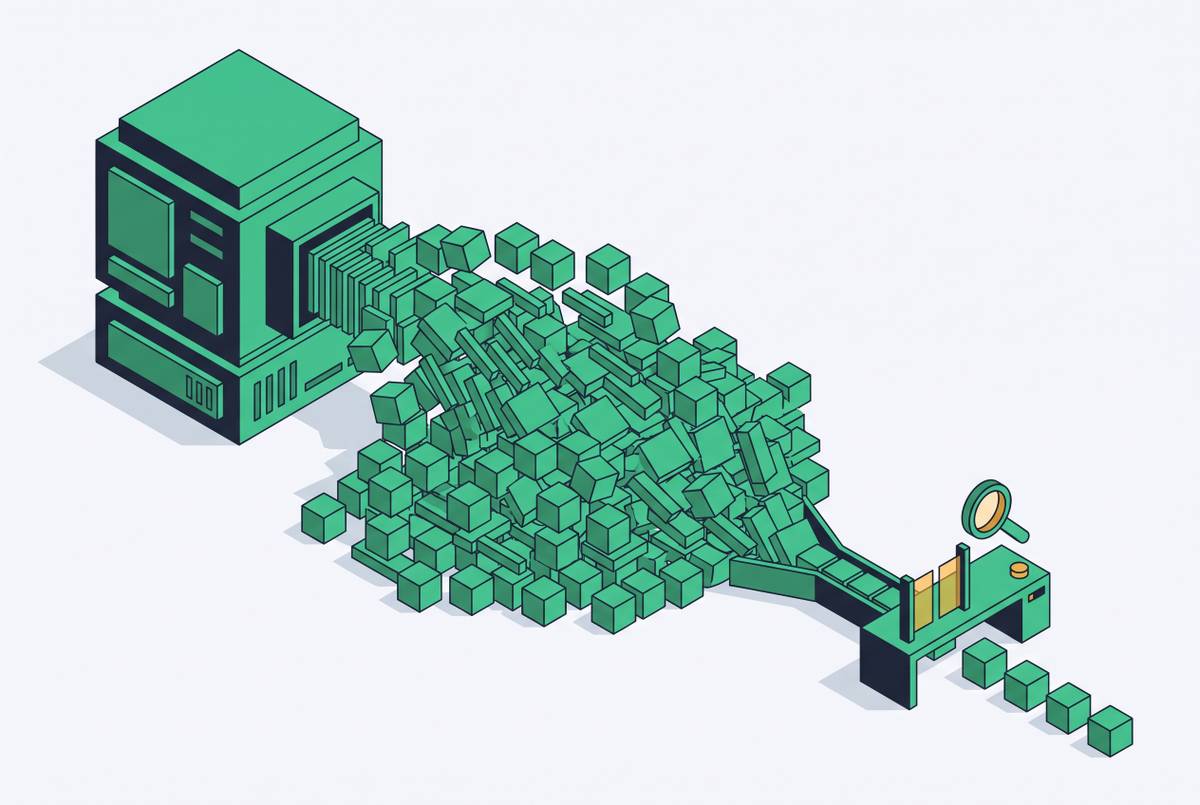
That gap points to a structural asymmetry. Generating code keeps getting easier and faster. Reliably verifying that the code actually does what a human intended is getting harder. The old assumption in computing, that verification is cheaper than generation, is reversing for code produced by these tools, and that reversal is the whole crux of the problem.
Tribal QA knowledge is exactly the missing context that makes verification hard. An AI agent can read a schema. It can follow a documented procedure step by step. What it cannot do is use context it was never given access to, because that context was never written down anywhere in the first place. Better training can improve how a model interprets the information it has, but training cannot recover a business rule that nobody ever recorded, cannot determine which of three conflicting definitions is the current one, and cannot infer an exception that only one engineer happens to know about. This failure mode is well-documented across agentic AI deployments: missing or stale context produces outputs that are technically accurate and operationally wrong.
Stale documentation used to be a minor human inconvenience. A new hire wastes an afternoon following an out-of-date test plan, shrugs, and asks someone. Once that same document gets piped into an AI agent's context window, the staleness becomes an infrastructure risk, because every downstream workflow that touches the agent inherits the same bad assumption, and the errors compound quietly rather than getting caught. This represents a core structural shift: documentation maintenance cannot keep pace with the rate at which knowledge is created, and AI consumption of that knowledge scales faster still.
Using one AI model to review code that another AI model, or the same one, generated is a specific trap. If both steps share the same foundational assumptions and the same blind spots, the review step doesn't catch the error. It just validates the misunderstanding a second time. Undocumented QA knowledge cannot be recovered by pointing a second model at the same gap that produced the first mistake.
The upstream signal is already visible in how teams work. Available industry data suggests that teams with high AI adoption ship more code but have not seen review time shrink to match, indicating that generation has outpaced verification capacity. Code generation has already outpaced human verification capacity, and that gap widens every time adoption grows without a matching investment in how quality gets enforced. Stack Overflow's 2024 Developer Survey found 63% of developers naming technical debt their top workplace frustration, roughly double the rate of the next most common complaint, and AI-generated code produced without any enforced quality context adds to that pile faster than most teams can pay it down.
Why traditional QA tools and documentation sprints cannot close this gap
Better tooling looks like the obvious fix. Better tooling isn't the fix, because it addresses the wrong problem. Too many teams jump straight into frameworks like Appium, Espresso, or XCUITest without first defining what they're actually testing for or why. A test script is not a quality standard. It's an expression of one, and it's only as good as the standard behind it. A tool that runs scripts reliably is not the same thing as a system that understands what "good" means for a product and enforces that understanding, because scripts can only check what someone happened to document at the exact moment the script was written. When the product changes six months later, as products always do, the tests either break outright or quietly go stale. Both are failures of undocumented intent, not failures of the tool itself.
Documentation sprints are the second false fix, and they fail for a different reason. Writing everything down after the fact does not guarantee that the hidden knowledge actually surfaces, and even when it does surface, Atlan's 2026 research finds there's no guarantee it stays current. Maintenance work scales linearly, one audit a year, one owner assigned per page. Knowledge creation scales much faster than that. And AI's consumption of that knowledge, according to Slite's analysis, scales faster still. An annual documentation audit was a perfectly reasonable rhythm back when humans were the only ones reading the docs. It's an inadequate rhythm once agents are acting on that same documentation continuously, at volume, without pausing to notice it's twelve months out of date.
Tribal peer review is the third false fix. Routing every hard question to the one person who knows the answer is itself a symptom of the underlying disease, not a treatment for it. It falls apart the moment that person is on vacation, has left the company, or is being asked to review AI-generated output arriving faster than any one human can read it. Knowledge scattered across individuals, negotiated case by case, isn't an enforceable standard. It's a set of opinions that shifts depending on who you ask, what mood they're in, and what they happen to remember that day.
DORA's 2025 research, drawn from nearly 5,000 technology professionals surveyed globally, gets at why all three fixes miss the actual target: AI acts as an amplifier, not a corrective. It magnifies the strengths of teams that already have solid structure, and it magnifies the dysfunction of teams that don't. Fragmented QA knowledge doesn't get smoothed over by AI. It gets amplified by it.
Context quality is the real lever here, and it's measurable. Atlan's Context Quality Testing research found a 38% improvement in AI accuracy across hundreds of queries when governed, structured metadata, essentially tribal context that had been encoded and made explicit, was added to an agent's available context, compared to unstructured retrieval alone. That gap is the cost of leaving knowledge tribal, stated as a number instead of a hunch. The fix isn't more test scripts, more documentation pages, or more human reviewers stacked on top of an already backed-up review queue. It's encoding the actual quality standard into a system that enforces it the same way every time, at whatever speed the agents are working, without needing a specific human in the room for every single check.
What it looks like to move from tribal memory to enforced quality standards
The underlying principle is simple to state and hard to build: quality expectations get defined once, approved by the humans who actually understand the product, and then enforced automatically and consistently across every build, every pull request, every release. Not renegotiated from memory each time someone new joins the team or an old hand walks out the door.
Multi-agent verification architectures are already showing up as one operational answer to this. Microsoft documented a working five-agent software development pipeline in early 2026, with a Spec-kit agent that turns ideas into formal requirements, a Coding Agent that implements against those requirements, a Quality Agent that assesses the resulting output, GitHub Actions handling the build pipeline, and an SRE Agent watching production once code ships. The structural point is that generation and verification live in separate steps handled by separate agents, rather than being collapsed into one model checking its own work.
GitHub's 2026 expansion of automatic security validation to third-party coding agents follows the same logic, extending an enforced check to agent-generated contributions rather than trusting that whatever produced the code also verified it correctly. The pattern across both examples is the same: the standard gets written down once, in a form a machine can act on consistently, and the checking happens as a separate, structural step rather than as a favor asked of whichever senior engineer happens to be free that afternoon.
That's the actual distance between tribal memory and an enforced standard. Tribal memory depends on a specific person being present, willing, and remembering correctly. An enforced standard doesn't care who's in the room. It runs the same check, the same way, every single time, whether the code came from a junior engineer, a senior one, or an agent that generated it in four seconds flat.