App Store Review Rejection Patterns From AI-Generated Code
AI-generated code tends to fail review for the same structural mistakes, not because it's AI-made.
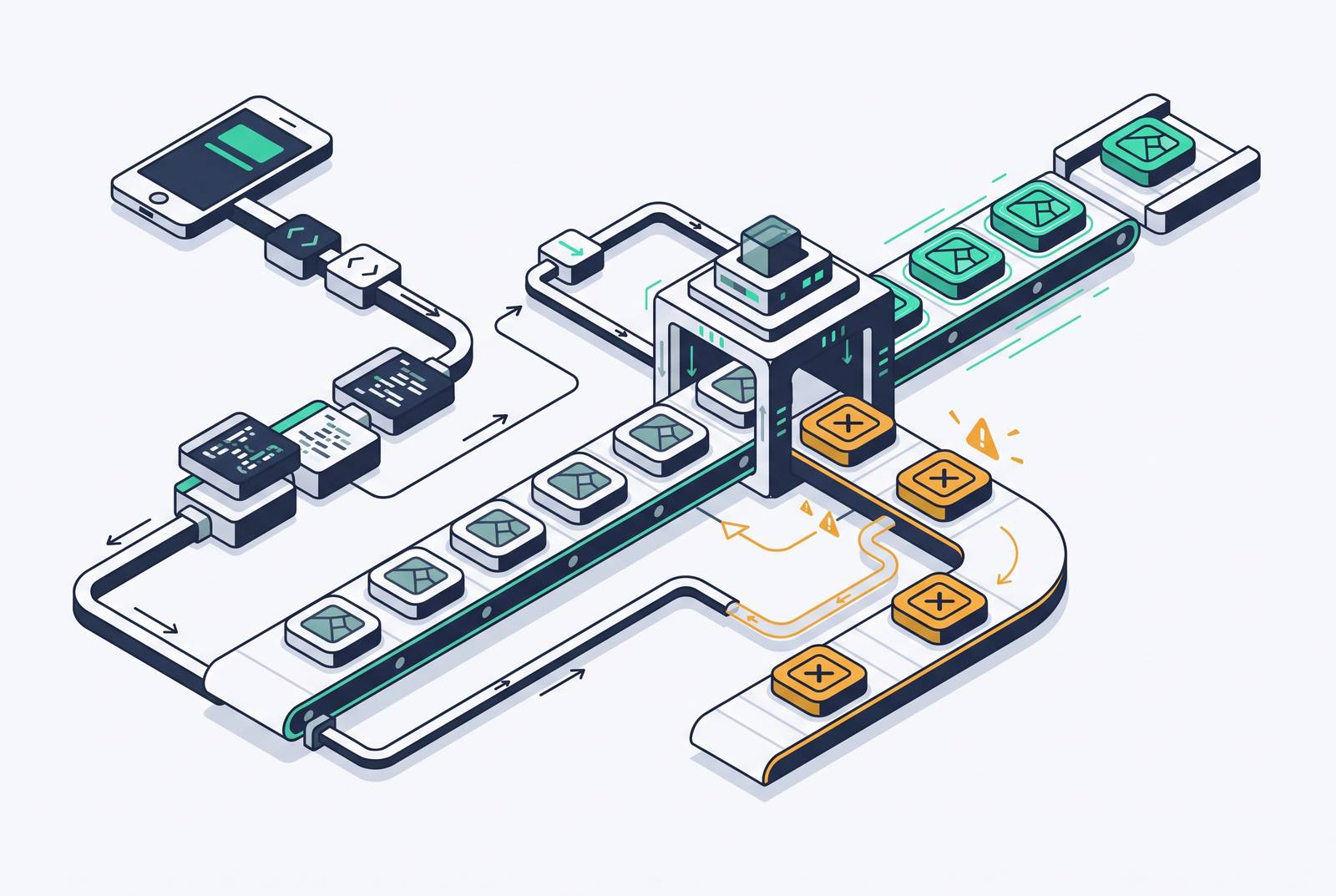
AI-generated mobile apps tend to run into the same risks of App Store rejection. The cause is not the use of AI, but the way generated code reuses templates, leaves flows incomplete, obscures data handling, and enables behavior reviewers never inspected. Understanding how those habits map to review guidelines turns rejection from a surprise into a quality problem that teams can address before submission.
Why AI-generated mobile apps face a predictable rejection problem
In March 2026, Apple blocked updates to Replit and Vibecode over tools that executed generated code inside in-app web views. Apple pointed to Guideline 2.5.2 and said it “does not have any rules specifically against 'vibe coding' apps”. The distinction matters because a rejection involving an AI tool is not necessarily a rejection of AI development.
Apple and Google both allow AI-built apps. Apple's App Store Review Guidelines, last updated October 16, 2026, have no rule against AI-generated code. But tools that generate code in the same ways also tend to make the same mistakes, which reviewers see in many apps sent for review. Automated screening can recognize those patterns too, making the development process itself relevant to the likelihood of rejection.
The structural habits of AI code generation that create review-ready failure points
The pattern begins with template reuse. AI generators use familiar designs, so their apps have similar color palettes, tab layouts, and home screens built around a prompt input. That resemblance can survive substantial changes to the underlying code because the visible product still follows the same template.
Incomplete flow wiring creates a different weakness. The happy path can work smoothly even when password recovery, account deletion, empty states, and offline handling have scaffolding but are not wired up. Settings toggles and support links make the interface look complete even when they do nothing. Reviewers test bad inputs, revoked permissions, and other conditions outside the demo path, exposing the gap between a finished screen and a finished flow.
Opaque dependency pulling extends that gap beyond the interface. Generated code brings in SDKs and libraries without auditing their data collection, privacy manifests, or policy compliance. The developer inherits responsibility for that code, even if it has not been read. Qodo's September 2026 State of AI Code Quality Report found that 26% of both developers and engineering leaders named reviewing and validating AI-generated code as their primary delivery constraint, ahead of trust, integration, or cost.
Guideline 2.1 and 4.2: why incomplete flows and thin apps are the baseline rejection
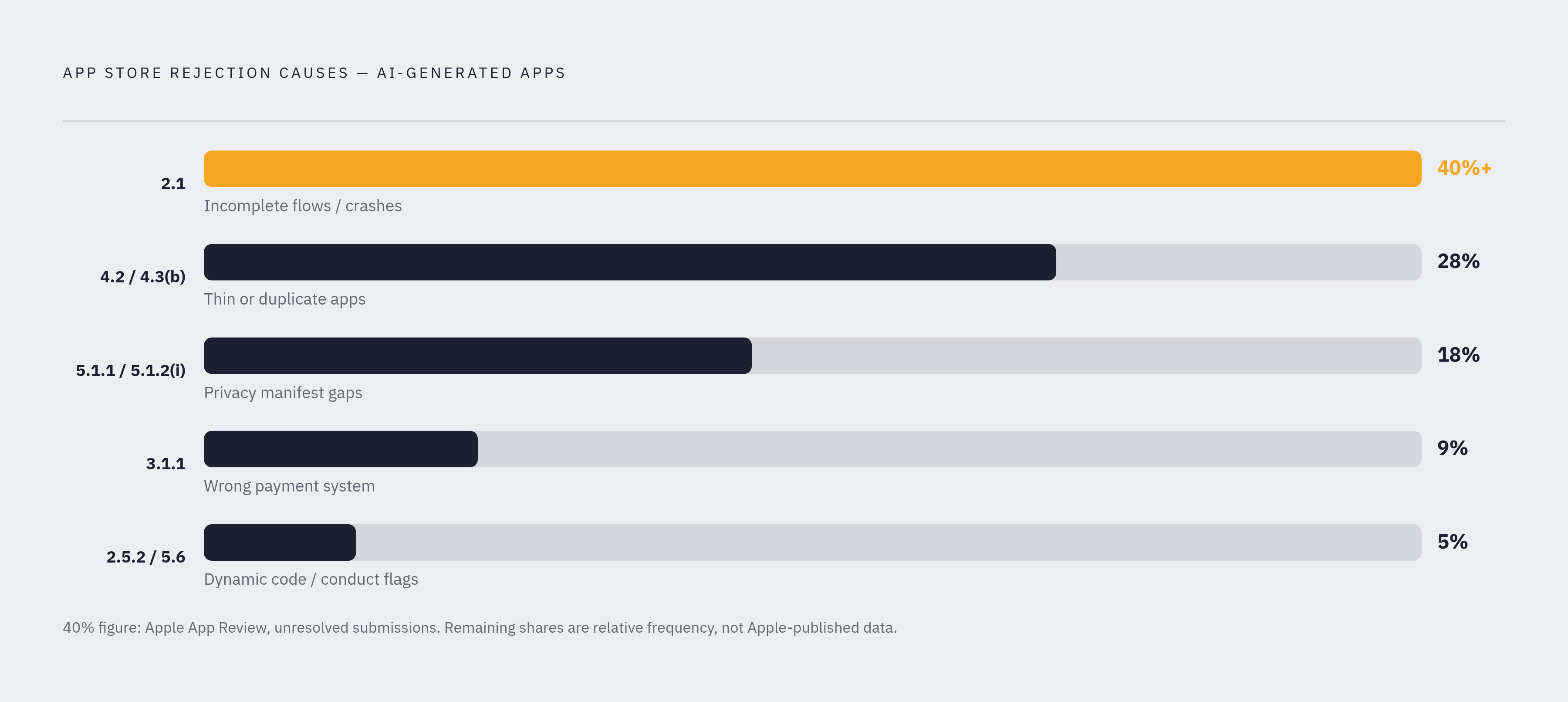
Guideline 2.1, App Completeness, catches the most direct consequences of unfinished wiring. Apple’s App Review page states that over 40% of unresolved issues relate to this guideline. Its scope includes crashes, placeholder content, broken flows, and missing reviewer credentials. A reviewer taps through the interface, so even a profile page that looks finished cannot make up for a password-recovery button that goes nowhere.
For an app that requires an account, Apple requires a working demo username and password in App Store Connect. Apple's App Review help page warns that credentials that expire or change before review starts may lead to rejection. A sleeping backend likewise leaves the reviewer with an app that does not work, regardless of how it performed during development.
Guideline 4.2 asks a separate question about minimum functionality. Apple requires features that “elevate it beyond a repackaged website” and states that limited web interactions do not make a quality app. AI tools often encourage building a web app and wrapping it in an app shell because that route is fast. The app may work as intended and still fail the minimum-functionality test, so it must be complete before submission but needs to meet that test too.
Guideline 4.3: why AI-generated apps look like spam even when they work
Once an app works, Guideline 4.3 can still reject what it offers. Apple updated Guideline 4.3(b) in June 2026 to explicitly exclude apps “indistinguishable from what's already widely available”. The guideline names saturated categories including dating, flashlights, sound effects, wallpaper, simple timers, and fortune-telling. New submissions in those categories need a “meaningfully different or improved experience”.
In practice, the same concern reaches generic AI chatbots, image-generator clones, summarizers, logo makers, companion apps, and study helpers, although those categories are not named in the guideline. Prompt-driven generators make the same input layout, example-question chips, and response cards again and again. Screenshots and binaries can be compared with recent submissions in the same category, allowing similarity to become apparent without extensive functional testing.
The corrective work therefore belongs in product scope, visible screens, and metadata. A specific job and a function beyond the chat box give the app a clearer purpose. That function might be a picker, calculator, planner, camera tool, or HealthKit reader, with visible polish that supports the task. A cleaner implementation of a generic chatbot does not by itself answer the objection.
Guideline 5.1.1 and privacy manifests: the compliance layer AI-generated code almost never produces
Privacy requirements expose work that a convincing demo can omit entirely. Guideline 5.1.1(i) requires a privacy policy link in App Store Connect and within the app. Since June 30, 2022, apps that support account creation must also let users initiate account deletion in the app. Deletion must erase backend data instead of just signing the user out, and permission prompts need purpose strings that explain why a feature needs access.
The November 2025 guideline update added disclosure and prior user consent for sharing personal data with third-party AI under Guideline 5.1.2(i). An app that sends personal data a user has entered to a model thus needs to ask for consent before sending it. A generated chat interface without that screen can expose both a privacy omission and the generic-wrapper pattern during the same review.
Privacy manifests add an upload-level constraint. Since May 1, 2024, App Store Connect has required apps that use required-reason APIs to have a manifest that states approved reasons. Manifest coverage includes the data collected by the app and its SDKs, with a documented reason for every required-reason API called. Generated code commonly omits this work, while imported SDKs may need their own manifests. Responsibility follows the full dependency tree.
Guideline 3.1.1 and Stripe: the payment mistake baked into AI starter kits
AI generators and starter kits rely heavily on patterns from web development, where Stripe is standard. They can reproduce that payment layer in an iOS app without identifying the policy mismatch. Under Guideline 3.1.1, selling digital content or features consumed inside the app requires Apple's In-App Purchase.
The implementation can therefore be technically correct and still fail review because it uses the wrong payment system. For this generated payment pattern, the fix requires substantive implementation work to replace the layer with StoreKit before submission. Generated paywalls can also introduce fake countdowns, pre-selected upsells, or unclear trial terms, moving the problem from payment compliance into developer conduct.
Guideline 5.6 and 2.5.2: the conduct and dynamic-code flags that catch AI-native patterns
Guideline 5.6 can feel opaque because the rejection describes a behavioral pattern. Apple's rejection language in 2026 typically refers to “a pattern of unusual behavior commonly associated with fraudulent activity” or features apparently hidden during review. One-click publishing can change a wrapped web app after approval, exposing features the reviewer never saw. Magic-link sign-in, failing Google login inside a WebView, empty demo accounts, and role-gated areas can also prevent reviewers from reaching important functionality.
Generated content can compound those access problems. Invented testimonials, user counts, ratings, and nonexistent “AI-powered” features create promises the app does not keep. Manipulative paywalls and unnecessary requests for personal data add further conduct signals. These features need not appear on the same screen for the overall pattern to draw scrutiny.
Guideline 2.5.2 covers a different risk: running code that Apple never checked. That concern is especially relevant to AI app-builder platforms, rather than every native-shell app produced with their tools. Published apps must keep their behavior from changing after review. Apple stated on May 20, 2026 that its systems use AI to “analyze app similarity and flag potentially problematic changes in app updates”, placing automated detection before human assessment.
How Google Play's enforcement direction differs from Apple's, and where it converges
Google Play places responsibility on developers for everything inside their apps, including third-party SDK behavior and AI-generated content. An analytics or advertising SDK that passed earlier checks can start collecting data in ways Google classifies as malicious. The developer remains responsible for what that SDK does at review time. This makes opaque dependency selection a cross-platform liability.
Google's AI-Generated Content policy also requires apps to prevent restricted content and provide in-app reporting or flagging. New personal developer accounts face a closed-testing requirement involving a minimum number of testers over a continuous period of weeks. Treating that period as a waiting room rather than a quality gate leaves meaningful testing until users encounter the app.
Apple's guideline-specific review patterns and Google's emphasis on developer accountability reach the same operational conclusion. Generated volume, similar products, and opaque dependency chains do not reduce the publisher's responsibility. Passing one store's review does not establish that the other platform's requirements have been met.
The multi-dimensional quality gap that store review exposes but doesn't fully test
Store review reveals only part of the quality debt created by generation. The same unaudited dependencies that cause privacy trouble also create security exposure. The OWASP Mobile Application Security project's MASVS defines what a mobile security test must cover. SBOM standards such as SPDX and CycloneDX document what is inside an app at build time, addressing the visibility that generated dependency chains often lack.
Accessibility exposes another limit of surface polish. ArcTouch and Fable tested 50 leading iOS and Android apps and found that a large majority of user journeys contained barriers serious enough to rate as poor or failing. That study demonstrates why a functional interface is not necessarily an accessible one. Generated UI scaffolds commonly omit accessibility semantics, making this a separate dimension of completeness.
Performance also needs to be tested beyond the demo path. Relevant checks include cold starts on mid-range devices, iOS first-frame render time, battery drain, and unbounded memory growth during extended soak tests. Generated content needs testing too, because Apple treats prompt-generated text, images, and chat as user-generated content. Reviewers test for harmful or unexpected output, and apps that lack tools for filtering, reporting, and blocking can be rejected under UGC rules.
Why verification at AI generation speed requires a different kind of quality layer
These failures recur quickly enough that verification cannot remain a final submission exercise. Generated code makes candidate implementations easier to produce while leaving flow completeness, privacy coverage, payments, and dependency behavior harder to establish reliably. Qodo's September 2026 report found that only 3.7% of engineering leaders believed their existing processes were sufficient to maintain quality and governance as agents took on more work. Manual pre-submission review cannot absorb that imbalance on its own.
The required quality layer defines standards once and enforces them automatically across every build and PR. Those standards must cover the guidelines that repeatedly fire, together with SDK audits, accessibility semantics, and performance baselines. The gate needs evidence that flows work, manifests cover actual dependencies, and payment implementations match the app's obligations. Checks must still cover what makes the product distinct and how it behaves on screen, even when it passes technical checks.
AI-assisted apps ship when generation speed is matched by evidence of release readiness.