Mobile Performance Budgets as Enforceable Standards
Treating performance budgets as CI gates prevents silent regressions.

A CI run goes green, but the app has quietly gained eight hundred kilobytes of uncompressed images and a render-blocking script no one reviewed. The pipeline verified accessibility, localization, and cross-browser correctness. It verified nothing about performance, because nothing in the pipeline was executable as a performance contract.
The dominant failure mode for mobile performance standards is not that teams ignore performance. It is that they treat budgets as advisory targets that live outside the enforcement path of the software development lifecycle. A release pipeline can be rigorous on accessibility, localization, and cross-browser correctness while having no executable performance contract at all. So you get a visually correct app that silently regresses in payload size, rendering cost, or interaction latency and never fails CI.
Without a blocking gate, the budget exists only as institutional memory. Whoever wrote it can be overridden by deadline pressure, by a new team member who never saw it, or by an AI coding agent that was never given it as a constraint. The gap is structural, not attitudinal. Even teams that care about performance cannot enforce what is not embedded in the pipeline as a hard condition.
What an enforceable performance budget actually specifies
An enforceable budget is not a goal statement. It is a set of numeric thresholds that a machine can evaluate unambiguously as pass or fail on every build. A working specification names explicit limits across multiple dimensions simultaneously. The composite Lighthouse mobile performance score must sit at or above 95. The largest content-inducing paint metric must land at or below 2.5 seconds. Cumulative Layout Shift must stay at or below 0.05. Below-the-fold images must carry loading="lazy".
The acceptance criteria follow directly from these numbers. A pull request that adds a hero image over 200 KB fails. A pull request that adds a script over 20 KB fails. It does not warn. It fails. Assertions configured as warnings are not a gate at all. The rationale for these specific thresholds is not arbitrary. The goal is to emulate a 75th-percentile user experience, meaning a full quarter of real devices and networks will perform worse than the chosen baseline. The budget must be strict enough to protect those users, not just the median ones.
The 2026 performance inequality analysis grounds this in network and device parameters: 9 Mbps downlink, 3 Mbps uplink, 100ms RTT, with a Samsung Galaxy A24 4G or equivalent as the representative mid-range device. The median mobile page already exceeds the three-second JS-light budget, so budgets set to the median protect no one. A valid budget also specifies which routes are measured. A single global score is insufficient. Each meaningful page type, the homepage, the content page, the feature entry point, needs its own budget.
How budget enforcement is embedded in the CI pipeline as a blocking gate
If you embed budgets as CI gates, the pipeline cannot advance until performance criteria are met. Human negotiation is removed from the enforcement path. The implementation pattern has three layers. A Lighthouse check workflow, for example lighthouse-pr-check.yml, triggers on changes to content, components, layouts, and pages, not only on source-level changes, and audits at least one URL per page type. Lighthouse assertions are configured as errors so any budget breach is a hard failure, not a logged warning.
Trigger scope carries particular weight. The check must run on content-only PRs, not just code PRs. A content change, a new image or a new embed, can breach a payload budget without touching a line of application code. The gate must also produce artifacts sufficient to diagnose a regression, not just a pass/fail signal. The developer needs to know which asset, on which route, by how much.
Deterministic local and browser measurements are preferred over cloud-only tooling because flaky single-number scores produce false positives that erode trust in the gate and eventually lead teams to disable it. The ratchet principle applies here as well. Budgets should be designed to tighten over time as the codebase matures, not held static. A stable, increasingly static codebase should be able to serve tighter limits than it could at launch.
Why AI coding agents make enforced gates structurally necessary, not just desirable
AI coding agents generate output faster than any human review cycle can verify it. Performance budgets that depend on human inspection will be violated at agent speed. The verification gap has a specific texture. Agents generate candidate solutions more readily than humans can confirm their correctness, and agents optimizing for a metric will satisfy the metric by whatever means the harness permits. The implication for performance is direct: an agent that knows the budget threshold can satisfy it superficially without actually making the app faster for users, unless the gate measures real runtime behavior against real device parameters.
Organizational standards are not automatically transmitted to agents. Only a minority of developers report that AI agents always follow organizational standards, and providing agents with the right codebase context remains a major gap for engineering leaders. The correct structural response is harness-enforced verification. The agent does not decide when quality is sufficient. The gate does. The agent literally cannot merge until the budget is met.
This reframes the performance gate from a human-process artifact to a machine-readable contract that both human developers and AI agents are held to equally. The urgency is no longer about good practice. It is about systemic necessity, because the rate at which agents produce code has outrun the rate at which humans can inspect it.
What happens to apps that reach distribution without enforced performance standards
Performance failures that are not caught in CI surface at the app store review stage, where they become rejections that block revenue and reset launch timelines. Performance alone accounts for more rejections than the Legal, Design, Business, and Safety categories combined. Apple's own guidance identifies crashes, placeholder content, and incomplete information under Guideline 2.1 (App Completeness) as a leading source of unresolved issues.
Google Play adds a parallel enforcement layer. Google rejected millions of app submissions for policy violations in 2025 and removed millions of already published apps. Technical standards at the OS level add further gatekeeping. As of the August 31, 2026 snapshot, new apps and updates generally must target Android 16 / API 36 or higher, a moving technical floor that an unenforced pipeline may not track.
The structural point is straightforward. App store reviewers enforce a performance standard whether teams do or not. The only question is whether teams discover violations before submission or after rejection. Enforced internal budgets are the earlier, cheaper gate.
Performance as one dimension in a multi-dimensional release condition
If you enforce performance in isolation and leave security, accessibility, and store compliance as advisory, your gate passes apps with serious quality deficits. Security must run on the same enforcement cadence as performance, not as a pre-release audit. The practitioner standard is OWASP's Mobile Application Security project, which organizes controls across eight categories including storage, cryptography, platform interaction, and reverse-engineering resilience. The decision matrix distinguishes three stages: SAST on every commit, DAST on every release candidate in staging, and manual penetration testing pre-major-release or pre-regulatory audit. Each of these is a gate condition, not a recommendation.
Accessibility is moving from periodic audit to continuous enforcement on the same trajectory as performance. On Android, you can integrate the Accessibility Test Framework with Compose testing. Automated accessibility checks are available starting with Compose 1.8.0, which makes accessibility a CI-level condition rather than a QA-phase activity. W3C has published WCAG2Mobile as a Draft Note, a mobile-specific interpretation of WCAG 2.2 for native, mobile-web, and hybrid apps. As of September 1, 2026, it remains a Group Draft Note, informative, not normative, which makes internally enforced accessibility budgets the de-facto standard in the interim. App stores are beginning to surface accessibility claims directly to users, turning testing evidence into a discoverability concern as well as a compliance one.
UX quality becomes enforceable when expressed as service-level indicators: startup time, crash-free session rate, API latency, defined numerically, monitored continuously, and tied to runbooks on breach. The shift is from "feels slow" to "breached SLI." The common thread across all four dimensions is the same structural move: translate a quality expectation into a numeric threshold, embed it in the pipeline as a blocking condition, and produce artifacts when it fails.
Why enforcement without a centralized standard degrades over time
A CI gate that enforces a standard no one owns will drift. When thresholds get loosened under deadline pressure and different teams run different versions, the gate becomes a formality, not a guarantee. The flakiness problem is real. A composite Lighthouse score used as a single-number gate is inherently noisy. Legitimate variance in measurement produces false failures, and teams respond by loosening thresholds or disabling the check. The answer is deterministic, per-artifact measurement that produces the same result locally and in CI, not looser budgets.
The consistency problem is equally real. Quality is often hero-based. One team has high automation and agility while another operates on legacy manual processes, and this inconsistency makes the weakest link the de-facto release standard for the whole organization. The root cause in both cases is that the standard lives in the tooling configuration rather than in a canonical, human-approved specification that all enforcement derives from.
When the standard is embedded in one team's CI yaml, it is invisible to other teams, fragile to configuration drift, and impossible to audit. When the standard is defined once, as a documented, versioned specification that the CI configuration implements, it can be reviewed, approved, updated, and inherited across teams and repos. You need human authority at the standard-definition layer even when enforcement is automated. The people who understand the product set the thresholds. The system enforces them. If you remove humans from the definition step, the gates enforce the wrong things consistently.
What a complete enforcement architecture looks like in practice
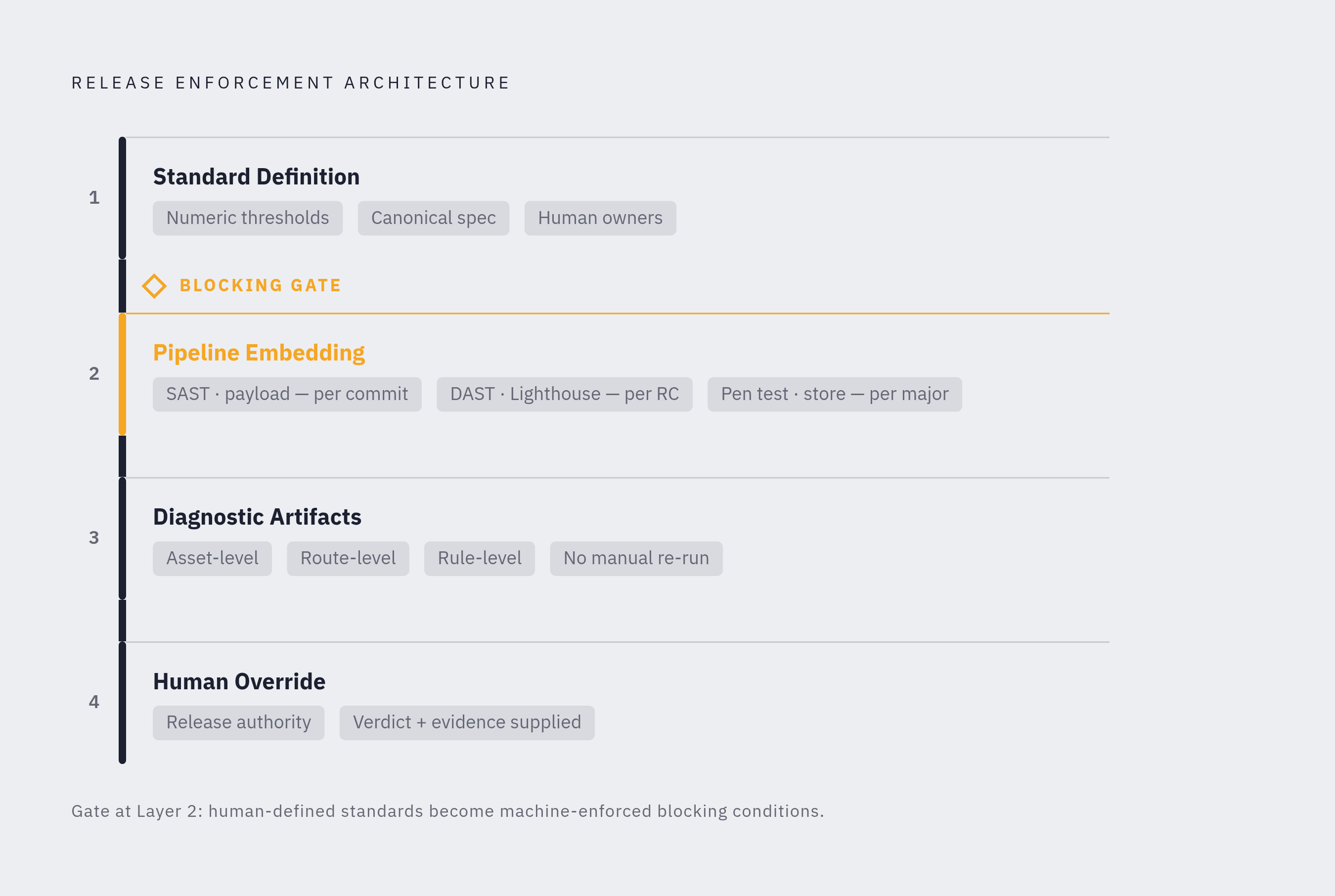
A mature enforcement architecture treats performance, security, accessibility, and store compliance as first-class, machine-evaluated release conditions defined by humans once and applied automatically on every build, PR, and release. The architecture has four layers that must cohere. Standard definition sets numeric thresholds for each quality dimension in one canonical specification, reviewed and approved by the humans who own the product, not scattered across CI configurations. Pipeline embedding implements each threshold as a blocking gate at the appropriate SDLC stage: per-commit for SAST and payload checks, per-release-candidate for DAST and composite Lighthouse audits, per-major-release for penetration testing and store compliance review. Diagnostic artifacts ensure every gate failure produces enough information to localize and fix the regression, which asset, which route, which rule, by how much, without requiring a developer to re-run the audit manually. Human override with evidence preserves release authority with people. The system provides the verdict and the evidence. Humans hold the power to approve or escalate.
The multi-agent enforcement model, where specialized agents covering performance, security, accessibility, design consistency, and store compliance each operate within their domain but share the same canonical standard, is the structural response to the verification gap that AI coding agents create. The business case closes the argument. Catching a performance regression in CI costs a developer minutes. Catching it at app store review costs a team days and a release cycle. Catching it in production costs users, ratings, and revenue.
The enforcement architecture is a cost-structure decision as much as a quality decision. The shift from advisory to enforced is a one-time structural investment that compounds. Once standards are defined and gated, every subsequent build, agent-generated or human-written, is verified against them automatically.