Automated Testing vs Automated Verification in Agentic Development
Human reviewers cannot keep pace with AI-generated code volume, creating a verification crisis.
The volume and pace of code that needs to be verified
Adoption crossed a threshold that changes the shape of the problem. An estimate from minitap.ai puts AI coding agents at writing 41% of production code now. SWE-bench Verified measures whether an AI agent can actually resolve a real GitHub issue, and on that benchmark, performance moved from 1.96% at the original baseline in October 2023 to over 87% by April 2026. That is a capability curve that outran almost every internal process built to check its output, and the mismatch is the whole story of this piece.
Speaking at Transform 2025, Tricentis' CEO put a number on the unease that curve produces: over 40% of code written in the prior year had been AI-generated, and confidence in that code had not kept pace with its volume. The workflow data explains why. Fifty-one percent of professional developers now use AI tools every day, with DORA respondents reporting a median of two hours a day spent on AI-assisted work. Writing code this way is the default, not the exception being piloted in one team. It is the default.
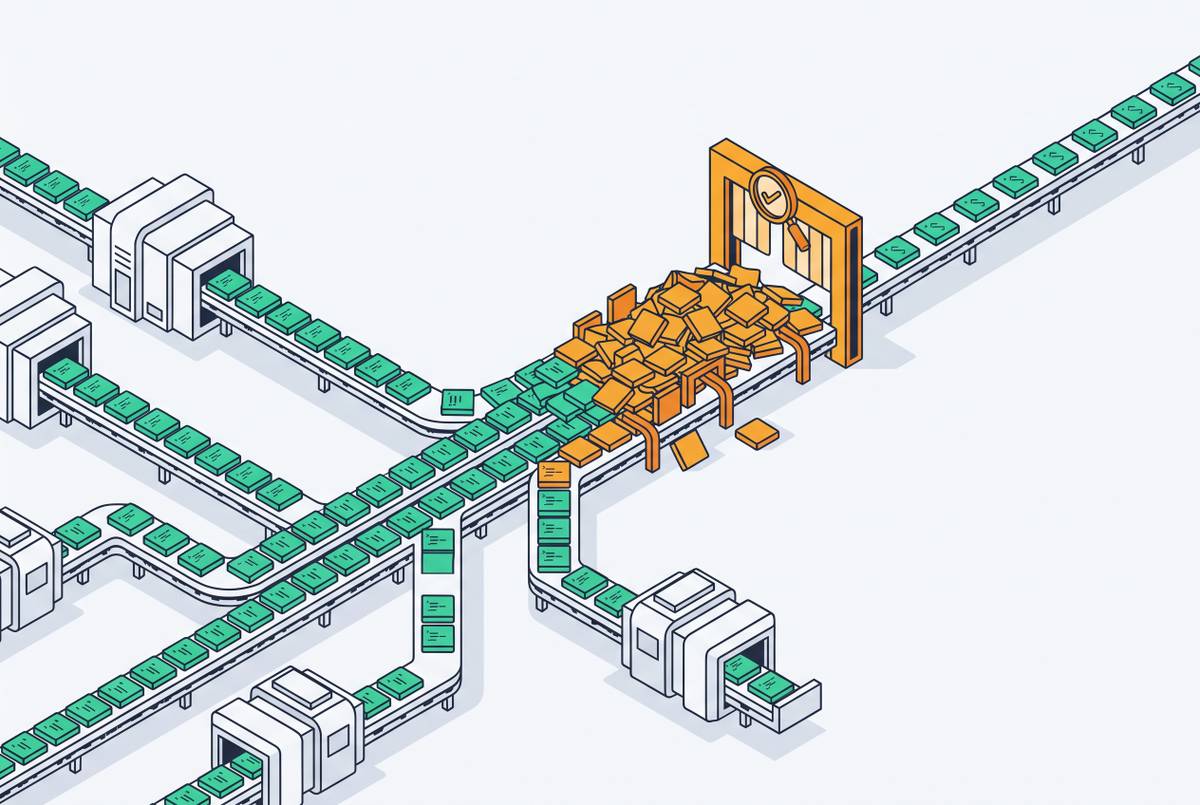
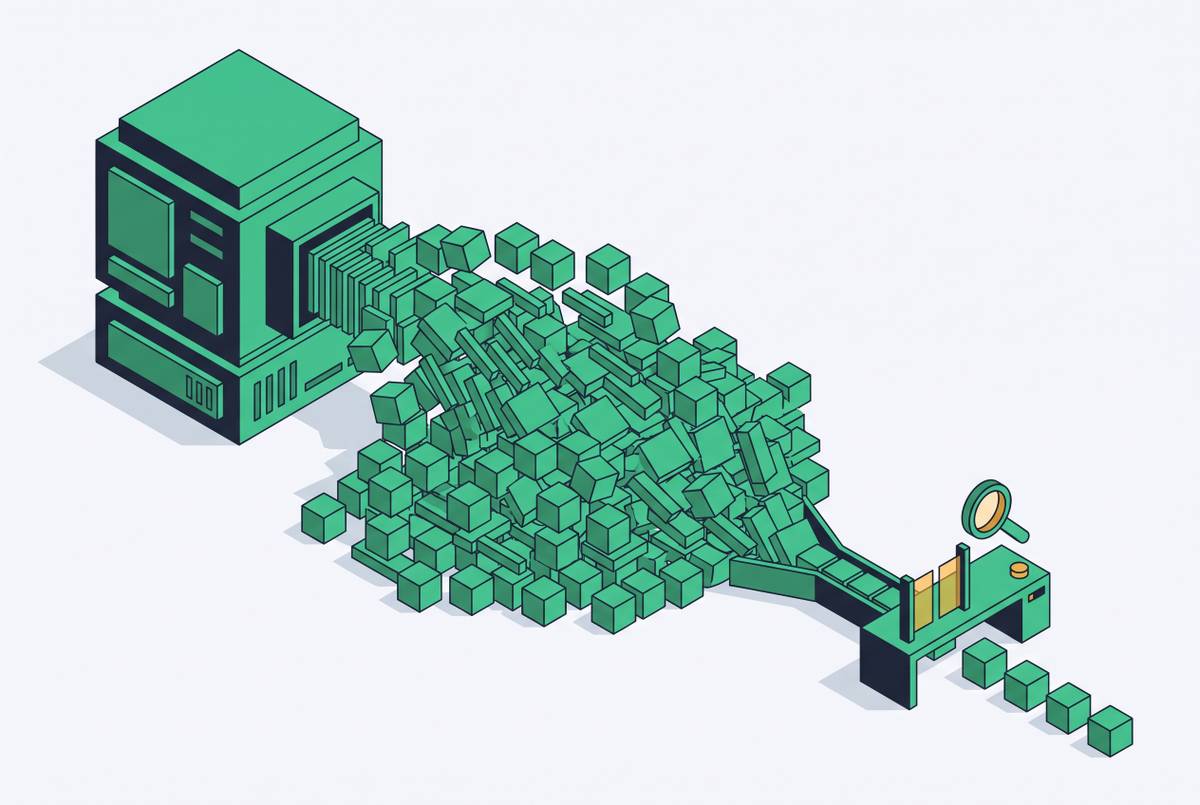
What that does to the job is simple to state and hard to live with: engineers spend less time building and more time reviewing. Pull requests arrive faster and in greater volume. Code review queues back up as a result, and every step downstream of "write the code" absorbs the pressure. Verification tooling has not gotten the same upgrade code generation did. Verification still runs largely on human hours, and that is the actual bottleneck, not model quality.
Two halves of the same development cycle are running at fundamentally different speeds, and nothing about that self-corrects on its own. Betting that human reviewers will eventually catch up to agent-speed output is the wrong bet. Any approach to verification that depends on a person writing every assertion by hand cannot keep pace with a system generating code this fast, and that mismatch sets up everything that goes wrong downstream.
The concrete failure modes AI-generated code produces that scripted tests cannot catch
Start with the defect data, because it puts a number on what "AI writes worse code sometimes" actually means. CodeRabbit's analysis of 470 open-source GitHub pull requests found AI-authored PRs averaged 10.83 issues, against 6.45 for human-written code. That is a 1.7x defect rate, and it does not sit still as flat overhead. It scales with adoption: more AI-generated code means more absolute defects riding along with it.
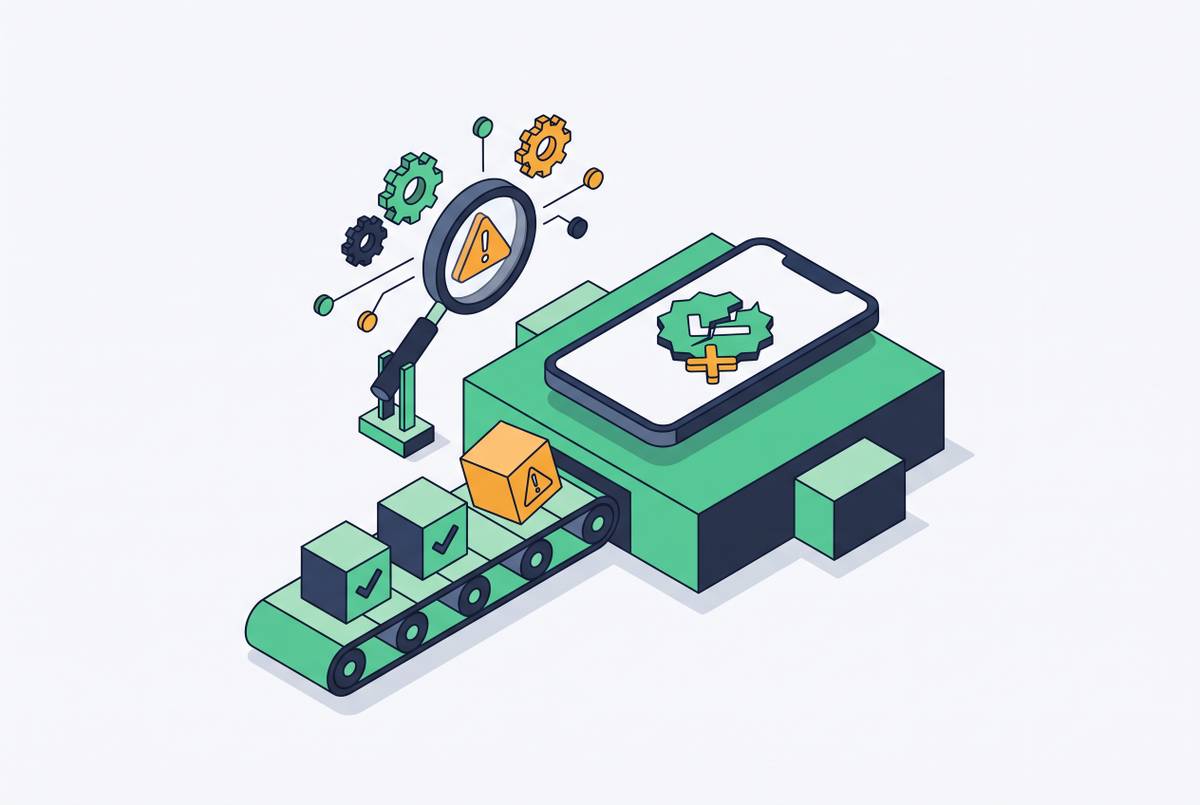
The failure mode that matters most is not the kind a compiler catches. Research from the MAST project (presented at NeurIPS 2025), analyzing 1,642 annotated multi-agent execution traces, found that 75.17% of multi-agent failures were what the researchers call silent gray errors: output that compiles, passes the superficial checks, and still violates the business logic it was meant to serve. A script cannot catch that class of error by design, because a script only asserts what a human already anticipated, and a gray error is by definition the thing nobody anticipated.
Trace the root cause and you land on what a separate arXiv paper calls the planner-coder gap, responsible for 75.3% of multi-agent code generation failures in that study. The break happens at the handoff: a product manager writes a ticket at a high level, an AI coding agent picks it up with no memory of the architectural decisions shaping the rest of the codebase, and it produces something that reads as reasonable in isolation but does not fit the system it lands in. The code compiles. The logic is wrong in a way that becomes visible only once it meets the rest of the product.
The edge cases developers miss most often share one trait: none of them are things a pre-written script could have anticipated, because they depend on runtime state that does not exist until the agent is actually running. Production environments introduce failure modes that static assertions never simulate, including malformed model output, ambiguous routing decisions, and outright call failures. Each happens only under production conditions a static assertion never simulates.
Developers feel this daily. The Stack Overflow Developer Survey found 66% cite "AI solutions that are almost right, but not quite" as their single biggest frustration, and 45.2% say debugging AI-generated code takes longer than writing it themselves would have taken. Scripted testing catches the bad paths someone already knew to look for, and it has no mechanism for catching the failure class agentic generation produces by its nature. No amount of additional scripts changes that.
Engineering teams in production when the verification gap goes unaddressed
Underinvestment in verification raises incidents first, and the numbers are not subtle. Harness' survey found 72% of organizations had experienced at least one production incident traced back to AI-generated code, 59% hit deployment problems at least half the time when using AI coding tools, and 67% reported spending more time debugging AI-generated code than they did before adopting those tools. The tool sold to save time is, for two-thirds of respondents, costing more of it. That is not a rounding error. That is the tool failing at its stated job.
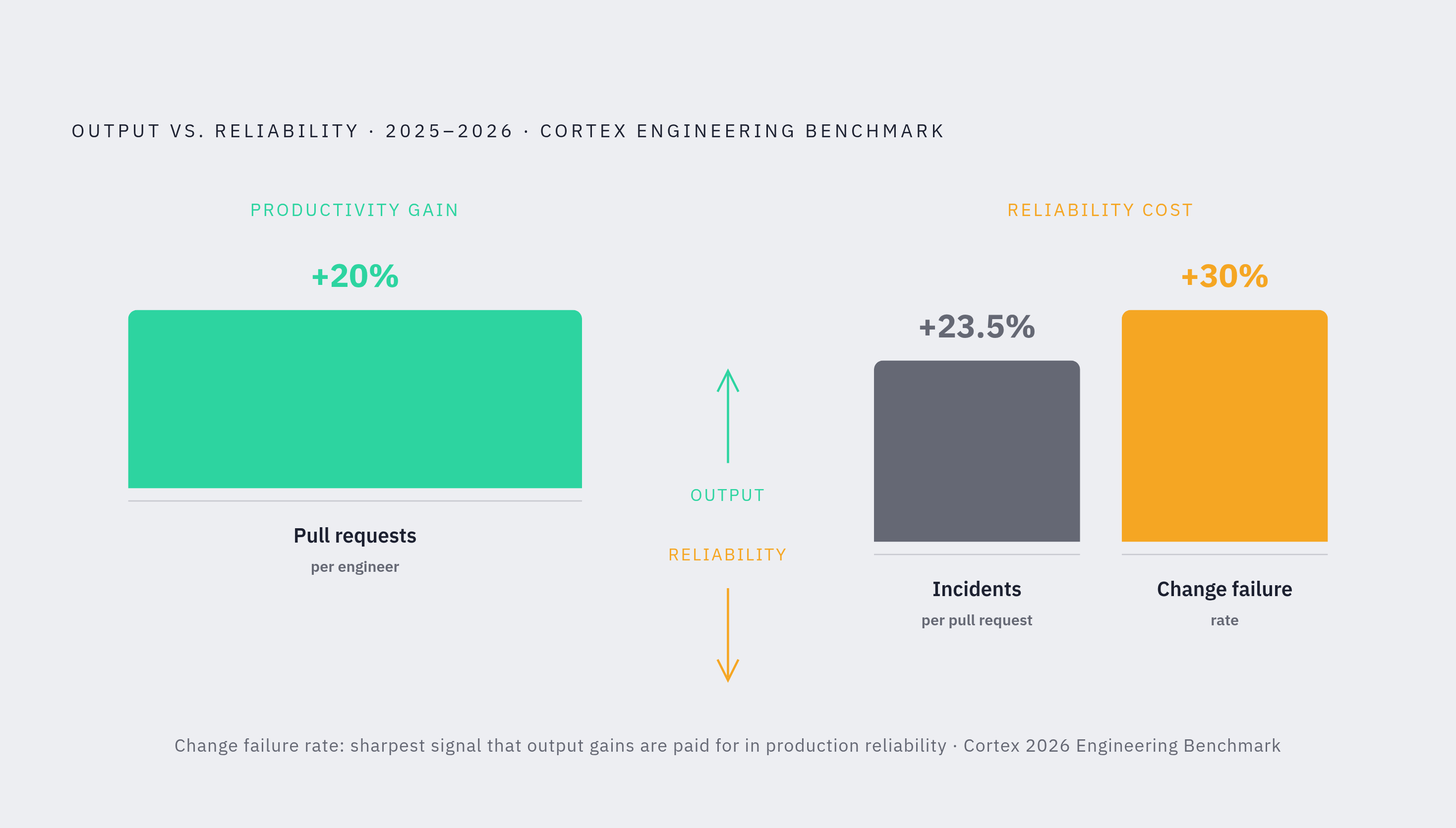
Cortex's 2026 Engineering Benchmark quantifies the tradeoff at the team level. Pull requests per engineer rose 20% year over year, which sounds like a productivity win until you look at the rest of it: incidents per pull request rose 23.5%, and change failure rates climbed roughly 30%. Output went up. Reliability went down, in the same measurement window, for the same teams.
The confidence numbers from Tricentis Transform 2025 tell the same story from another angle. A Stack Overflow survey found 88% of respondents were not confident deploying AI-generated code without extensive review, and a GitLab survey found 29% had actually rolled back a release because of AI-introduced errors. Nearly a third of respondents have lived through that rollback already. It is not a hypothetical sitting in a slide deck somewhere.
MIT's "GenAI Divide" study, based on 300 enterprise AI deployments, found 95% of enterprise GenAI pilot programs failed to produce measurable financial return. The researchers did not attribute that to weak models. They attributed it to organizations generating code at AI speed while verifying it at the old, human pace, a mismatch that eats the productivity gain before it ever reaches the balance sheet.
DORA's 2025 State of AI-Assisted Software Development report found AI adoption correlates with increased software delivery instability, and DORA retired its old elite/high/medium/low performance tiers in favor of seven distinct team archetypes precisely because that old framework could not capture what is happening now. Teams still running tests at the end of a sprint watch this gap widen fastest. Across every survey cited here, the pattern holds: as generation speed rises, production failure frequency rises with it. That correlation belongs on the same spreadsheet as headcount and cloud spend, not filed under growing pains.
Why scripted test automation cannot structurally close this gap, even at scale
Writing more tests or hiring more QA engineers does not fix this, because the limit sits one level above headcount. A script can only assert what a human thought to check at the moment it was written. It has no way to enforce a standard nobody encoded, and no way to catch a silent gray error or a planner-coder mismatch, because both are by definition things nobody saw coming. Scale just multiplies the number of scripts that were already blind to the thing that broke.
The maintenance math makes the case on its own. Test maintenance already eats 30 to 50% of the average automation budget, minitap.ai finds, and that is before factoring in how much faster AI-generated code churns the UI and logic scripts depend on. Every rewrite is a fresh round of broken selectors waiting to happen.
Mobile makes the problem structurally worse, not just incrementally worse. There is no DOM to anchor a selector against, so a UI change breaks locators outright rather than degrading gracefully. Fragmentation across more than 25,000 Android device variants from different manufacturers stretches coverage decisions thin before a single AI-generated commit even lands. Deviqa.com describes the common instinct here: teams grab Appium, Espresso, or XCUITest and start scripting before they have defined an actual testing strategy. None of those tools is the problem. Reaching for them first, before the strategy exists, is what an unchanged architecture trains people to do.
Layering AI-assisted scripting on top does not change the underlying shape. Turning a natural-language description into a Playwright stub is faster to write, but the assertion is still human-defined, and the resulting script is exactly as brittle as one a person typed by hand. Faster authoring of a fragile artifact is still a fragile artifact, produced on a shorter timeline.
Scaling the human side is not an option either. With 41% of code already AI-generated and rising, no team of reviewers, however large, can read, test, and sign off on output arriving at agent speed. Something has to change architecturally, not numerically. A Galileo analysis, cited by testquality.com, found properly orchestrated verification systems produce failure rates several times lower than unstructured multi-agent setups. That gap is measurable and large, and closing it should outrank buying more scripting seats on any 2026 roadmap.
What verification that enforces standards looks like in an agentic pipeline
Everything starts with the specification, because a standard cannot be enforced if it does not exist somewhere in writing first. A consistent theme across 2026 practitioner guidance is that the quality of requirements, context, and acceptance criteria now determines how well an AI agent performs, more than the model itself does. GitHub's Spec Kit, an open-source project released in 2025, builds that idea into tooling directly: the specification is at the center of the process, and implementation, checklists, and task breakdowns all get generated from it, rather than the spec surviving as an afterthought written after the code ships, as Microsoft's developer blog covers.
None of this works without an explicit division of labor. Governance frameworks increasingly argue that responsibilities, decision rights, approval gates, and authority levels need mapping between humans and agents before agent autonomy can expand safely. Skip that mapping and autonomy just means nobody is accountable when something goes wrong.
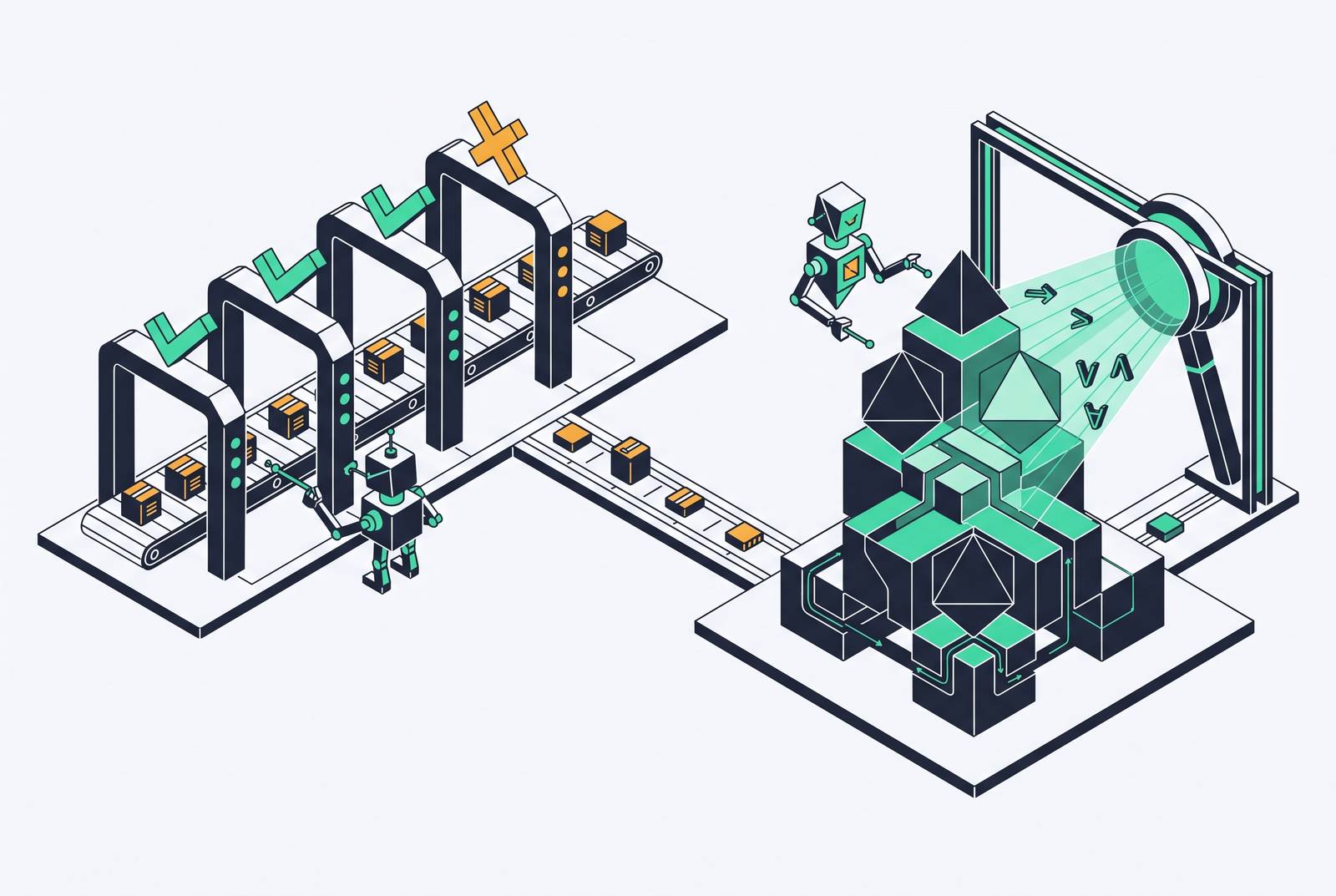
A properly built agentic software development lifecycle runs specialized, narrowly scoped agents across sequential stages, each with its own defined inputs, outputs, and a verification checkpoint before the next stage begins. Skipping a checkpoint reopens the verification gap further down the pipeline, quietly, where it is harder to trace back. The MAST research found that adding explicit verification phases produced a 15.6% improvement in agentic task success rates, a meaningful number for something that amounts to slowing down long enough to check the work.
Agents discover problems and draft fixes. Deterministic checks and accountable humans decide whether the result actually passed. Verification does not hand the verdict to the machine. It automates the collection of evidence a human uses to make that call, which is a different act entirely from automating the call itself.
For mobile specifically, the standards that matter are not functional test cases at all: product intent, design consistency, security, performance, accessibility, and store policy compliance. None of those admits a single clean assertion. They require a system that understands what the product is meant to do and checks the build against that understanding continuously, generating and maintaining its own test coverage from real product expectations rather than a static inventory of scripts someone wrote eight months ago.
Google's Firebase App Testing Agent, in Android preview, shows one narrow slice of what this looks like in practice. It accepts a natural-language goal and a final-screen assertion, then runs it across selected devices. Google is upfront about the current limits: runs can vary in the exact actions taken, AI-guided tests cap out at a five-minute timeout, and complex tasks work better broken into smaller steps. A preview feature with real boundaries, not a finished answer, but a useful marker of where things are headed.
The governance structure that makes agentic verification trustworthy rather than autonomous
The consistent guidance heading into 2026 is unambiguous: organizations getting this right treat AI-generated code with the same rigor as human-written code, or higher, and they do not expand agent autonomy in production without guardrails, audit trails, and a clear human on the hook for the outcome. Autonomy without that scaffolding is a liability with a delay built into it.
The tension is well documented: AI in the software development lifecycle makes strong engineering organizations stronger and weak ones more fragile. Governance is the variable that decides which side of that line a team lands on. It functions as the condition that lets AI-generated speed convert into something reliable, rather than something that just breaks faster.
Skipping the governance produces what practitioners and researchers alike describe: fragmentation, technical debt, and real operational risk, worsened by the fact that no standard specification language yet exists for expressing these constraints in a form a system can execute against. The need for oversight is documented everywhere. The tooling to encode it consistently is still catching up.
The fix is not complicated to state, even if it is hard to build. Quality expectations get defined once, approved by humans once, and enforced automatically after that, instead of surviving as tribal knowledge scattered across three tools and whichever engineer happens to remember the rule. Authority over the actual verdict, approve, override, ship, has to stay with people. Agents do the work of gathering evidence and flagging problems. Humans hold the decision, full stop.
Forrester's message to CIOs, CTOs, and engineering VPs for 2026 is to move past experimentation into what it calls intentful adoption: pilot across multiple stages of the development lifecycle, adjust the operating model as you go, define explicitly how humans and agents split the work, and invest in testing and governance early rather than retrofitting it after an incident. The ThinkSys QA Trends Report backs up how fast this is moving: 77.7% of organizations are already using AI in QA or planning to. Adoption is not the open question anymore. Governance of that adoption is.
There is a concrete payoff for getting the sequencing right. Capgemini data shows shift-left testing, catching problems before code is even written rather than after, cuts defect escape rates by 30 to 40%. That is the governance lever that moves verification upstream of the problem, instead of leaving it as a final gate that catches issues only after they have already cost time and money to produce.
Distinguishing verification capability from testing capability when evaluating tooling
The right benchmark for 2026 is not how many test cases a tool can generate. It is how much maintenance debt the agent actually takes on, and how many failure classes it catches that nobody thought to script for. Ask any vendor one question before anything else: does the system understand your product's actual standards, or does it just execute assertions a human already wrote down? The answer sorts every tool on the market into one of two categories, and only one of them closes the gap this piece has described.
A handful of concrete questions separate the two categories in practice. Does the tool ingest product intent, requirements, user stories, and design specs, and generate its own coverage from that material, or does it only run scripts a human already authored? Does it map the product on an ongoing basis and update its own test cases as the product changes, or does it wait for a human to fix broken selectors after every build? Does it check multi-dimensional standards (design consistency, security, accessibility, store compliance, performance), or does it stop at functional pass/fail? Does it produce evidence for a person to review and gate the release against, or does it just return a checkmark against a pre-written script?
Mobile teams have a useful floor to measure against. A baseline for 2026 looks like unit and integration tests blocking every merge, P0 flows running on every pull request, and full regression running nightly, table stakes rather than the ceiling. That is table stakes, not the ceiling. Verifying design intent, accessibility, and store policy compliance requires a layer sitting above that baseline, one that understands what "correct" means for this specific product rather than just what "passing" means for a given script.
The pace of the industry does not leave room to build that layer later. Runway's 2025 Mobile Release Management Report found 75% of mobile teams already invest regularly in release automation and scripting, with top App Store apps shipping updates roughly every two weeks. Verification has to keep pace with that cadence rather than trail behind it, waiting on a quarterly cleanup sprint that never quite happens.
The architecture that actually fits this problem uses specialized expert agents, covering product, design, security, engineering, performance, accessibility, store policy, and compliance, working against AI-generated code at the same speed the code gets written. Not a faster way to write a script, but a system built to enforce a standard. Quality expectations should live in one place, get defined by the people who understand the product, and get enforced automatically across every build, every pull request, every release. That is what verification means, and it has never been the same thing as running a test.