How AI Coding Agents Restructure the Mobile SDLC
AI agents speed up coding far faster than testing and deployment can keep pace.
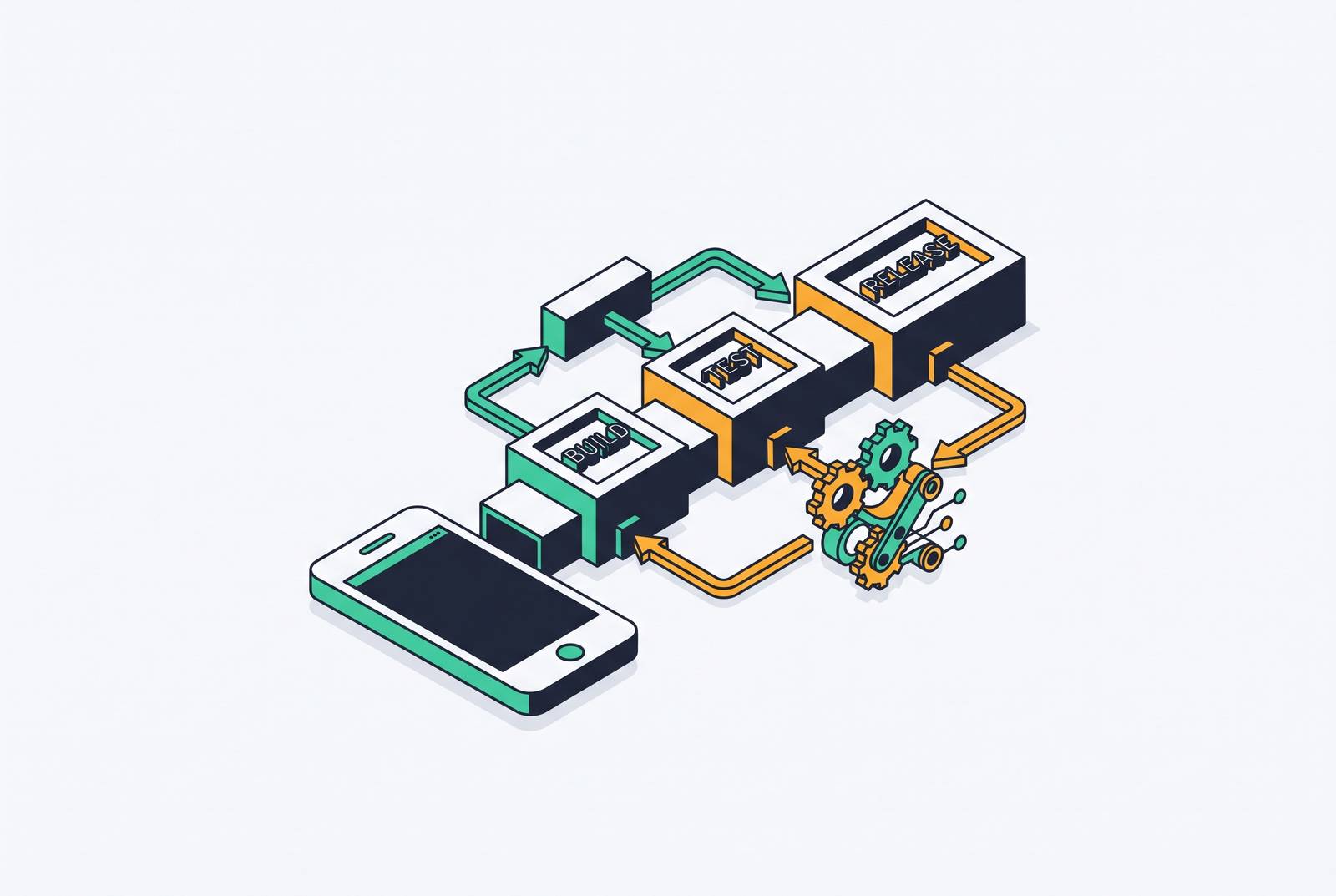
Agentic AI stopped being a pilot program in 2026. Agents now sit across the whole software development lifecycle: analysis, planning, design, build, test runs, delivery. Not just finishing a function a developer started typing. That marks a real break from the earlier era of manual, human-driven testing.
The adoption numbers back it up. Somewhere between 84% and 85% of developers now use AI coding tools or plan to start soon, and by early 2026 roughly 51% of all code committed to GitHub was AI-generated or substantially AI-assisted. Google, Microsoft, Salesforce, and GitHub's own telemetry all report big AI code shares moving into production. AI-written code is the norm now.
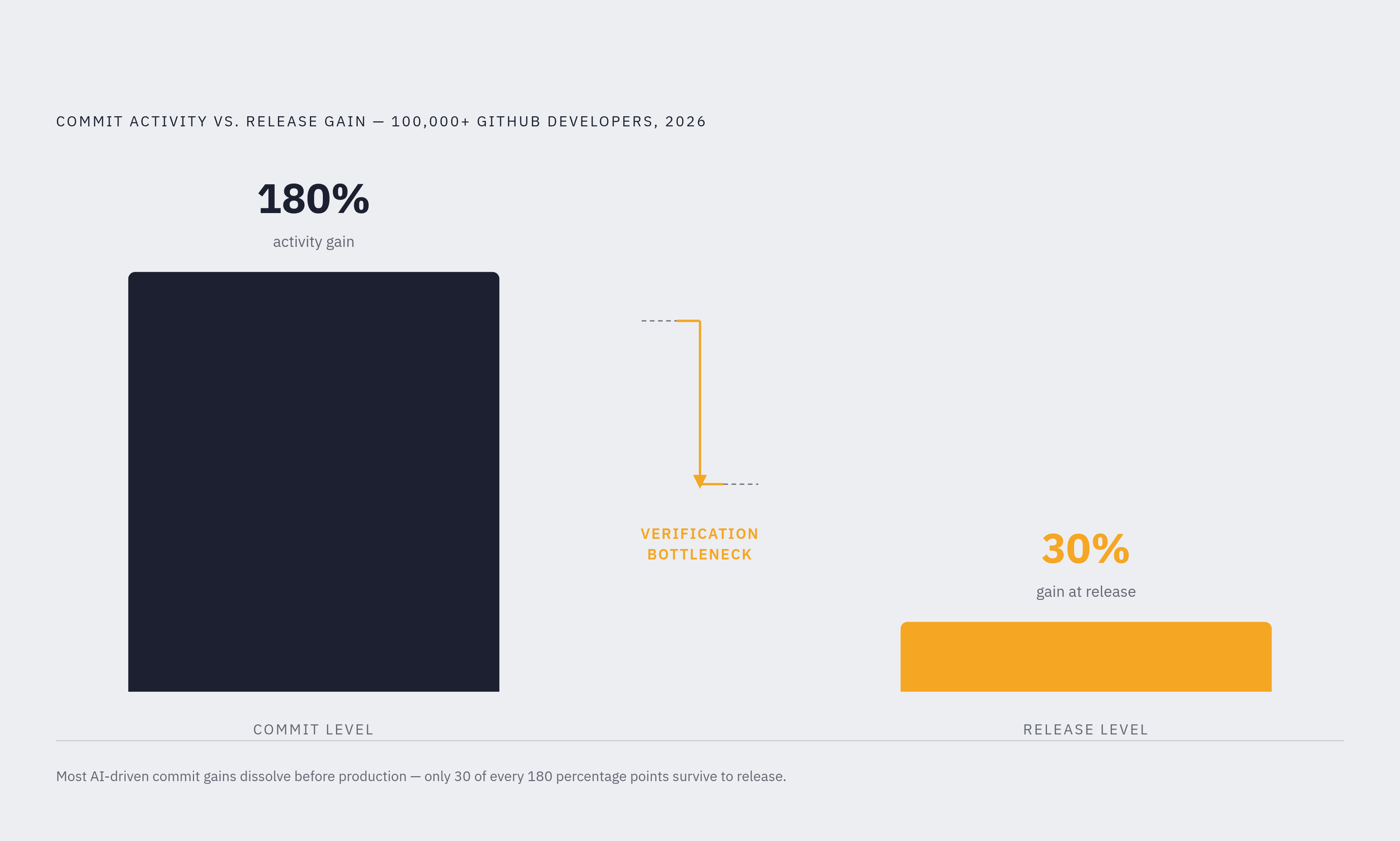
The story turns here. A 2026 study tracking more than 100,000 GitHub developers found coding activity up 180% at the commit level. Measured at actual releases, that same activity collapsed to a 30% gain. Call it the Agentic SDLC Throughput Paradox: commits explode, shipped software barely moves. Something between the commit and the release swallows almost all of the gain, and that something is what this piece is about.
Where the pipeline's gains land
Not every stage of the SDLC sped up at the same rate, and the gap between stages is the whole story. Coding and code generation hit adoption in the 84% to 90% range. Testing and QA grew too, landing around 55% to 64%. Deployment and CI/CD lagged far behind, running just 13% to 22% even this year, where the low end reflects full-SDLC AI coverage and the higher figure reflects actual AI coding agent deployment rather than broad CI/CD tooling adoption.
Forrester found that if AI makes coding 30% to 40% faster but planning, testing, and release stay mostly manual, the productivity gain for the whole team often lands under 10%. Speeding up one stage doesn't make the bottleneck disappear; it just moves house. It just moves house.
A synthesis paper by researcher Bhati names this a "weak-link production structure." Writing code accelerates faster than the human and organizational steps needed to turn a change into shipped software, and a chain moves only as fast as its slowest link, no matter how much you speed up the rest of it.
Mobile teams feel this harder than most, because mobile delivery already had non-code constraints stacked up before any of this started. Device fragmentation spans more than 25,000 Android device variants across multiple OEMs. OS fragmentation across Android and iOS versions means a single feature has to behave correctly across a wide spread of hardware and software combinations, and app store submission queues add their own latency on top of that. AI code generation removes none of those constraints. It just pours more volume into a pipeline that was already gated somewhere other than the code itself.
What the verification bottleneck looks like in practice
Qodo's State of Code Quality report surveyed developers and engineering leaders separately, and both groups landed on the same answer without being asked to agree: reviewing and validating AI-generated code is the single biggest bottleneck in delivery, cited by 26% of developers. Among engineering leaders specifically, it's also the most cited quality and governance gap, at 48%.
Two groups with different jobs, different incentives, and different vantage points converging on the same complaint is not a coincidence. It's a structural signal. Developers feel it as review fatigue. Leaders feel it as a governance hole, and both are describing the same bottleneck from opposite ends of the pipe.
DORA calls this mechanism the "verification tax," a term cited in CodeRabbit's guide to the agentic SDLC. The time a team saves by having an agent write code doesn't vanish. It gets re-spent auditing that code afterward, and a team comes out ahead net only when the audit runs efficiently, not when the code got written fast.
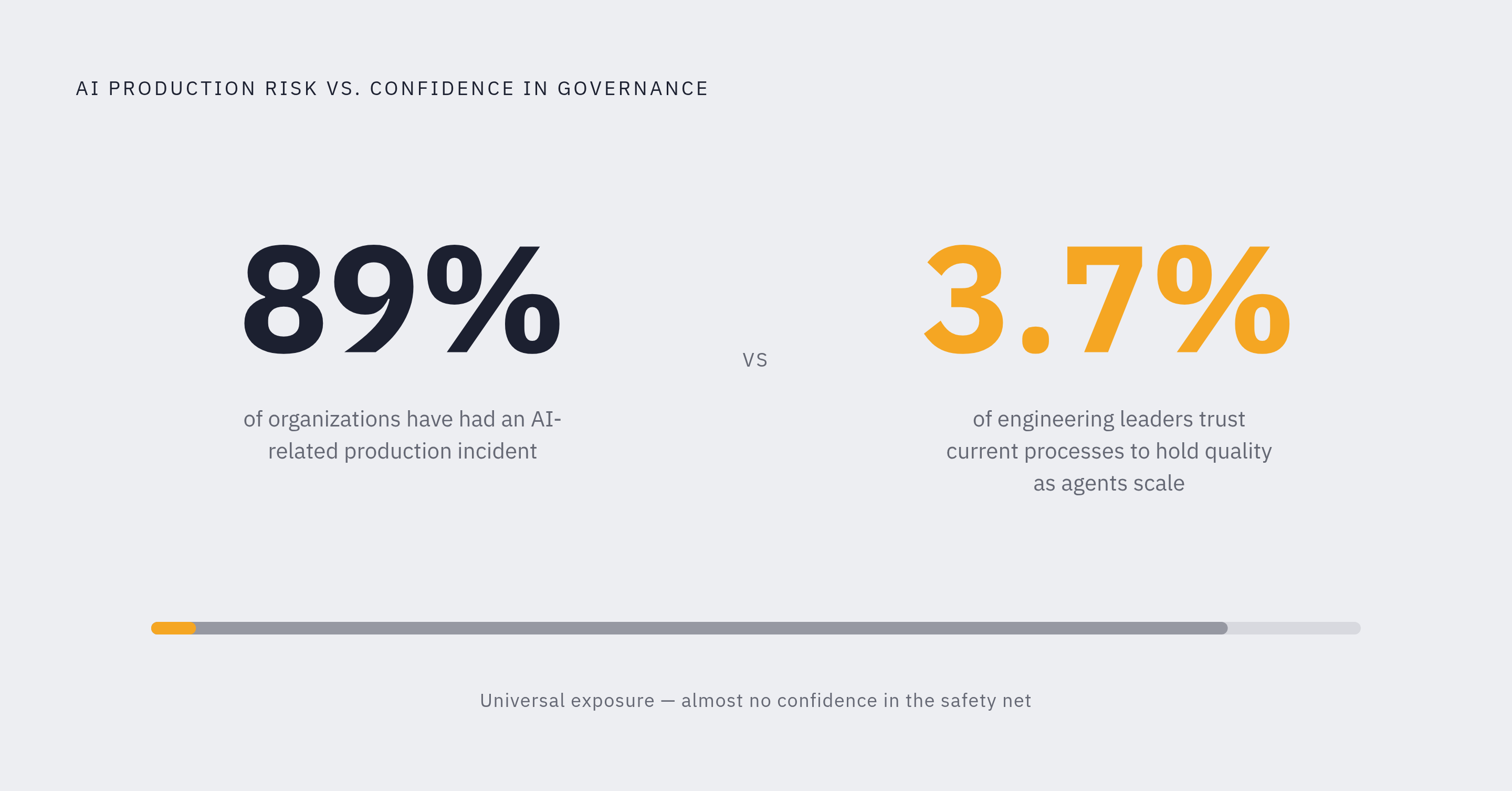
The confidence gap here is stark. 89% of organizations report having had an AI-related production incident already, yet only 3.7% of engineering leaders say their current processes actually hold the line on quality and governance as agents take on more of the workload. Most of an industry is admitting its safety net has holes in it while the volume of code running through that net keeps climbing.
Why AI-generated code is structurally harder to verify than human-written code
A developer working with AI tools can generate three to five times more lines of code than before, so the review queue grows faster than any fixed team's review capacity can absorb. But volume alone doesn't explain why the code itself needs more scrutiny per line, not just more scrutiny in total.
The quality signals point somewhere more specific. A Stanford-MIT study found that 14.3% of AI-generated code snippets carried at least one security vulnerability, against 9.1% for human-written code. That's a meaningfully higher rate of a defect that's expensive to catch late and dangerous to miss.
A McKinsey study found something similar downstream: projects with unreviewed AI-generated code carried 23% higher bug density than projects where human oversight stayed in the loop. Oversight does measurable work here. Skipping oversight raises the bug count directly.
Code churn tells a quieter version of the same story. GitClear data showed churn, meaning code rewritten or reverted shortly after being written, rising from a 3.3% baseline in 2021 to somewhere between 5.7% and 7.1% by 2024–2025. Raw commit counts don't show any of this. A commit graph full of green squares looks productive right up until you notice how much of that code gets torn up and rewritten a week later. Churn is the tell that the commit count is lying about how settled the code actually is.
Verification pressure accumulation across each mobile SDLC stage
The bottleneck builds up differently depending on where you look in the pipeline, and each stage buckles under agent-speed volume in its own particular way.
Start with PR review, because that's where the volume hits first and hardest. Agents open pull requests far faster than any human reviewer can read them, and mobile PRs are not simple diffs. They carry device-specific logic, OS permission flows, and sensor and network state transitions that need a reviewer to actually think through edge cases, not skim for syntax errors. Generated test scripts catch surface-level regressions fine, but they tend to miss the deeper interaction bugs that occur when a permission prompt fires mid-transition or a network drop hits during a sensor read. A reviewer who once handled a manageable queue is now looking at far more PRs than before, and the real attention available per PR collapses accordingly. Nobody reads a pull request more carefully because there are four times as many of them sitting in the queue.
Integration and CI absorb the next wave. A sensible 2026 gate structure runs unit and integration tests as a merge block, runs the app's P0 flows on every PR, and pushes full regression to a nightly run. That structure only holds, though, if the underlying test suites stay current, and agent-speed code changes can outrun test maintenance without much warning. Shift-left testing cuts defect escape rates by something like 30% to 40% when it's working, but that number assumes the shift-left layer is actually keeping pace with how fast new code shows up. A stale test suite just means catching stale problems earlier.
Device and OS coverage is where things get physical. Code that passes cleanly on a simulator can behave differently on real hardware, under real network conditions, with real permission dialogs interrupting real user flows, and device fragmentation across more than 25,000 Android device variants means that gap is wide to begin with. Around 75% of mobile teams already invest regularly in automation and scripting for release, which sounds reassuring until you split two different things apart: automating a test run and designing tests that actually cover the device matrix are not the same achievement. A team can be heavily automated and still be testing the wrong slice of the matrix.
The store compliance layer that AI-first mobile teams are most likely to miss
Apple's guideline revision on November 13, 2025 introduced significant new requirements, and a good chunk of it aims squarely at AI-first apps whether those teams noticed or not. Apps now have to disclose when personal data is shared with third-party AI providers and obtain user consent before doing so. That means a consent step making clear what data is involved before it moves.
If an app calls out to OpenAI, Anthropic, Google Gemini, or any external model, that disclosure and that explicit permission step come mandatory before any personal data moves. Apps built and shipped before this rule existed can find themselves subject to it on their next update submission, since anything going through review now must meet current guidelines. The same revision tightened copycat app protections, capped APR disclosures for loan apps, and pulled HTML5 and JavaScript mini apps explicitly into scope where they'd previously sat in something of a gray zone.
On top of the policy changes sits a hard toolchain gate: since April 28, 2026, every upload to Apple has to be built with Xcode 26 and the iOS 26 SDK, or the matching SDK for whichever Apple platform is the target. That's a build requirement, and an automated release pipeline needs to enforce it directly rather than assume a developer remembered to update the toolchain.
The rejection data for 2026 shows where teams actually trip, and it's mostly compliance plumbing rather than functionality bugs, including issues like broken support URLs, missing or inaccurate privacy policies, and App Privacy disclosures that don't match what the binary actually does.
For apps generating content through AI specifically, both major stores now expect a visible layer of moderation. Apple's guidelines require a moderation layer over generative output and restrict deepfake-style content. Google flags unmoderated generative output under its AI-Generated Content policy, which in turn requires compliance with its separate Deceptive Behavior policy. If an app calls an LLM or an image model anywhere in its flow, both stores expect a visible moderation and consent layer sitting in front of that output, not bolted on after a rejection notice arrives.
Requirements of a verification layer built for agent-speed mobile development
Forrester's finding about compounding gains is the right organizing idea here: when AI applies consistently across the whole SDLC rather than just at the code-writing step, the gains stack instead of canceling each other out. Getting there means verification has to run at AI speed too, not at the pace of a human review cycle bolted onto an AI-speed pipeline.
Whatever sits between a coding agent and a shipped release, call it a harness, decides whether agentic development stays governed or drifts into something nobody can fully account for. That harness connects project context, tool access, the actual verification mechanisms, permission boundaries, logging, and the point where a human signs off. It is the governance layer itself, and treating it as optional is how a team ends up in the 89% with a production incident behind it and no clean read on why.
In a mobile context specifically, that harness has to do several things at once, none of which a single tool or a single role can cover alone. It has to understand the product's actual standards, enforcing expectations the team defined and approved once, rather than running a generic lint pass against syntax. It has to check several dimensions at the same time: the change must match product intent, hold to the app's design system, clear security and performance bars, meet accessibility requirements, and pass store compliance. It has to generate and maintain its own test cases from those standards, not from whatever the AI happened to output, because a test suite built from the code it's supposed to be checking isn't checking much of anything. And it has to run at the pace of agent commits, producing real evidence, an auditable record a human can review, override, or sign off on, rather than a bare pass or fail with no trail behind it.
The tooling market is already moving this direction. Roughly 77.7% of organizations either use AI in QA now or plan to soon, with test case formulation leading adoption at 46% and log analysis close behind at 35.7%. Some of these tools compress QA cycles that used to take multiple days down to something closer to two hours. That's the shape of agent-speed verification when it works: not slower scrutiny, just scrutiny that finally matches the speed of what it's scrutinizing.
The calculable cost of leaving the verification gap open
Bhati's synthesis paper offers a useful frame for putting a number on all of this: Production-Qualified Change, or PQC. The idea is simple once you see it. What matters isn't how much code an agent produces; what matters is how much of that output actually becomes production-qualified value that ships and holds up under real use. Measured that way, the cost of skipping verification turns into something a team can calculate directly, not an abstract risk to gesture at.
The verification tax DORA describes is a specific trade a team makes whether it decides to or not. Time saved writing code gets spent again auditing that code, and the audit either runs cheaply through tooling built for the job or expensively through human hours pulled off other work. Teams that never built the tooling pay the tax in the more expensive currency by default, not by choice.
Store rejections add their own tax on top. Each rejection round trip with Apple costs days, and given how many 2026 rejections trace back to compliance plumbing rather than functionality (a broken support URL, a privacy policy that doesn't match the binary, an AI feature missing its consent screen), most of that cost is avoidable with a verification layer that checks compliance before submission rather than after a rejection notice appears. The 180%-to-30% throughput gap stops looking like a mystery when all of this is added up. It's the visible mark of a verification gap that never got closed.
Sources
- Beyond Code Generation: Reliability, Verification, and Cost Economics in the Agentic Software Development Lifecycle
- Agentic Software Development Takes The Lead: From Code Assistants To Orchestrated SDLC Agents
- A guide to the agentic software development lifecycle (SDLC)
- globenewswire.com
- qodo.ai
- gitclear.com