Agent Orchestration Patterns in Mobile Engineering Workflows
Organizing AI agents matters more than individual agent quality for shipping trustworthy code.
Mobile engineering teams have a structural problem, not a talent problem: the way agent workflows are organized, rather than how good any single agent is, determines whether AI-accelerated development turns into shipped, trustworthy software or a faster pile-up of risk nobody has checked. AI coding agents now sit inside every stage of the mobile SDLC, planning, code generation, test generation, review, security analysis, bug fixing, and they've stopped being occasional tools that a developer reaches for on a hard problem. They're primary collaborators now, present at each handoff whether a team has designed for that or not.
The evidence that this has become the central bottleneck isn't anecdotal. The Qodo 2026 State of AI Code Quality Report surveyed developers and engineering leaders separately, and both groups landed on the exact same answer, at the exact same rate, when asked what constrains delivery most: reviewing and validating AI-generated code, named by 26% of each group. That's not security, not cost, not trust, those all ranked lower. When two groups with different incentives and different vantage points converge on the same number independently, that's a signal the problem is structural rather than a matter of perception. This piece exists to give mobile teams a map of the orchestration patterns already in use, so a team can name what it's running and see where the risk actually sits, before picking or building a pipeline rather than after.
The verification gap in mobile pipelines
The verification gap isn't a backlog of pull requests waiting for a tired reviewer to get to them. It's a mismatch between how fast code can now get generated and how much organizational and cognitive capacity exists to confirm that code is actually correct, and mobile development stretches that mismatch further than most domains do.
Start with the hidden cost that a sprint burndown chart does not capture. Per the Qodo 2026 report, 36% of developers say reviewing AI-generated code takes the same amount of time it always did, but demands more mental effort to reach the same level of confidence. Throughput dashboards don't register that strain at all; the ticket closes on schedule, but the reviewer spent more of themselves getting there.
Then there's the handoff itself. Research published on arXiv traces the majority of multi-agent code generation failures to what's called the planner-coder gap: semantic alignment breaks down at the exact moment a planning agent hands its output to a coding agent.
What comes out the other side of that gap often looks fine. UC Berkeley's MAST research, published on arXiv and presented at NeurIPS 2025, found that most multi-agent failures aren't crashes or syntax errors, they're outputs that pass compilation and pass the superficial checks while quietly violating the business logic the team actually intended. Code that reads clean and behaves wrong is harder to catch than code that obviously breaks, and it's exactly the kind of error a rushed review will wave through.
The risk compounds further when the same model that wrote the code is also asked to check it. An agent built on the same foundation model, working from the same context and the same assumptions, tends to validate its own blind spots rather than catch them, because it never sees a version of the problem that its training didn't already shape. A synthesis paper on arXiv (Beyond Code Generation) puts a number behind the downstream effect: a large-scale study of GitHub developers found that coding activity gains at the commit level fell sharply by the time they reached actual releases. The paper describes this as a weak-link production structure: the writing of code accelerates faster than the human and organizational steps needed to turn that code into something shippable. Code generation outran everything downstream of it, and nobody rebuilt the downstream capacity to match.
Mobile adds its own layers on top of all this. Android alone spans thousands of device variants across Samsung, Xiaomi, Huawei, OPPO and others, and AI-generated code that passes a simulator may fail on real hardware configurations. A single release also has to clear a quality surface with no single owner: product intent, design system compliance, security under standards like OWASP MASVS, accessibility under the European Accessibility Act and ADA Title II / WCAG 2.1 Level AA, performance budgets, and app store policy, and no one review pass covers all of it. Store review is the part with the sharpest teeth: in 2025 Apple App Store data, performance issues, crashes, bugs, incomplete builds, caused more rejections than every other category combined. That's a warning about real, not hypothetical, risk. That's a hard stop with real revenue attached.
The obvious counterargument is that better context solves this: richer instruction files, deeper repository indexing, longer agent memory. The Qodo 2026 data pushes back on that directly. Most developers say agents still don't reliably follow organizational standards even when they've been handed centralized context, and a good share of engineering leaders still name insufficient agent context as a major governance gap. Giving an agent access to the standards is not the same as the agent adhering to them, and mobile teams betting on context alone are betting on a fix that the data says doesn't hold.
The four core orchestration patterns
Four recognizable structures appear across mobile engineering teams running agents at scale, and each one makes a different bet about where intelligence lives, how agents pass work to each other, and where a human has to sign off.
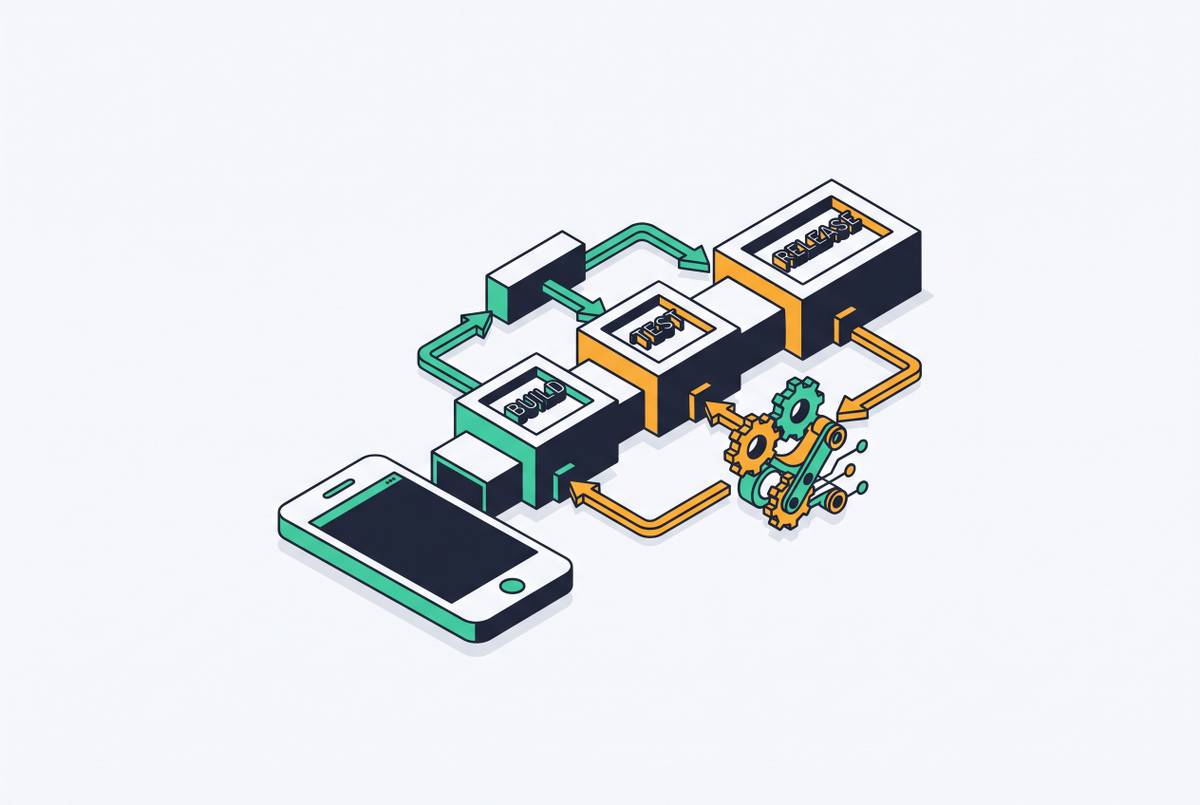
The first is the sequential pipeline, a fixed line of handoffs: requirements parsing, then code generation, then test generation, then review, then a deployment gate. It's predictable and easy to instrument, since each stage can be measured on its own. But it has one sharp failure mode: an error introduced early rides forward unchallenged, and the planner-coder gap becomes most dangerous in exactly this structure, because the coding agent simply inherits whatever the planning agent misunderstood, with nothing built in to catch it.
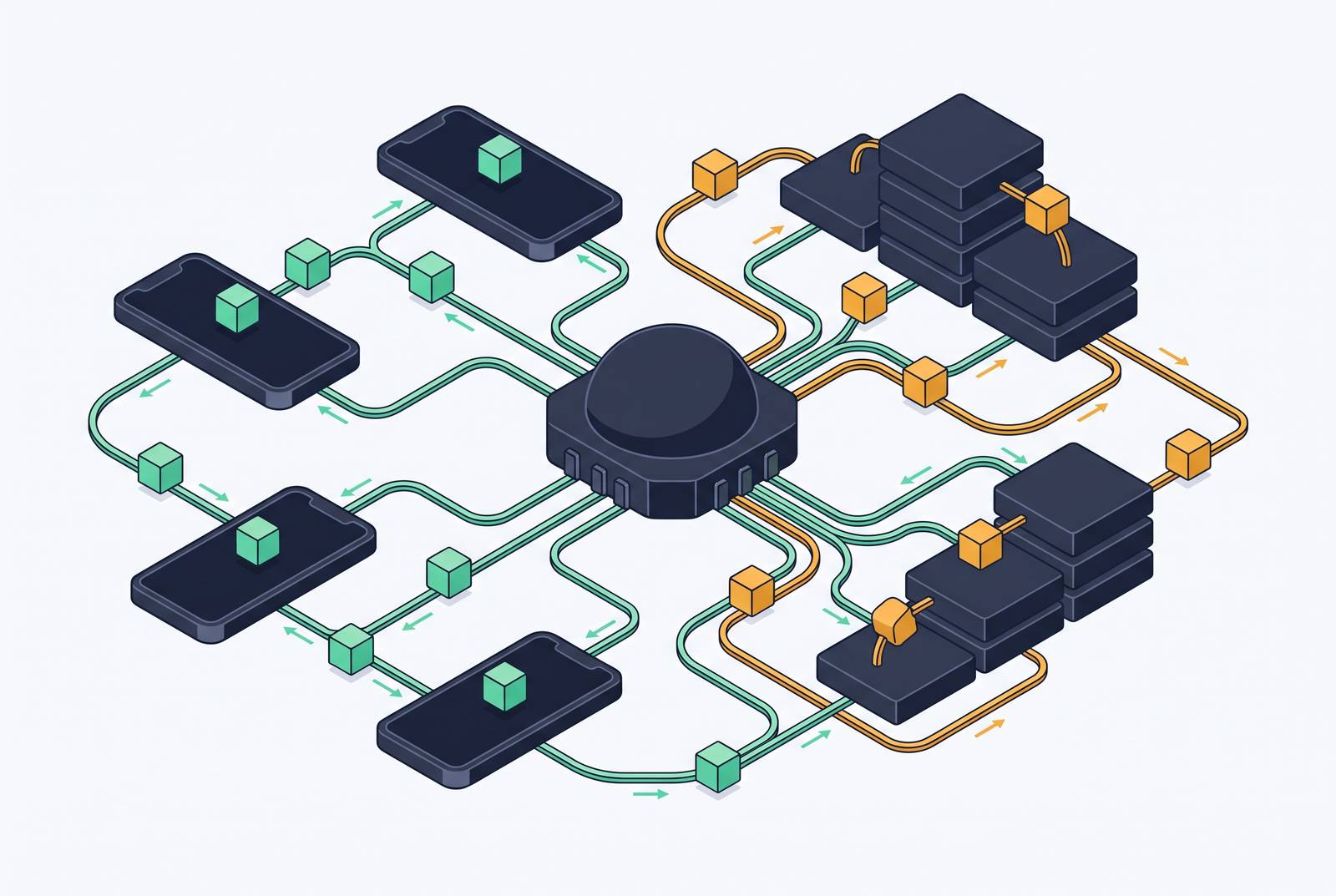
The second is parallel specialist agents, a fan-out structure where a coordinator sends the same artifact to several specialist agents at once, one checking security, one accessibility, one performance, one store compliance, and then synthesizes what comes back before a human sees it. This pattern earns its keep specifically in mobile, where the quality surface really is multi-dimensional: a security agent running OWASP MASVS checks alongside an accessibility agent running WCAG 2.1 Level AA checks covers ground at a pace no generalist reviewer could match alone. The hard part is synthesis. When the security agent and the accessibility agent disagree about priority, something has to resolve that, and without a coordination layer built for it, the conflict just lands on the human reviewer's desk unresolved.
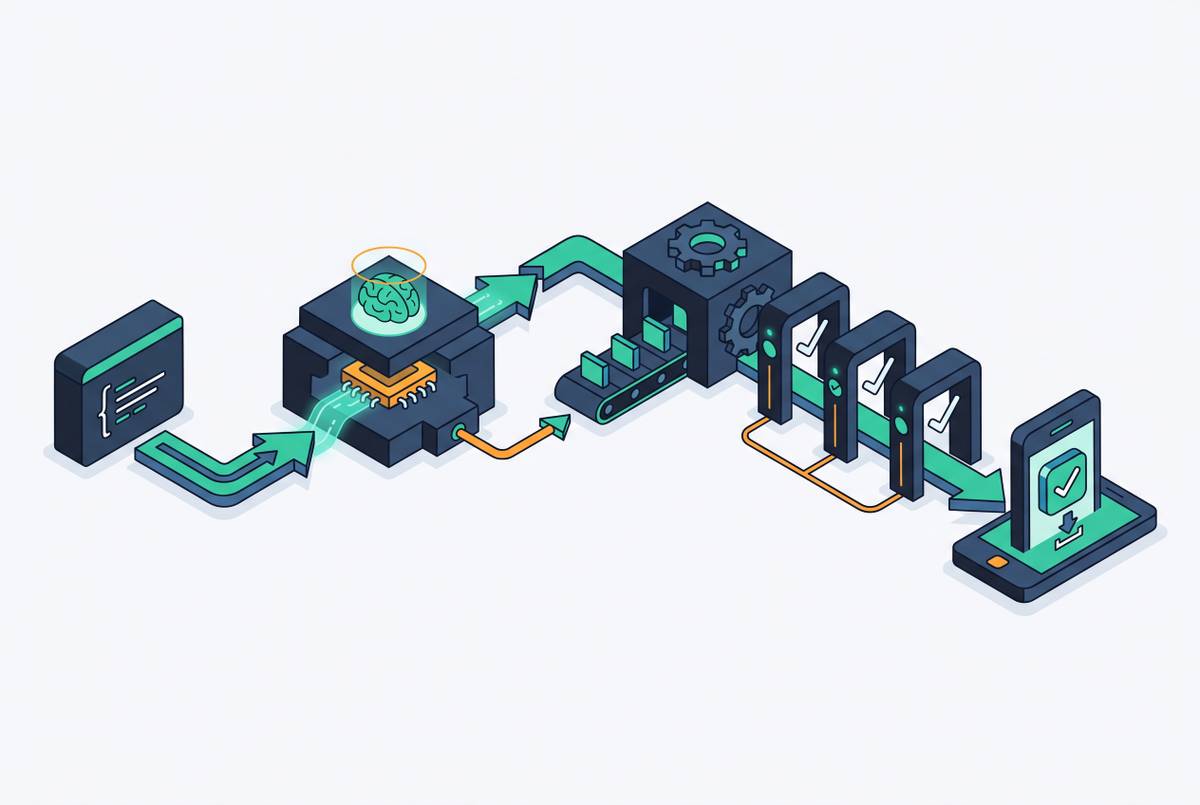
The third pattern is the builder-validator chain, where the agent that generates code and the agent that checks it are kept structurally apart, different context, different prompting, sometimes different underlying models, so the validator can't simply rubber-stamp the builder's assumptions. The MAST research found that adding an explicit verification phase like this measurably improves success rates on agentic tasks, which makes intuitive sense: it directly targets the circular review described earlier. But the separation only means something if the validator is grounded independently, in its own specification source, its own test cases, its own evaluation criteria. A 2026 arXiv paper on scientific software governance out of Idaho National Laboratory makes this point precisely: when implementation and testing come from similar agentic models, what you get is correlated failure, not independent verification, and the same structural risk applies in mobile pipelines. The common trap here is a QA agent that writes its tests by reading the code it's supposed to check rather than the product spec, at which point it's just confirming the code agrees with itself.
The fourth pattern is human-in-the-loop orchestration with agent-prepared evidence. The Verification Horizon paper, published on arXiv in June 2026, makes the case that no orchestration pattern actually removes the need for verification; it just moves it somewhere else. Human judgment at the gate isn't a stopgap teams will eventually engineer away; it's a permanent structural piece. This pattern maps directly onto the decisions mobile teams can't delegate anyway: store submission, release sign-off, compliance declarations, the exact places where Apple and Google expect a documented, accountable human behind what got submitted. Its weak point is quality of evidence. If what the agents hand up is incomplete or poorly calibrated, the human is making a real decision on bad information, dressed up to look thorough.
How these patterns combine in practice and their critical handoff points
None of this plays out as a single pattern in isolation. Pipelines that actually work layer sequential structure, parallel specialist checks, and builder-validator separation on top of each other, and the seams between those layers are where quality actually breaks or holds. A mobile pipeline that's working well might run sequential handoff at the macro level, planning into generation into verification into release, while running parallel specialist agents at the verification stage and keeping a hard builder-validator split between whoever writes the code and whoever writes the tests for it.
The handoff failure is easy to mistake for a technical glitch when it is really a translation failure. The arXiv research on planner-coder gaps traces most multi-agent failures to that exact seam, the semantic handoff between agents, not to either agent malfunctioning on its own. For mobile, that seam is the moment a product requirement becomes a platform-specific implementation instruction, and it's lossy by nature.
Good handoffs need a few things agents don't get by default. Downstream agents need grounding in the same product intent document the upstream agent worked from, not just whatever artifact came out the other end, or every handoff becomes another lossy compression of the original ask. Agents also need explicit context boundaries: one that receives a code artifact with no specification attached can only judge it against surface properties, does it compile, does it match known style, it has no way to check it against what the product was actually supposed to do. And the MAST research is specific on one more point: the silent gray errors described earlier, code that compiles clean but violates business logic, become visible only when you evaluate the whole trajectory of a task, not when you review each output as a standalone artifact.
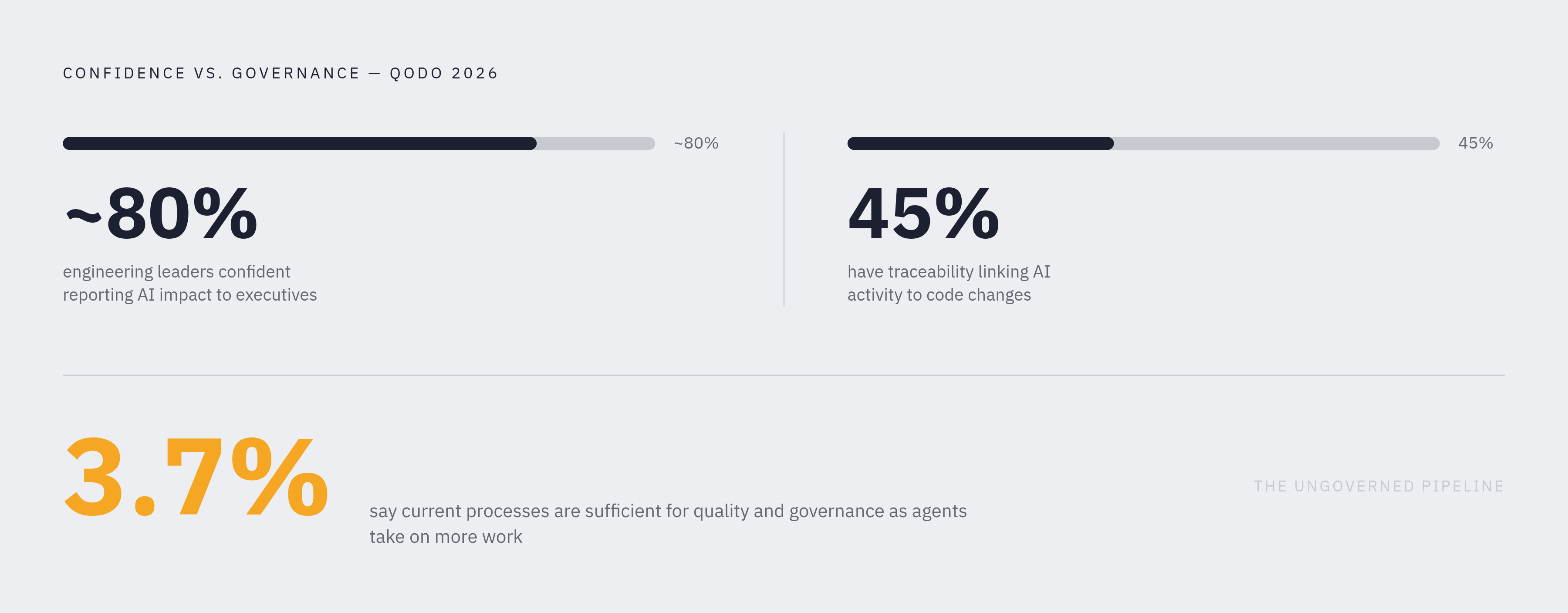
The governance numbers show the scale of this starkly. Per the Qodo 2026 report, most engineering leaders say they're confident in their ability to report AI's impact to executives, yet only 45% actually have traceability connecting AI activity to the code changes it produced. Leaders are confident about a pipeline they can't audit. The enforcement side tells the same story from another angle: only a minority of developers say agents always follow organizational standards, and most leaders admit they can't enforce policy consistently across teams, repositories, and tools. Standards exist in a document somewhere. They don't reliably travel through the handoffs.
Mobile makes this worse in a specific way. The handoff from specification to platform-specific implementation is unusually lossy because iOS and Android both carry idiomatic patterns, SDK constraints, and store policy requirements that a generalist product requirement never captures. An agent can write business logic that's entirely correct and still produce a build that violates platform convention or trips a store guideline, because "correct" and "store-compliant" aren't the same test, and nothing in a generic spec forces an agent to run both.
Where human authority must sit in any orchestration structure
The real question isn't whether humans stay in the loop, every serious mobile team already assumes that they do. The question is where exactly human authority has to sit for that involvement to mean something, rather than functioning as a signature on a form nobody read.
The Verification Horizon paper's argument matters here again: no orchestration pattern removes the need for verification, it only relocates it, and as the engineering behind these agent harnesses gets more sophisticated, reliably verifying the output actually gets harder, not easier. That means human judgment at the gate isn't a temporary crutch teams will eventually automate past. It's permanent, by structure.
Three specific points in a mobile pipeline demand real human authority, not a nominal one. Standards definition is the first: what counts as acceptable performance, which design system elements are non-negotiable, what accessibility level the product commits to, these decisions have to be set and owned by humans who understand the product, with agents enforcing what's been specified rather than inventing the bar themselves. Release sign-off is the second: submitting to the App Store or Google Play is a human accountability decision, and Apple's new AI disclosure requirements from November 2025 make that accountability explicit for apps using third-party AI services. Override authority is the third: when an agent's finding runs against a human's read on product intent or business priority, that human needs a clear, usable way to overrule it, and a system that buries or fails to log that override is undermining the exact governance it's supposed to provide.
A shift in what the specification itself is for produces all three. In AI-first teams, the spec is becoming the primary artifact that actually governs how agents behave, so better requirements and tighter acceptance criteria aren't a nice-to-have anymore, they're the main lever a team has over agent output. That makes quality standards definition a core piece of engineering work now, not a formality a team does once before a project starts and forgets about. It follows that QA's job is changing shape too: QA engineers in these pipelines are moving toward specification governance, making sure AI-generated tests check against what was actually required rather than against what got built. When the same system writes the code and writes the tests for it, the risk is a test suite that just confirms the code agrees with itself, which is not verification.
Ceremonial authority is common and easy to miss. A human gate that receives a passing test suite with no traceability back to the original requirement, a build with no record of which agents touched what, a compliance report with no evidence attached showing what was actually checked, none of that is governance. It's a rubber stamp wearing governance's clothes. The Qodo 2026 report finds that only 3.7% of engineering leaders say their current processes are sufficient to maintain quality and governance as agents take on more of the work. That figure alone should settle any argument about whether this is a solved problem. It isn't, and the teams that treat orchestration design as a real engineering decision, rather than a byproduct of whatever tools they happened to adopt first, are the ones that will find out before an App Store rejection does.
Sources
- The 2026 State of AI Code Quality Report: Verification Is the New Bottleneck - Qodo
- Bridging the Gap on AI-Assisted Scientific Software Development Through Transparency and Traceability
- Beyond Code Generation: Reliability, Verification, and Cost Economics in the Agentic Software Development Lifecycle
- The Verification Horizon: No Silver Bullet for Coding Agent Rewards
- Humans are Missing from AI Coding Agent Research
- AI IDEs or Autonomous Agents? Measuring the Impact of Coding Agents on Software Development