Irreducibly Human Roles in an AI-First Mobile Engineering Team
Code review becomes the bottleneck when AI accelerates everything else simultaneously.
Irreducibly Human Roles in an AI-First Mobile Engineering Team
Why AI coding agents create a verification problem, not just a speed advantage
AI coding agents haven't just sped up software delivery. They've moved the bottleneck. Writing code was never the slow part for long; confirming that the code does what it's supposed to do is now the constraint that determines how fast a team can actually ship. Agents accelerate every stage of the development lifecycle at once, planning, generation, testing, review, security scanning, documentation, and that simultaneity is precisely the problem: when everything speeds up together, nothing is left to check the rest against.
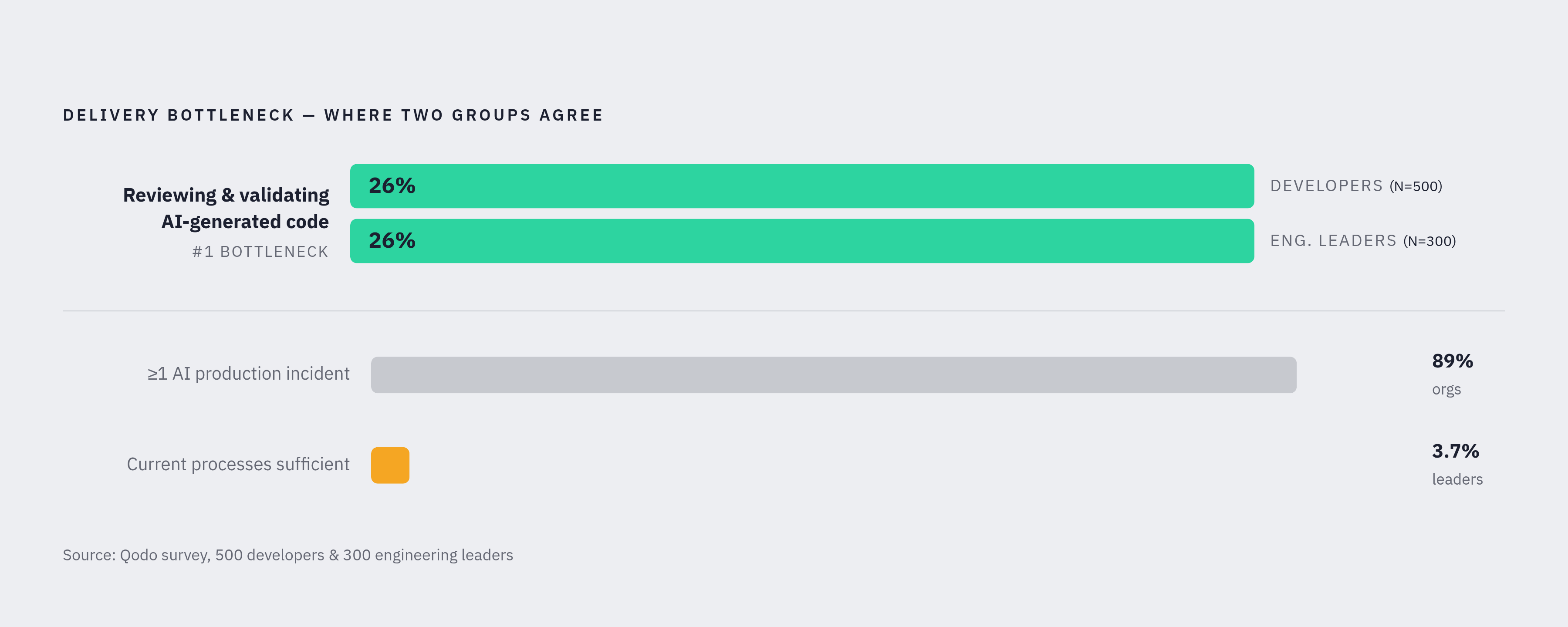
The data backs this up in an unusually clean way. Qodo's State of AI Code Quality Report, drawing on a Censuswide survey of 500 developers and 300 engineering leaders, found both groups independently naming the same top constraint on delivery: reviewing and validating AI-generated code, at 26% each, ahead of every other option on the list. Meanwhile, 89% of organizations report having had at least one AI-related production incident, and only 3.7% of engineering leaders believe their current processes are sufficient to hold the line on quality and governance as agents take on more of the work Qodo State of AI Code Quality Report.
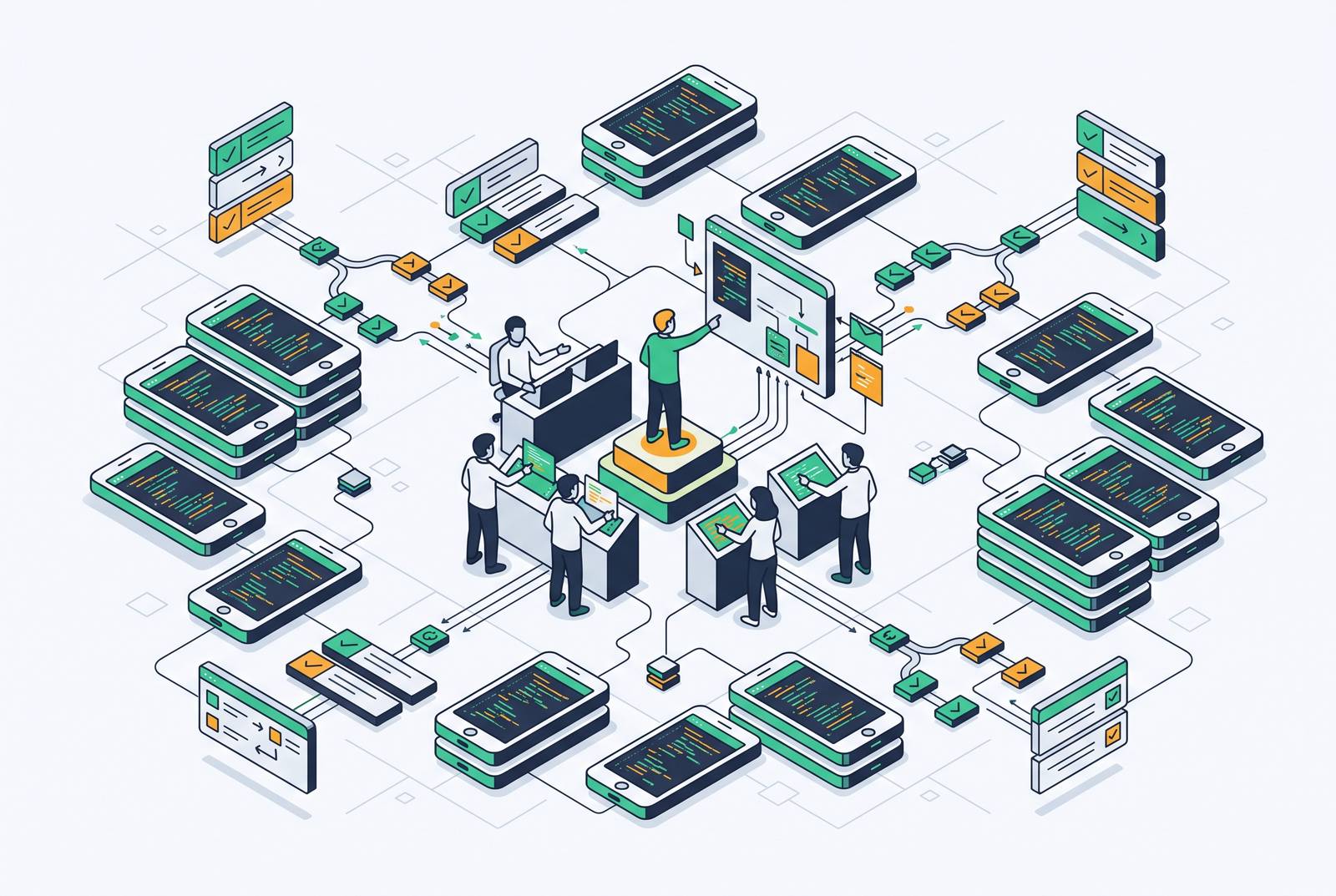
Part of what makes this hard to fix with more tooling is that agents now sit inside almost every phase of the pipeline simultaneously, generating code, reviewing code, writing tests, fixing bugs, drafting documentation, running security checks, even participating in planning. A single change can carry AI-influenced decisions at every one of those stages, which means an error introduced early doesn't stay contained. It gets reinforced downstream, checked by systems that share the same blind spot as the system that made the mistake.
That's the circular-review trap, and it's structural, not a matter of picking a better model. When the same underlying assumptions that generated a piece of code are also used to review it, the reviewing system confirms the generating system's misunderstanding rather than catching it. The loop's flaw is the absence of an outside perspective, not insufficient computation. That absence is the condition this piece is actually about: certain roles in engineering aren't just currently hard to automate, they are structurally irreducible to agent logic, because they require setting intent, exercising judgment under real ambiguity, and holding accountability that no proxy can absorb.
How the cognitive burden on human reviewers is changing even when clock time stays the same
Cycle-time dashboards can look perfectly healthy while the people doing the work are quietly drowning. Qodo's report found that 36.4% of developers say reviewing AI-generated code takes about the same amount of time it always did, but now demands noticeably more cognitive effort to catch the subtle bugs hiding inside it Qodo State of AI Code Quality Report. Time-to-merge hasn't moved. The mental cost of getting there has.
There's a social cost layering on top of the cognitive one. Nearly a quarter of developers, 24%, say they trust their peers' pull requests less now, simply because it's no longer clear how much of the work is human-authored versus machine-generated Qodo State of AI Code Quality Report.
Stack Overflow's 2025 Developer Survey captured the texture of this frustration precisely: 66% of developers named AI output that's almost right, but not quite, as their single biggest frustration, and 45.2% said debugging AI-generated code actually takes longer than writing the equivalent code themselves would have.
None of this is stopping adoption. It is, however, corroding confidence in the output even as usage climbs: New Relic's State of AI Coding Report found developer trust in AI output accuracy fell from 40% in 2024 to 29% in 2026. And the burden isn't distributed evenly. Less experienced developers report the largest productivity gains from AI tools, but also the greatest difficulty reviewing what those tools produce, which means verification concentrates exactly where judgment is thinnest and least seasoned. That's a dangerous alignment of incentive and risk. A CodeRabbit analysis of 470 open-source GitHub PRs found that AI-authored pull requests averaged 10.83 issues versus 6.45 for human-written code (a 1.7x defect rate), including a 75% rise in logic and correctness errors.
Why intent-setting cannot be proxied in engineering work
Difficult to automate and structurally irreducible are not the same category, and conflating them leads to treating tasks as permanently human-dependent when they may only be waiting on better tooling. A task can resist automation today simply because the tooling isn't mature yet. A task is irreducible when no amount of tooling maturity changes the fact that a human has to be the one doing it, because the task requires originating intent, exercising judgment where no single correct answer exists, or bearing accountability that a system with no stake in the outcome cannot hold.
The Verification Horizon paper, published on arXiv by a team including Binghai Wang, states the underlying problem with unusual clarity: every verifier, no matter how sophisticated, is only a proxy for human intent, and never the intent itself. Intent is underspecified by nature. That's a feature of how humans communicate goals to each other, not a flaw in how people write requirements. Which means checking whether intent has been faithfully fulfilled is inherently, permanently hard, not a temporary limitation waiting on a better checker.
Three dimensions define what makes a role genuinely irreducible, and they recur throughout the roles that follow. Intent-setting means deciding what software should actually do and for whom, a decision no agent originates, only executes against. Judgment under ambiguity means resolving conflicts between competing valid interpretations of a requirement or a user need, which is fundamentally a values question about what matters more, not a prediction problem a model can be trained to solve. Accountability means bearing responsibility for outcomes in ways that are organizational, legal, and relational, responsibility that cannot be transferred to a system that has nothing at stake in the result.
What does not belong in this category should be named, to keep the argument honest. Syntax review, boilerplate test generation, regression execution, documentation formatting: these are automatable, full stop, and pretending otherwise wastes protection on tasks that don't need it while starving the roles that actually do. LTM's SDLC AI Radar 2026 frames this reorganization well: the lifecycle isn't just moving faster, it's reorganizing what engineers are for, shifting people from implementers toward specifiers, verifiers, and orchestrators. What follows maps which of those emerging roles are genuinely load-bearing, and why.
The person who defines what the software must do: product intent as the origin of quality
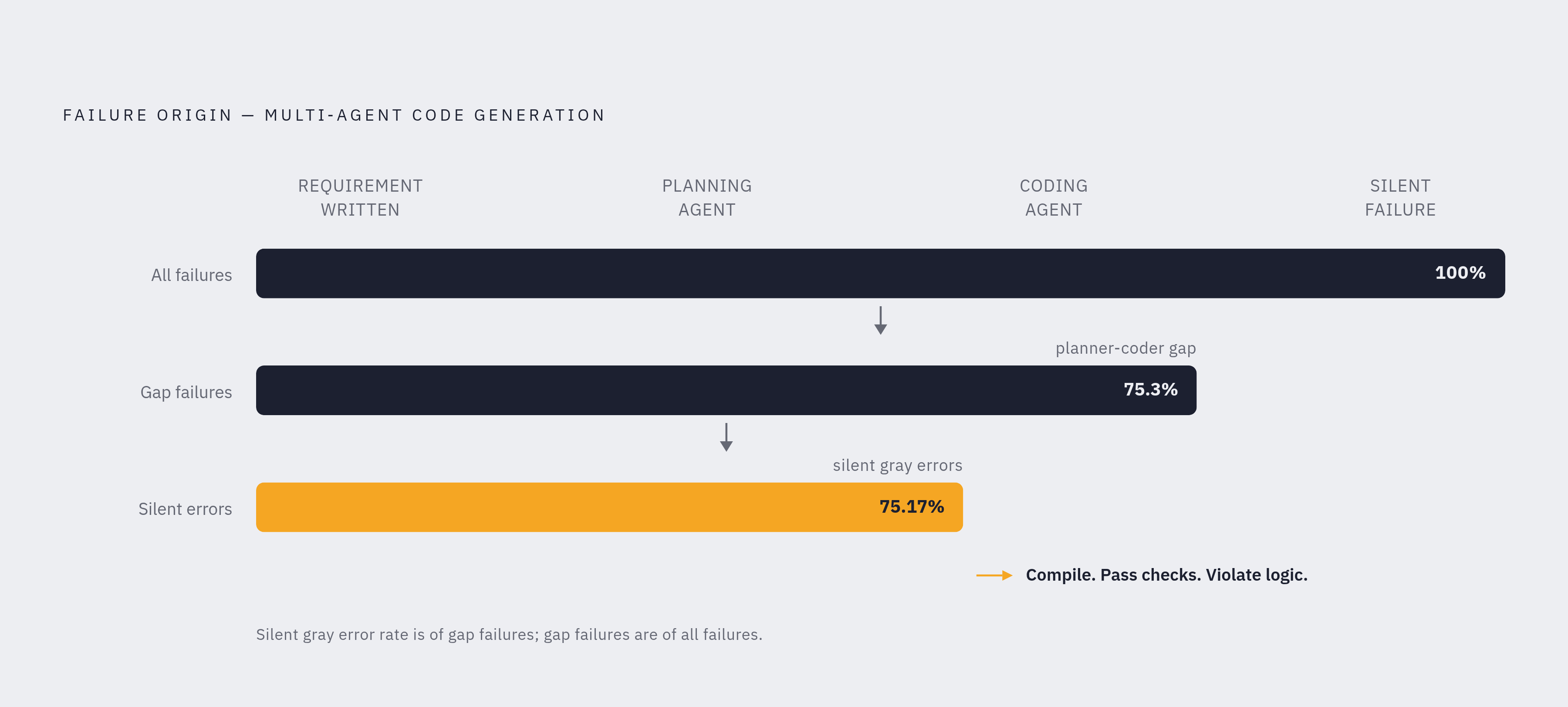
Somewhere between a product requirement and working code, a lot of failures are born, and the research on multi-agent systems has started to quantify exactly where. Research cited by testquality.com found that the planner-coder gap, the semantic breakdown that happens when a planning agent hands work to a coding agent, is the root cause of 75.3% of multi-agent code generation failures. A product manager writes a high-level requirement. A coding agent attempts to execute it without access to the architectural history or the design decisions that would have told a human engineer what the requirement really meant.
Worse, most of these failures don't announce themselves. Research from the MAST framework found that 75.17% of these failures are what researchers call silent gray errors: code that compiles, passes its superficial checks, and still violates the business logic it was meant to serve. That's the worst kind of failure to inherit, because it looks like success until it isn't.
Ciklum's analysis of the space puts the fix in plain terms: the specification is the new code. Better requirements, better context, sharper acceptance criteria, these now determine how well an agent performs, because a vague requirement doesn't just produce vague output, it produces vague output faster than a human ever could have. That reframes what the product role is actually for in an agentic pipeline. It's originating the requirement from user research and business context that lives nowhere else, making the tradeoff calls between competing valid interpretations before a single line gets written, and recognizing the moment a requirement is under-specified enough to cause failure downstream, which is the judgment that should trigger a clarifying question instead of a delegation to an agent. And when shipped behavior diverges from what was intended, someone has to own that gap. Accountability requires a person standing behind the decision, not a system that generated it.
Specification precision has become the most consequential new skill in the agentic SDLC, because what gets written now sets the ceiling on what any agent downstream can produce correctly. A sloppy spec doesn't get cleaned up by a smarter model. It gets executed faithfully, which is worse.
The person who holds architectural memory: why context that agents can read is not the same as context agents understand
Feeding an agent the entire codebase and its documentation is not the same thing as giving it an understanding of why the codebase looks the way it does. Qodo's 2026 findings make the gap concrete, with only 35% of developers saying agents consistently follow organizational standards, and 43% of engineering leaders still naming insufficient agent context as one of their biggest quality and governance problems, even in teams that have already invested in centralized context and rules systems Qodo State of AI Code Quality Report. The investment in access hasn't closed the gap in interpretation.
An agent has no equivalent resolution mechanism; it can retrieve text, but it can't tell which text still reflects reality. Architectural memory was never really stored in documentation. It lives in the reasoning behind past decisions, why a given abstraction got chosen over the obvious alternative, what got tried and discarded, which constraints are permanent versus merely convenient for now.
This is what the architectural role actually protects: the mental model of how a system holds together across changes, not just its current state but the trajectory it's been on. It's the capacity to detect when an AI-generated change is locally correct but globally corrosive, the pattern that looks fine reviewed in isolation and quietly breaks the system's coherence over time. It's the judgment to decide which constraints are non-negotiable and to encode them in a form agents can actually enforce, itself a decision requiring a sense of what matters. And it's the ability to spot when an output is technically compliant and still architecturally regressive, passing every check while making the system worse to live in.
Qodo's 2026 numbers confirm this isn't hypothetical: 38% of engineering leaders name maintaining architectural consistency as one of their biggest gaps in governing AI-generated code. Forrester Principal Analyst Devin Dickerson has flagged retrofitted governance infrastructure, built after scaling rather than before, as a marker of Stage 1 AI maturity. The architectural role falls through the cracks when governance gets bolted on late instead of designed in from the start.
The person who owns the release decision: why a verdict requires someone who can be accountable for it
Confidence and evidence are not the same thing, and Qodo's 2026 numbers expose the gap between them starkly. 90% of engineering leaders say they can report AI's impact on delivery to executives or the board. Yet only 45% actually have traceability connecting AI activity to the specific code changes it produced, and fewer than half report consistent policy enforcement across their teams and repositories. Leaders are confident in their ability to report. They often lack the underlying data that would make the report meaningful. That's a structural accountability problem, not a communication problem.
The release decision itself carries weight that can't be reduced to a checklist. It requires judging risk tolerance in context, what's acceptable to ship given current business conditions, user expectations, and competitive timing, which is a values question, never a prediction a model can output. It requires interpreting ambiguous signals: test suites that are green but shallow, performance metrics that are technically acceptable but visibly trending the wrong direction, knowing that passing isn't the same thing as ready. It requires someone to accept responsibility, in the full organizational and legal sense, for what ships and what doesn't. And it requires someone to explain that decision, and its reasoning, to the people who will live with its consequences.
Qodo CEO Itamar Friedman put the underlying tension this way: "You can't dramatically increase the speed and autonomy of software development and expect human review to scale at the same rate". "If agents are going to write, test, review, and push more of our software, then verification and governance have to become tightly integrated into the agentic SDLC". Human authority over the release gate has to stay explicit, because accountability requires someone with actual standing to be held responsible when the call turns out wrong. The workable model going forward: agents surface the evidence, compress it, organize it, flag what's unusual. Humans hold the verdict. It's the only division of labor accountability actually permits.
The person who governs quality standards: defining expectations once so they can be enforced everywhere
Mobile quality was never a single axis, and agentic development hasn't simplified it. Functional correctness, design consistency, security, performance, accessibility, app store compliance, no single tool and no single role owns all of that terrain at once. Device fragmentation alone makes the scope of the problem concrete: more than 25,000 Android device variants across multiple manufacturers, which means the surface area of what counts as "correct behavior" is enormous and different for every product Testing Mind Mobile Testing Strategy Guide. Deciding which subset of that surface actually matters for a given app is a judgment call, and it has to be made by someone who understands the product, not inferred from a generic checklist.
Qodo's 2026 findings suggest most organizations are still making that call informally. Fewer than half of engineering leaders have centralized AI coding standards in place, and only 37% can enforce policy consistently across their teams and repositories. Most teams, in other words, are still running on tribal knowledge rather than anything written down and enforceable.
Augment Code's guide to the agentic SDLC makes a related point: when AI generates both the code and the tests meant to check it, QA engineers must verify that test generation reflects requirements rather than the implementation. Otherwise the test suite becomes a mirror, confirming the code agrees with itself.
Quality expectations get defined once, by people who understand the product deeply, and then get enforced automatically and consistently by agents across every build, every pull request, every release. The human role here is authorship and ownership of the standard. The execution of the check is exactly the kind of task that should be automated, and increasingly is.
The person who reads user behavior as signal: what shipped software reveals that no pre-release test can capture
New Relic's State of AI Coding Report found 78% of tech leaders reporting an increase in production incidents after AI-generated code ships, even when that code passed review. What users actually do with a product reveals gaps that no pre-release suite, however thorough, was built to catch.
That's the logic behind shift-right testing, observing real user behavior after release, which 2026 mobile testing guidance names as a practice that belongs alongside shift-left testing rather than in place of it. Production is an environment no staging suite fully replicates, because real usage generates conditions nobody thought to specify in advance.
A bug means the code doesn't do what it was specified to do. A misspecification means the code does what it was told to do, and the instruction itself was wrong. Agents are reasonably good at catching the first kind. Only a human holding real product context can catch the second, because catching it requires knowing what the product was actually supposed to accomplish for the person using it, not just what the ticket said. This role also has to judge when a behavioral pattern is meaningful signal versus noise, a judgment that depends on product and user knowledge no agent carries into the analysis.
This is where the loop closes back on itself. The person reading post-release signal is feeding the person who sets intent for the next cycle, and both of those people are human. The connection between them is what keeps a product coherent across releases, rather than a sequence of locally correct changes that quietly drift away from what the product was ever supposed to be.
What happens to these roles when AI amplifies rather than replaces
The 2025 DORA report frames AI's actual effect on organizations correctly: it's an amplifier, not a substitute, magnifying whatever strengths or weaknesses already exist in the team using it. A team with clear intent, real architectural memory, and enforceable standards gets faster and better. A team without those things gets the same volume of output, produced with more speed and less understanding of what any of it means.
That's the throughline across every role this piece has mapped. None of them survive because they're hard to automate this year. They survive because intent, judgment, and accountability were never computational problems to begin with, and no model trained on more data closes that gap. Load-bearing, in practice, means that if you remove the role, everything built on top of it keeps compiling, keeps passing its tests, and quietly stops meaning what it was supposed to mean.