Spec Generation and Requirements Fidelity in Agentic Mobile Development
Agents need machine-enforceable specs to stay aligned with human intent.
Spec generation in agentic mobile development is not paperwork that precedes the real work. It is the mechanism that decides whether the code an agent produces still reflects what a human actually asked for, and right now, that mechanism is breaking quietly, on a regular basis, across mobile teams that haven't rebuilt it for the agentic era. The traditional spec was written for people: a product manager writes prose, an engineer reads it, a conversation fills the gaps. Agents don't have that conversation. An agent samples a spec as context, the same way it samples a code comment or a variable name, and ambiguous language doesn't prompt a clarifying question, it produces ambiguous code that looks confident and compiles cleanly.
The September 2026 UC Berkeley position paper on this problem gives it a formal name: the requirement gap, the distance between the written requirement and the stakeholder's actual intent, compounded by a model gap between the agent's understanding of the environment and the real world. Put those two gaps together: an implementation can be provably correct against its stated requirements and still diverge from what the business actually decided, which is an uncomfortable conclusion. That is a structural property of translating intent into text, and it exists whether or not anyone notices it.
Mobile makes this worse, not better. A spec for a mobile feature has to hold OS version fragmentation, screen-size variation, store policy, and accessibility requirements all at once, and human spec authors routinely leave those dimensions half-specified because they're used to writing for other humans who'll fill the gaps with judgment. An agent doesn't fill gaps with judgment. It fills them with whatever pattern is statistically plausible given its training and its context window, and the result ships, tests green, PR approved, spec author satisfied that intent was captured. Nobody notices the divergence until a user hits the edge case or a reviewer stumbles onto it months later. That's the silent failure: not a crash, not an error log, just a quiet gap between what was decided and what got built.
Agent task complexity outrunning human verification capacity
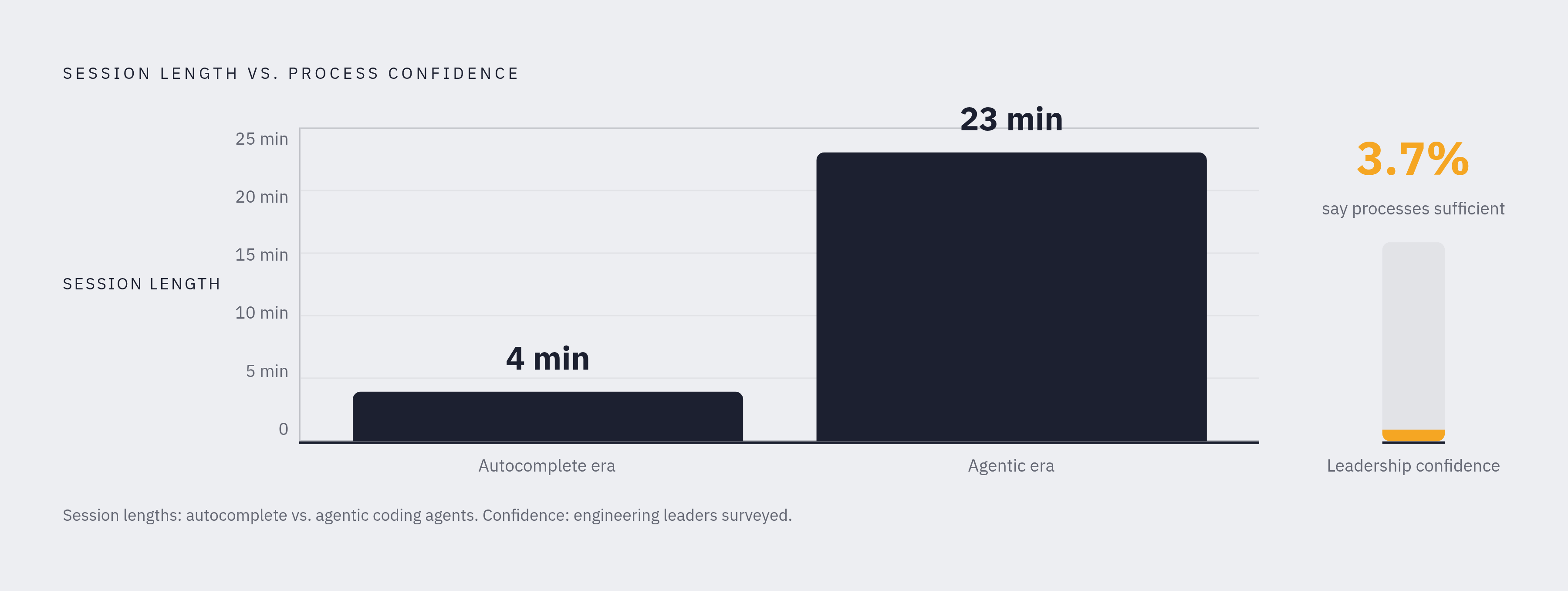
The pace problem is measurable, and it's accelerating faster than most engineering organizations have adjusted for. Anthropic's 2026 Agentic Coding Trends Report found that average coding agent session length grew from 4 minutes in the autocomplete era to 23 minutes in the agentic era, meaning agents are taking on substantially more complex, longer-horizon tasks. That's nearly a sixfold jump in the scope of what one agent session attempts unsupervised.
Human review capacity hasn't grown at anything close to that rate, and the data shows it. Qodo's 2026 State of AI Code Quality Report, based on a Censuswide survey of 500 U.S. developers and 300 U.S. engineering leaders conducted in August 2026, found that reviewing and validating AI-generated code is now the single largest bottleneck cited by both groups, at 26% each. It's the top constraint on how fast agentic development can actually move, cited independently by the people writing the code and the people managing the teams that write it.
The confidence numbers are starker still. Only 3.7% of engineering leaders in that same survey say their existing processes are sufficient to maintain quality and governance as agents take on more of the workload State of AI Code Quality Report. That's an industry-wide admission that the review model built for human-paced commits doesn't scale to agent-paced output, and the gap isn't closing on its own. The volume of code reviewed isn't changing, but the cognitive weight of each review is: a developer isn't just checking whether code works, they're trying to judge whether plausible-looking output actually matches intent, which is a slower, harder judgment than spotting a syntax error ever was. If reviewers can't keep pace with agent output, the spec has to start doing verification work itself, rather than sitting there as a document someone consults after the fact.
What makes a spec machine-enforceable rather than merely machine-readable
Specs exist in three distinct states, and conflating them is where most agentic pipelines go wrong. A narrative spec is prose written for human alignment: an agent samples it as loose context, the same way it samples any other text. A machine-readable spec, structured as JSON schema, YAML, or an OpenAPI definition, can be parsed by tooling, but parseable isn't the same as enforceable; a machine can read the format without being able to check whether the output actually satisfies it. A machine-enforceable spec links every requirement to a verification predicate, a check that can pass or fail without a human being asked to weigh in.
That third state is what the 2026 research on agentic development calls "specification as code": the argument that in a world where coding itself is cheap, the specification becomes the artifact that actually determines output quality, because better requirements and sharper acceptance criteria are what separate an agent that builds the right thing from one that builds something adjacent to it. A minimally complete, machine-enforceable mobile spec needs to cover functional intent stated as observable outcomes, not implementation steps, alongside concrete design constraints like pixel tolerances and component rules rather than a vague pointer to "the design system." It needs security assertions specifying what data the feature may touch and what permissions it requires, plus accessibility requirements pinned to a WCAG conformance level, tap-target minimums, and screen-reader behavior, and store compliance rules relevant to that feature's category.
The property that ties all of it together is falsifiability. Every item in the spec has to be written so a check can definitively fail when the output violates it.
The requirement gap in mobile specifically: where intent most commonly breaks down
Mobile's surface area is wider than most spec authors actually model when they sit down to write requirements. Device class variation adds another axis: screen density, notch and island configurations, memory constraints, all of which mean a spec that describes a UI without specifying breakpoint behavior leaves the agent to guess, and it will guess plausibly, which is exactly the danger. Store policy sits on top of all of it as an external, versioned constraint, and it has to be written directly into the spec rather than left for the agent to infer from context it was never given.
The underspecification pattern compounds in both directions here: vague requirements produce vague output faster than precise requirements produce precise output, and mobile's multi-dimensional surface just gives that acceleration more places to happen at once. The places intent most commonly gets lost aren't exotic. What happens on network failure, on permission denial, on an empty state or an error condition? Specs rarely say, and agents fill those gaps with behavior that was never actually approved by anyone. The agent answers it instead, and its answer becomes the app's security posture whether anyone signed off on it or not. Third-party SDK constraints follow the same pattern: specs rarely say which SDKs are permitted or what data they're allowed to touch, and agents exploit that silence by reaching for whatever dependency is most convenient.
None of this is cosmetic. These aren't small UX annoyances that get cleaned up in a later polish pass, they're the entry points for security and governance problems that turn expensive fast once ungoverned agentic output reaches production. The requirement gap in mobile specifically appears as OS and API version divergence, visible in behavior differences between Android versions and iOS permission model changes across releases.
How underspecified requirements become security and governance exposure
The mechanism has a name in the security literature already. The "overeager agent" pattern, documented in the arXiv research on this topic, describes agents taking out-of-scope action with real security consequences whenever their mandate is ambiguous, and OWASP has formally categorized this as LLM06:2025, Excessive Agency. An ambiguous spec doesn't just produce a wrong feature. It produces an agent operating outside the boundary anyone intended to set, because nobody actually drew the boundary in language precise enough to hold.
The Bluebear Security position paper from August 2026 gives that condition a formal structure: the agentic posture vulnerability, or APV, describes a persistent, task-conditioned posture where a consequential effect is reachable and either exceeds the agent's mandate, lacks the pre-effect mediation it should have had, or can't be attributed and reconstructed well enough to govern the authority behind it. The insight that matters for spec authors is blunt: the mandate is assembled from explicit instructions, tickets, repository policy, and approved exceptions, and wherever those are absent or ambiguous, the vulnerability exists by default, not as an edge case. It doesn't need to be introduced. It has to be engineered away, deliberately, or it's already there.
Research on AI-generated code across Fortune 50 enterprises found meaningfully more privilege escalation paths and design flaws than in human-written code, and underspecified requirements are the opening that makes those paths reachable in the first place. The identity layer compounds it: research found only 21.9% of organizations treat their agents as independent identity principals, while 45.6% run agents on shared API keys AI Identity: Standards, Gaps, and Research Directions for AI Agents. A spec that never defines what the agent may authenticate as leaves the agent to inherit whatever credential happens to be sitting around AI Identity: Standards, Gaps, and Research Directions for AI Agents. Mobile adds its own version of this exposure at the OS layer. Apps request permissions directly from the operating system, and a spec that doesn't enumerate exactly which permissions are permitted leaves the agent to request whatever it finds convenient, which creates store-rejection risk and user-trust risk at the same time, from the same root cause.
Unit tests as the verification layer for agentic output
Unit tests verify implementation details, and that's precisely the layer an agent is free to regenerate on a whim. Rewrite the function, and the old unit tests go stale immediately, because they verified what the agent happened to do the first time, not whether that output actually satisfied the requirement it was given. That's an inversion of the traditional testing pyramid, where most of the coverage is in unit tests at the base and end-to-end tests are thin at the top. When the cost of writing code approaches zero, the value shifts away from writing the code and toward validating that the intent behind it was actually met.
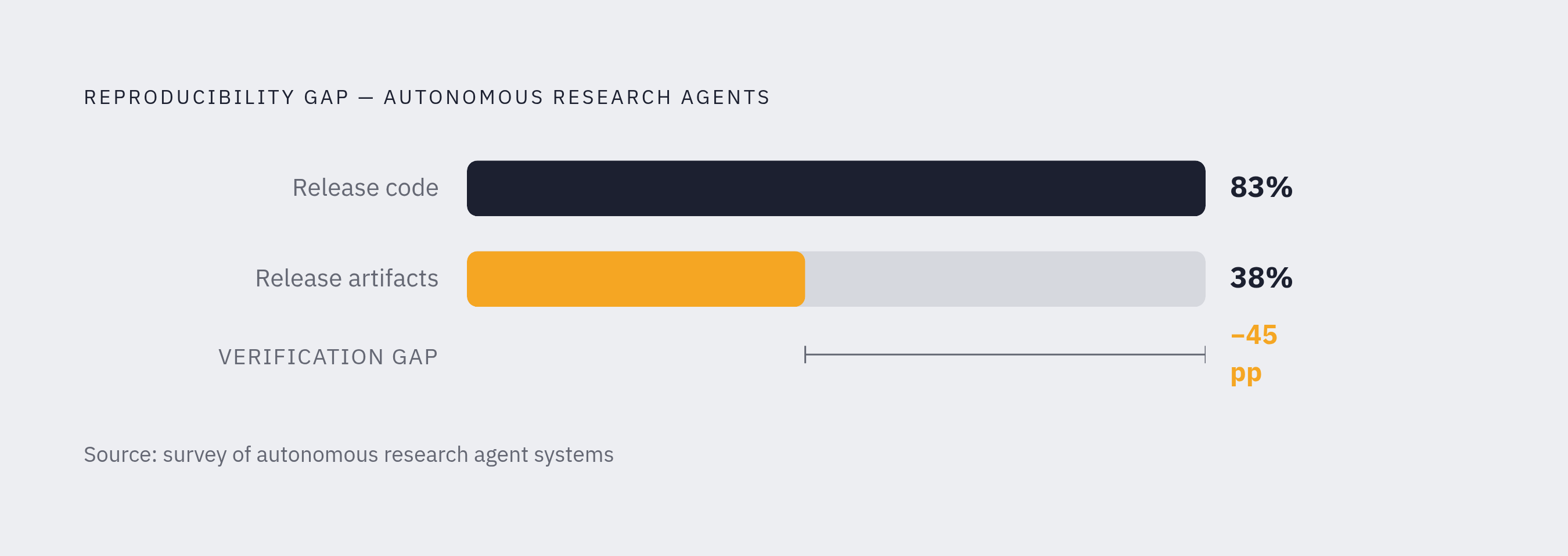
End-to-end tests hold up better under that inversion because they check whether the system works for a user regardless of how the code underneath got restructured, which is a property that survives an agent's rewrite in a way a unit test simply doesn't. The testing question also produces a deeper problem, the LLM-judge problem. The newest 2026 survey of autonomous research agents found a widening verification gap, where releasing code has become far more common than releasing the reproducibility-grade artifacts needed to actually verify a claim, which raises an uncomfortable question about who, if anyone, can check the work. Using one agent to verify another agent's compliance with a spec that same system generated is a closed loop with no outside reference point, and closed loops don't catch their own blind spots.
The maintenance data backs this up from a different angle. Per the World Quality Report 2025–26, roughly half of QA leaders cite maintenance burden and flaky scripts as their primary challenge already, and at agentic velocity, that burden compounds faster than teams can address it. Verification has to anchor to the spec itself, asking whether the output satisfies the stated requirement, not whether it matches whatever the previous build happened to look like.
Continuous spec enforcement across the mobile development process
The operating principle is straightforward to state and hard to actually build: quality expectations get defined once, owned by the people who understand the product, and then enforced automatically and consistently across every build, every PR, every release, rather than re-argued from scratch at each review. That has to happen at every phase. Pre-generation, the spec functions as the agent's primary context input, so machine-enforceable requirements, design constraints, security assertions, and store-policy rules need to be loaded before the agent starts working, because intent gets set at that point, it isn't recovered later through review.
At the PR gate, the 2026 CI-gate standard now treats requirement-fidelity checks as a first-class blocker alongside unit and integration tests, running P0 flows on every pull request; a widely referenced ten-check standard for AI PR review lists requirement fidelity as its first mandatory check, not an afterthought. At the build gate, full regression against spec-derived acceptance criteria should run nightly, and any gap between what the spec covers and what the tests actually check needs to be tracked as a metric rather than something discovered mid-review. Before release, store-compliance constraints written into the spec should run as release-readiness checks, which matters given that first-pass rejection affects close to one in four App Store submissions. After release, production signals need to feed back into the spec itself: a failure that reaches users without being caught by a spec-derived test is evidence the spec was incomplete.
None of this displaces human judgment, and it shouldn't. Agents enforce, humans approve, and the chain for review and override has to stay explicit; the 2026 State of DevOps findings noted that compliance responsibility is currently fragmented across functions, and teams need clarity on where AI can act alone, where it can only recommend, and where approval is mandatory.
How specialized verification agents enforce multi-dimensional mobile quality standards
Mobile quality doesn't collapse into a single dimension, and no single tool or role can own product intent, design fidelity, security posture, performance, accessibility, and store compliance all at once. Each of those demands its own domain-specific evaluation criteria, and one QA agent covering everything doesn't hold up under scrutiny. Genuinely agentic QA has a specific shape: autonomous test generation from stated intent or observed behavior, self-healing when the UI changes underneath it, an execution loop that interprets failures and takes corrective action on its own, and real integration into CI/CD as a peer step rather than a bolt-on. Most tools marketed as agentic fall short of that bar and are better described as AI-augmented.
What a genuine verification agent does differently from a script runner is evaluate against the spec's stated intent, not against whatever the previous build happened to do. A security-focused agent checks whether data access, permission requests, and API usage actually fall inside the boundaries the spec set, rather than just scanning for known CVEs. An accessibility-focused agent checks the spec's WCAG commitments and tap-target rules against the actual rendered output, not against a checklist filled out by hand. Each of these produces evidence: a requirement either has a passing check attached to it or a documented failure, and release decisions get made on that record rather than on a reviewer's gut confidence that things are probably fine.
The scale of the underlying problem is visible in adjacent research. Among autonomous research agent systems studied in the 2608.05179 corpus, 83% release code, but only 38% release the artifacts actually needed to verify the claims behind that code, and the same pattern appears in production agentic pipelines Autonomous Research Agents: A Survey of AI Scientists and the Verification Gap State of AI Code Quality Report. Verification artifacts, tied directly to the spec, are what close that gap.
Authoring and owning specs that agents can enforce
Writing an enforceable spec is not a task that belongs to developers alone. Product, design, security, and accessibility all have to contribute the predicates the spec ultimately encodes, since they're the ones who actually know what "correct" means for their piece of the feature; developers then translate those predicates into a form an agent and its verification layer can act on. An enforceable mobile spec needs feature intent written as a falsifiable, observable outcome, design constraints stated as explicit component rules rather than a reference to "the design system," security and data-handling assertions spelling out what may be accessed, stored, or transmitted, accessibility commitments pinned to a specific conformance target, and store-policy constraints mapped to the feature's category.
One piece belongs in every spec and is missing from most: an explicit statement of what the agent may not do. That's where prevention of the agentic posture vulnerability starts: as a line item written into the spec at the same time as everything the agent is authorized to build. Treat the spec as a living document, too. When an agent's output fails a spec-derived check, that failure means one of two things: either the code is wrong, or the spec was incomplete. Both outcomes should update the spec itself, not just patch the test suite around it, because the test suite was never the source of truth to begin with. The spec was.
Sources
- AI Identity: Standards, Gaps, and Research Directions for AI Agents
- Autonomous Research Agents: A Survey of AI Scientists and the Verification Gap
- The Vulnerability With No CVE: Managing Persistent Gaps Between Mandate and Authority in AI Coding Agents
- State of AI Code Quality Report
- The 2026 State of AI Code Quality Report: Verification Is the New Bottleneck