Test Case Generation and Maintenance in Agentic Pipelines
When agents generate both code and tests, they encode the same misunderstanding twice.
Test case generation and maintenance in agentic pipelines run into trouble because a quiet assumption baked into the classical model of software testing has quietly stopped being true. The test, in other words, was never really about the code. It was about confirming that two people, working from the same intent, arrived at compatible interpretations of it.
Agentic pipelines break that chain at the root. When that happens, there's no longer a second, independent human perspective checking the first one's work.
The UC Berkeley two-gap framework gives this problem a formal shape. Any implementation-verification loop only catches failures that fall inside its fixed requirements specification (R) and its environment model (M), and both of those are approximations, R of stakeholder intent, M of the real deployment world. Neither gap can be certified closed, regardless of how sophisticated the loop gets. That's true even in fully human-authored pipelines. What changes under agentic conditions is who's doing the approximating, and how often the same approximation gets reused without anyone noticing.
An agent generating both the code and the test for that code doesn't introduce two independent checks on intent. It tends to encode one misunderstanding twice. If the model misreads what a feature is supposed to do, the code will reflect that misreading, and so will the test built to confirm the code works. The test passes. The feature is wrong. Nothing in the pipeline flags it, because nothing in the pipeline was built to check intent against anything other than itself. In an agentic pipeline, the requirement parsing, the code, and the test can all be AI-generated, often by the same underlying model or model family.
The pace of agentic code generation versus verification systems
DROP (pending claim content) That's a near-total admission, from the people responsible for governance, that governance hasn't caught up.
Trust has moved in the wrong direction too, which should give anyone pause. Developer confidence in AI output accuracy fell from 40% in 2024 to 29% by 2026 https://www.tabnine.com/blog/ai-verification-gap-code-quality/. Adoption climbed through that same window. Ordinarily, familiarity breeds confidence. Here, it seems to have bred caution instead, likely because developers are seeing the failure modes up close and recognizing that fluent, plausible-looking code isn't the same thing as correct code.
The defect data backs that instinct. AI-authored pull requests averaged 10.83 issues against 6.45 for human-written code, a 1.7x defect rate, and that defect rate scales linearly with adoption https://testquality.com/agentic-sdlc-guide-build-test-verify-ai-generated-code/. It scales with it. It means a proportionally larger volume of the same defect pattern appears faster than review capacity can absorb it.
The sharpest finding, though, concerns what kind of failures occur. Research on multi-agent systems (the MAESTRO body of work) found that 75.17% of multi-agent failures are silent, gray errors: code that compiles cleanly, passes surface-level checks, and still violates the business logic it was supposed to implement https://testquality.com/agentic-sdlc-guide-build-test-verify-ai-generated-code/. They're quiet wrongness rather than crashes. They're quiet wrongness, and they are exactly the category of failure that a test suite generated from the same model's assumptions is structurally unable to catch. A test built on the same misunderstanding as the code it's checking will confirm the misunderstanding, not expose it.
The planner-coder gap and silent misalignment in test case generation
The failure tends to originate in one specific seam: the handoff between the agent that plans a piece of work and the agent that codes it. Research cited by testquality.com puts 75.3% of multi-agent code generation failures at this planner-coder gap, a breakdown in meaning that happens during the handoff itself https://testquality.com/agentic-sdlc-guide-build-test-verify-ai-generated-code/. It's a semantic failure, not a syntactic one. The instructions transfer; the intent behind them does not.
Picture the mechanism concretely. A product manager writes a requirement at a reasonably high level of abstraction. An AI coding agent picks it up and executes it, but without access to the architectural history behind the system or the design decisions that shaped how similar features were built before. What comes out the other side looks structurally sound. It compiles, it runs, it might even pass a casual read. But it's logically disconnected from the accumulated context that would have told a human engineer why the obvious implementation was wrong for this particular codebase.
Now add the test-generation agent into that same chain. It reads the same requirement and the same generated code, and it inherits the identical gap. The tests it produces confirm that the code does what the code does. They say nothing about whether what the code does is what the stakeholder actually wanted. That distinction, between confirming behavior and confirming intent, is the entire difference between a test suite that's green and a product that's correct.
The UC Berkeley framework names this precisely, and naming it matters because it turns a vague unease into something teams can actually design around. The model gap is the distance between the environment model M an agent tests against and the actual deployment world W. An agent generating tests exclusively from R and M has no way to close either gap on its own, because both gaps live outside the information it was given. Closing them requires something the agent doesn't have: an outside reference point.
The circular review problem: why using AI to verify AI-generated tests compounds the gap
Using a model from the same family to check its own output doesn't add a second opinion. It adds a mirror. If a foundational model, or a set of models sharing the same training distribution, generates the code, generates the tests, and then reviews the tests for adequacy, every step validates the same underlying assumptions the first step made. Whatever it misunderstood at the start, it will confirm as correct at the end.
The traceability numbers make this circularity almost impossible to spot from inside an organization. That's a confidence gap sitting directly on top of a data gap. Without traceability linking agent output to agent decisions, circular review does not appear as an anomaly in any dashboard. It just looks like a clean pipeline, right up until production tells a different story.
Context access compounds the problem rather than solving it. Only 35% of developers say AI agents always follow organizational standards, and 43% of engineering leaders name insufficient agent context as a top quality and governance gap https://www.globenewswire.com/news-release/2026/09/23/3367496/0/en/qodo-s-2026-state-of-ai-code-quality-report-reveals-growing-verification-challenge-as-agentic-development-scales.html. Giving an agent more context doesn't guarantee it applies that context correctly. An agent can have the style guide, the architectural decision records, and the prior incident reports sitting in its context window and still produce a test that misses the point those documents were written to prevent.
None of this is invisible to the humans still in the loop, and the toll on them is measurable. Reviewing AI-generated code takes the same amount of time as before, but 36.4% of developers say it now demands noticeably higher cognitive effort to catch subtle bugs https://www.qodo.ai/state-of-ai-code-quality-report/. Nearly a quarter, 24%, say they trust a peer's pull request less simply because they can't tell how much of it was written by AI https://www.qodo.ai/state-of-ai-code-quality-report/. Reviewers are already stretched thin evaluating the code itself. Asking them to also judge whether the accompanying tests are adequate, when those tests were generated by the same system under review, asks for a second layer of scrutiny most review processes were never built to carry. 90% of engineering leaders say they can report AI's impact to executives, but only 45% have traceability connecting AI activity to the code changes it produces, and without that traceability, circular review is invisible in the data.
How test maintenance debt accumulates differently with AI-generated code
Agentic pipelines violate both at once. Code ships faster, and features change over a matter of days rather than sprints or quarters. It needs a different maintenance model.
Every AI-generated change that touches the UI, an API contract, or a piece of business logic carries a chance of breaking some portion of the existing test suite, and that chance compounds as both automation coverage and code velocity increase. More tests mean more surface area to break. Faster code changes mean more frequent opportunities to break it. The maintenance tax doesn't grow at a fixed rate; it grows proportionally with the two forces the industry keeps trying to increase.
What makes this particular debt harder to service than ordinary test flakiness is the character of the underlying defects. That same near-correctness appears in test maintenance. A test that's failing for an obvious reason gets fixed quickly. A test that's failing because the underlying code shifted its behavior in some subtle, almost-defensible way takes far longer to diagnose, because the failure doesn't look like a failure. It looks like a small discrepancy that could plausibly be either a bug or an intentional change.
Flaky tests are the visible surface of this same problem: tests that pass on one run and fail on the next, for reasons that have nothing to do with the feature they're supposed to verify. They eat hours in false-failure investigation, they seed doubt about whether a release is actually ready to ship, and over time they erode the one thing an automated suite is supposed to provide, confidence. A test suite nobody trusts is a test suite people start ignoring, which defeats the purpose of building one. 66% of developers cite "AI solutions that are almost right, but not quite" as their primary frustration, 45% report debugging AI-generated code is more time-consuming than writing it themselves, and the same pattern applies to test maintenance, where the near-correctness of AI output makes failures harder to diagnose.
The bottleneck in agentic test pipelines
Execution frameworks aren't where the slowdown lives. Playwright, Selenium, Espresso, XCUITest: these tools run fast, and running tests has been a largely solved, commoditized problem for years. Nobody's engineering pipeline is stalling because a test runner takes too long to execute a suite.
The actual constraint sits one layer upstream, in the sustained work of keeping test coverage aligned with a codebase that ships weekly or faster: requirement analysis, coverage planning, and the writing of test specifications that reflect what the product is actually supposed to do. That's reasoning work, not execution work, and reasoning work doesn't parallelize the way test execution does.
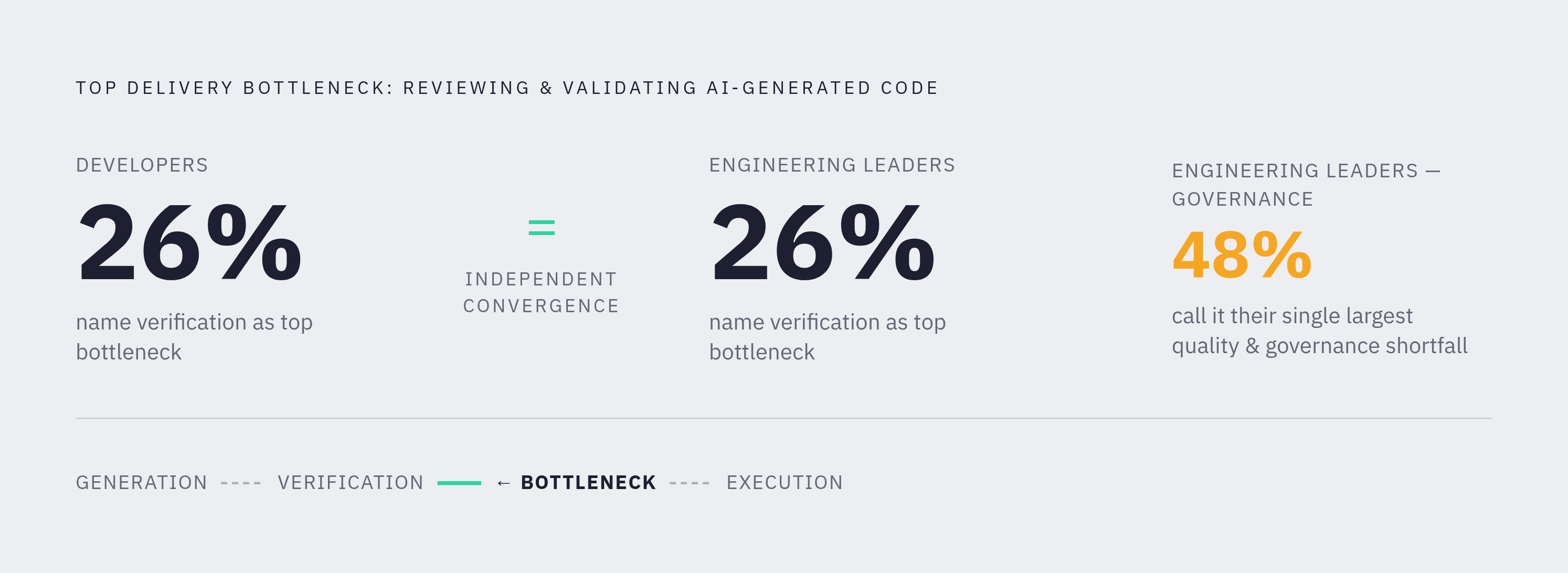
The data on where teams say they're stuck confirms this directly, and it's notable that developers and engineering leaders land on the identical number from opposite vantage points. They agree on where the friction is, even though they're answering from different seats in the organization.
That convergence signals the answer is real rather than a symptom of shared bias. When two groups with different incentives, different daily workflows, and different accountability structures land on the same answer, it's a strong signal the answer is real rather than a symptom of one group's particular complaint. Verification, not generation and not execution, is where the agentic pipeline actually slows down. Reviewing and validating AI-generated code is the top delivery bottleneck for both developers (26%) and engineering leaders (26%), converging on verification, not execution, as the constraint. 48% of engineering leaders name reviewing and validating AI-generated code as their single largest quality and governance shortfall.
Requirements for effective test case generation when AI agents write the code
Independence between the agent that implements and the agent that evaluates is the structural requirement the whole problem reduces to. It's the structural requirement the whole problem reduces to. The verifying agent has to sit outside the context, the training assumptions, and the requirement interpretation of the agent that wrote the code. Otherwise verification is just generation, run twice, dressed up as a second opinion.
On the requirement side, test cases need to be built from explicit statements of product intent that a human has actually reviewed and approved, not inferred backward from whatever the AI-generated code happens to do. That ordering matters more than it sounds like it should. Intent has to be the input that shapes the test, never the output the test derives from the code after the fact. Generate a test from the code, and all it can ever tell you is whether the code is internally consistent with itself.
On the environment side, the same logic applies to deployment conditions. Test cases need evaluation against conditions that resemble the real world the software will actually run in, real devices, real network variability, real user behavior patterns, beyond the internal model the coding agent used while it was writing the implementation. An agent's internal environment model is, by definition, a simplification. Testing exclusively against that simplification just re-confirms the simplification.
Architecturally, this points toward a specific division of labor: a planning agent, distinct from the implementation agent, that analyzes requirements, tracks code changes, and reasons about risk in order to determine what actually needs testing. Test prioritization, under this model, is a reasoning task in its own right, not something that falls out automatically as a byproduct of writing the code. Treating it as a byproduct is precisely how the planner-coder gap re-enters the pipeline through the back door.
The sharpest form of the test generation and maintenance problem in mobile app pipelines
Mobile is where every piece of this argument gets harder all at once, because mobile quality was never a single-dimensional problem to begin with. Building for one tends to leave blind spots in the others.
Device fragmentation makes the model gap concrete in a way that's hard to overstate. Thousands of device variants, spread across multiple hardware manufacturers, running fragmented and unevenly updated operating system versions, mean the gap between whatever environment a test suite runs against and the real deployment world is structurally wider in mobile than it is in web or server-side software. A test that passes cleanly on the reference device tells a team comparatively little about how the same feature behaves on the long tail of devices actual users carry.
Release velocity then compounds the fragmentation problem instead of easing it. Top App Store apps ship updates roughly every two weeks; the maintenance tax on a mobile test suite compounds at a pace that matches, or outruns, how fast AI is generating the underlying code changes. There's no slow season in mobile release cadence to catch the test suite up.
Security adds a final layer that agentic test generation is particularly badly suited to catch on its own. Following the 2025 OWASP updates, supply chain weaknesses, compromised dependencies, tampered builds, insecure CI/CD pipelines, moved to the center of the mobile attack surface. Test cases need to cover exactly that ground, but these are systemic, context-dependent requirements. An agent generating tests by reading surface-level code has no way to derive them independently, because the risk doesn't live in the code it's looking at. It lives in the pipeline and the dependency chain surrounding that code, which is precisely the kind of context a single generating agent was never given visibility into.
The operational model for governing test generation and maintenance under agentic conditions
Quality standards need to become explicit, versioned artifacts that a human has actually signed off on, not tribal knowledge sitting in someone's head or conventions an agent inferred on its own from whatever code it happened to see. Those standards, defined ahead of time and written down, become the canonical input against which all test generation gets measured. Skipping this step leaves nothing stable for any later verification effort to check against.
Generation and verification need to be separated as distinct structural roles, not just as a matter of organizational preference. The agent or system that writes the code should never be the same agent or system that decides whether the code is correct. Independence here is the actual mechanism that makes verification meaningful; without it, the word "verification" describes something closer to a formality.
Coverage numbers stop being the right thing to gate on once the tests themselves come from AI. A coverage percentage generated against AI-authored tests measures whether the tests are internally consistent with the code, which is not the same thing as measuring whether that code does what the product was actually supposed to do. The gate that actually matters is whether the tests trace back to an explicit, human-approved statement of intent and hold up against conditions that resemble real deployment, not whether a percentage on a dashboard looks reassuring.
Test maintenance, finally, has to be treated as a continuous, closed loop rather than a one-time build. Deployment feedback, production crashes, App Store or Play Store rejections, user-reported failures, needs to flow back into the requirement definitions and the environment models that shaped the original tests, beyond isolated script fixes that patch one symptom without touching the assumption that produced it. Closing that loop is what keeps the test suite honest as the code underneath it keeps moving. If it is left open, the gap the tests were supposed to catch widens quietly, one release at a time. 89% of organizations report having had an AI-related production incident (Qodo 2026 State of AI Code Quality Report) https://www.qodo.ai/blog/state-of-ai-code-quality-report-2026/. Only 3.7% of engineering leaders say their existing processes are sufficient to maintain quality and governance as agents take on more work (Qodo 2026 State of AI Code Quality Report) https://www.qodo.ai/blog/state-of-ai-code-quality-report-2026/. 26% of developers rank reviewing and validating AI-generated code as the top bottleneck preventing AI from accelerating software delivery (Qodo 2026 State of AI Code Quality Report) https://www.qodo.ai/blog/state-of-ai-code-quality-report-2026/. 48% of engineering leaders cite reviewing and validating AI-generated code as the most cited quality and governance gap (Qodo's State of AI Code Quality Report) https://www.globenewswire.com/news-release/2026/09/23/3367496/0/en/qodo-s-2026-state-of-ai-code-quality-report-reveals-growing-verification-challenge-as-agentic-development-scales.html. 66% of developers cite AI solutions that are almost right, but not quite as their primary frustration (Stack Overflow 2025 Developer Survey) https://testquality.com/agentic-sdlc-guide-build-test-verify-ai-generated-code/. Adding explicit verification phases yields a 15.6% improvement in agentic task success rates (MAST / arXiv 2503.13657, NeurIPS 2025) https://testquality.com/agentic-sdlc-guide-build-test-verify-ai-generated-code/. Properly orchestrated systems show 3.2x lower failure rates than unstructured multi-agent environments (Galileo, 2025) https://testquality.com/agentic-sdlc-guide-build-test-verify-ai-generated-code/. 90% of engineering leaders are confident reporting AI's impact to executives or the board (Qodo 2026 State of AI Code Quality Report) https://www.qodo.ai/state-of-ai-code-quality-report/.
Sources
- The 2026 State of AI Code Quality Report: Verification Is the New Bottleneck
- State of AI Code Quality Report
- The Agentic SDLC: Build, Test & Verify AI Code in 2026
- Reality Is the Final Verifier: On Two Key Gaps in Agentic Software Engineering
- Qodo’s 2026 State of AI Code Quality Report Reveals Growing Verification Challenge as Agentic Development Scales
- Learn: Software Testing 101