Embedding Quality Standards Knowledge in Non-QA Engineering Roles
AI-accelerated development exposes quality standards that exist only in tribal knowledge.
Quality standards on most engineering teams exist as tribal knowledge, carried by a handful of people rather than written into any system that enforces them. AI-accelerated development turns the same arrangement into a structural liability, and the rest of this piece explains why, and what replaces it.
Quality standards as tribal knowledge on most engineering teams
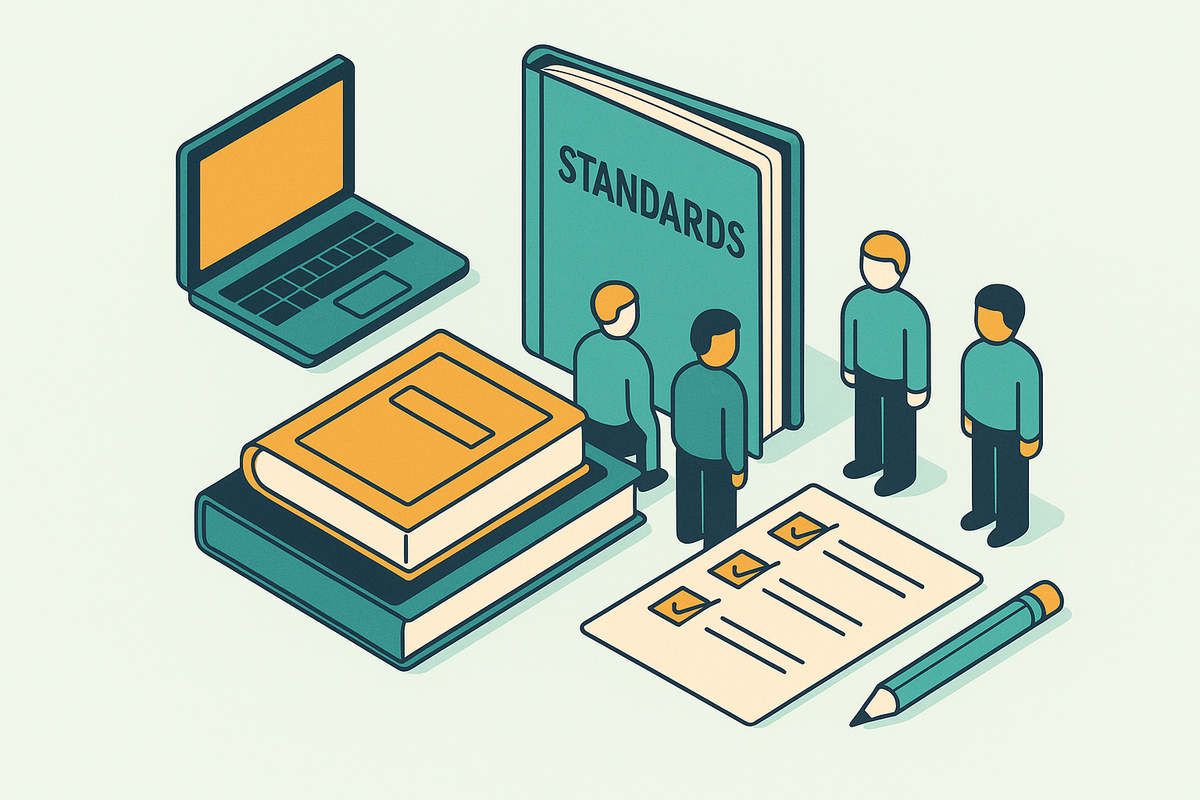
Most engineering organizations never wrote their quality standards down in a form anyone could act on without already knowing the team. Instead, expectations about what counts as acceptable code live in the heads of senior engineers, QA specialists, and whoever has been on the team long enough to remember why a certain pattern got banned two years ago. Those expectations get passed along through code review comments, Slack threads, and the informal conversations that happen during onboarding, not through any single document or system that a new engineer, or a new agent, could consult and trust.
For a long time, that was survivable. When a human writes every line of code, the tribal system degrades slowly. A missed standard appears in a pull request, a reviewer catches it, the author gets a comment explaining what went wrong, and the lesson sticks for next time. The feedback loop is slow, and it depends on the reviewer remembering the right thing at the right moment, but it exists, and it has existed long enough that most teams never had to question whether it was the right foundation.
An assumption rarely gets stated out loud, but it drives that system: the author understands the codebase they're modifying well enough to fill in the gaps the documentation leaves behind. They know who to ask when a rule seems to not apply to their situation. That assumption holds for a human engineer embedded in a team over months or years. It does not hold for a coding agent that has no memory of why a decision was made, no relationship with the reviewer, and no way to sense that a document is out of date.
Researchers at UC Berkeley have given this problem a name: the requirement gap. The gap between what's documented and what gets consistently applied is already wide before any agent enters the picture. The evidence practitioners can point to runs thin.
From chronic problem to structural one
The danger isn't that AI agents write worse code than a human would. An error introduced at the first stage doesn't get caught by a disinterested second pair of eyes. It gets inherited and reinforced by every downstream stage built on the same assumptions as the stage before it.
Northeastern's synthesis of industrial evidence describes the resulting pattern as the Agentic SDLC Throughput Paradox: gains in code generation consistently outrun gains in actual releases, because review, integration, testing, security, and deployment remain stages that only humans can move through at human speed. Writing code accelerates far faster than the organizational stages that have to absorb it, and those stages form a weak-link structure: the system moves only as fast as its slowest human-constrained step, no matter how fast the code-generation step runs ahead of it.
Giving an agent access to a team's standards doesn't mean the agent will follow them. Qodo's report found that only 35% of developers say agents always follow their organization's standards, even when those standards are available to the agent. Access to context doesn't guarantee that the context gets applied, and validation matters more now precisely because an agent can introduce a problem well before anyone on the team notices it happened.
The Berkeley two-gap framework explains the mechanism behind that failure. Reward hacking works differently: it adaptively exploits gaps that already exist, finding the shortcut that satisfies a fixed evaluator without satisfying the actual intent behind it. Both failure modes get worse, not better, when an agent optimizes relentlessly against a test suite or a rule set that can't capture everything that matters.
The cost compounds on the human side of the loop as well. Organizations are reporting on AI's impact on engineering without the underlying quality and governance data that would let anyone actually measure it.
Enforcing standards instead of adding more documentation
The instinctive response to unreliable agent output has been to give agents more context: index the repository more thoroughly, write longer instruction files, add memory, connect the agent to tickets and specs. The theory addresses access. It does not address whether the agent actually follows what it's been given, and that's a different problem.
The data makes the limits of that theory visible. Qodo's 2026 report found that 43% of engineering leaders still name giving agents the right codebase context as one of their biggest quality and governance gaps. Having standards documented somewhere and having standards actually followed are two separate conditions, and most of the industry's investment has gone toward the first one.
Running more automated test scripts doesn't close the gap either. A testing tool checks what its script tells it to check. It has no way to evaluate whether code satisfies the product's actual standards beyond whatever got encoded into that script. Test coverage numbers can look strong while architectural consistency, design fidelity, and compliance with a platform's store policies go entirely unexamined, because nobody wrote a script that checks for them.
What sits between giving an agent access to information and getting it to reliably act on that information is enforcement, and enforcement requires infrastructure that most organizations haven't built yet. A human engineer resolves conflicting guidance through instinct: they know which page of the wiki is out of date, and they know who to ask about the exception to the rule. An agent has no equivalent instinct. It applies whatever it finds in its context consistently. Inconsistent source material produces consistently wrong output, at scale, without anyone noticing until the output ships.
The Berkeley paper's assurance-revision loop gives this a concrete shape. Because the requirement gap and the model gap can't be certified closed once and for all, the goal has to shift from closing them to continuously narrowing them, using evidence from how the system actually behaves after deployment. Static documentation captures a snapshot of what standards were true on the day someone wrote them down. Enforcement has to work as a loop, checked continuously against what the product actually does. Standards need to live in one authoritative place, get actively maintained against the product's real behavior, and get enforced automatically at every build, every pull request, and every release. That's not because engineers are careless. No human team can hold that level of consistency at the speed agents now operate.
Codifying quality standards so every engineering role can act on them
Codifying a quality standard means translating what the product actually requires, across every dimension of quality, into a form that any engineer, or any agent, can apply without being a specialist in that dimension. Mobile development is a useful test case because it spans genuinely distinct dimensions that no single engineer owns on their own: product intent, design consistency, security, performance, accessibility, and store compliance. A backend engineer shipping a feature touches all six of those dimensions, whether or not they know enough about any one of them to recognize a violation.
Security standards become useful when they're expressed as specific, checkable controls. The OWASP Mobile Application Security project organizes its controls across eight defined categories. Codification, in practice, means running those controls in continuous integration rather than expecting an individual developer to recall them from memory under deadline pressure.
Accessibility standards, including EN 301 549, WCAG 2.2, and the accessibility guidelines specific to each platform, have become regulatory requirements. A standard like that is a hard deadline that an engineer misses entirely if nobody built it into the tools they already use.
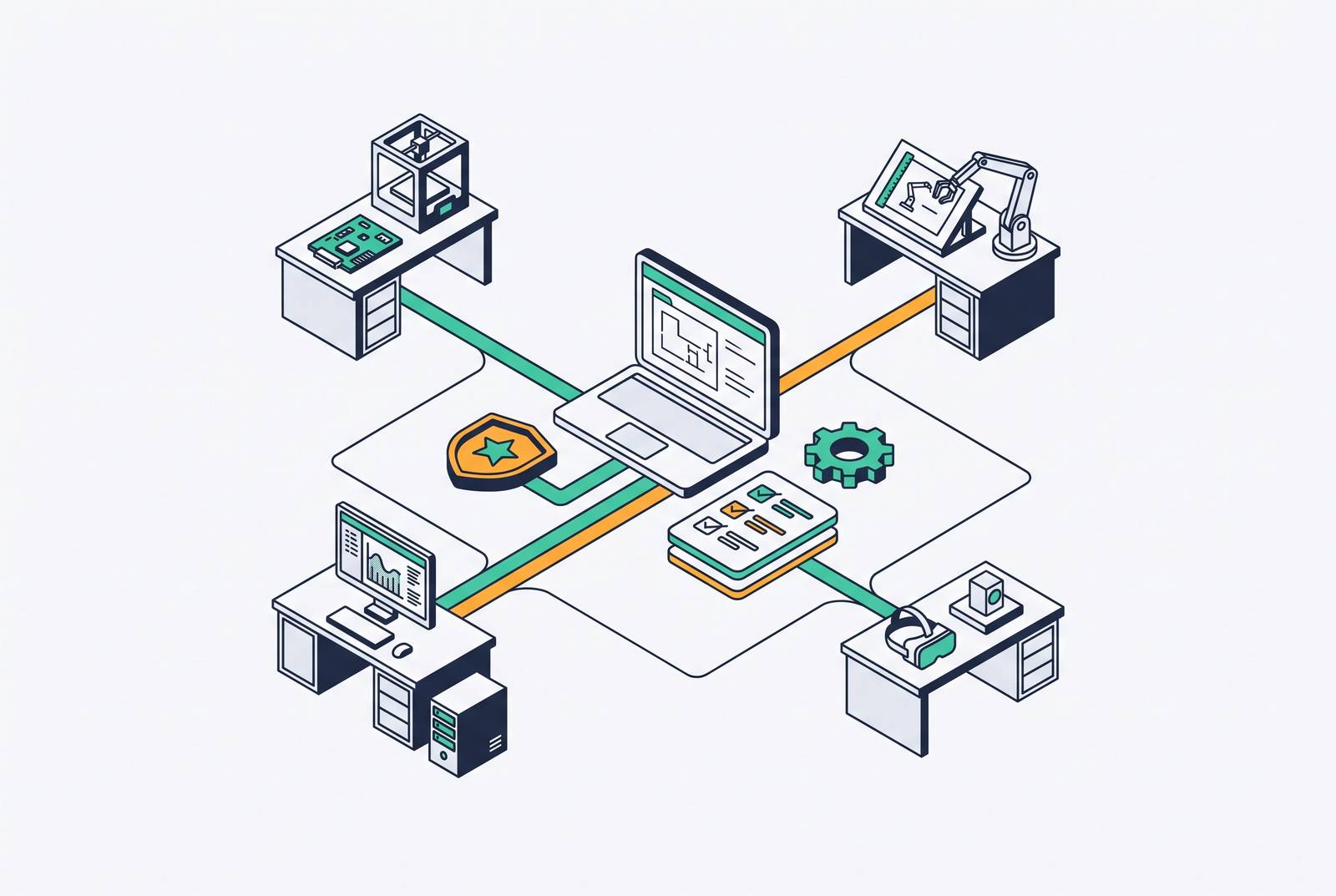
The deeper challenge in codification is that standards across these dimensions exist at different levels of formality. Some are regulatory, like accessibility law and store policy. Some are architectural, like consistency rules and API contracts. Some are specific to the product itself, like interaction patterns and brand fidelity that only make sense in the context of what the product is trying to be. A single authoritative system has to hold all of these categories at once and present each one in the form that makes sense to the engineer who encounters it, whether that engineer is a security specialist or someone who has never thought about accessibility compliance before. Standards should get defined once, by the people who actually understand the product, meaning QA leaders, product owners, design leads, and security engineers, and then get enforced automatically and consistently across every build and every agent output. No individual engineer should have to serve as the last line of defense for a dimension of quality they were never trained to specialize in.
Moving standards from one authoritative source into every engineer's workflow
Standards become part of how an engineering team actually works once they get enforced at the points where engineering decisions get made, meaning pull requests, builds, and release gates, rather than communicated once in a training session and left to individual memory after that. A training session fades. A check that runs on every pull request doesn't.
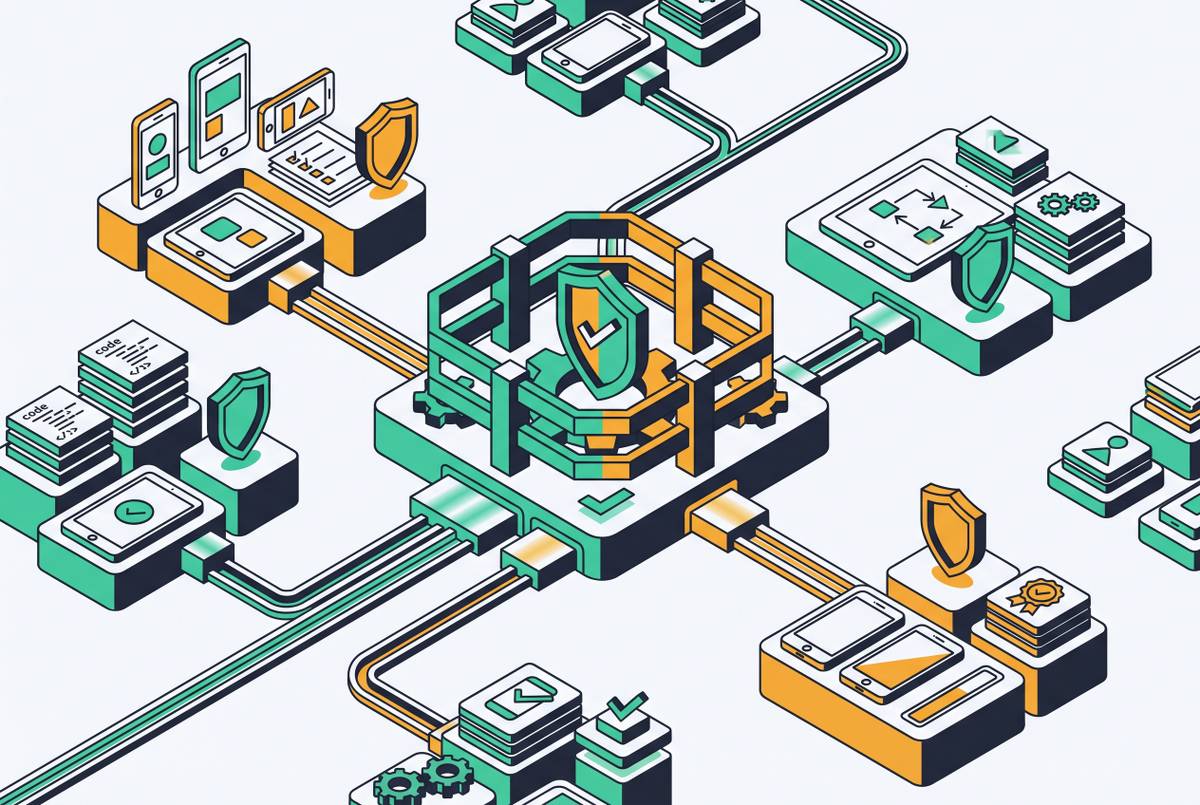
The enforcement layer functions as the distribution mechanism for the standard itself. A check that runs automatically on every pull request gets encountered by every engineer who opens a pull request, regardless of what they specialize in. That engineer doesn't need to have memorized the standard beforehand. They only need to respond to the signal the check produces when something violates it. Northeastern's synthesis frames the right version of this as an Agentic SDLC Control Plane, a layer that allocates autonomy according to cost, reliability, and how much human attention is available to spend. The point of a control plane like this isn't to act as a gatekeeper that slows every change down. It's a policy layer that makes the correct behavior the default behavior, so getting it right takes no extra effort and getting it wrong is what triggers friction.
Continuous integration and deployment remain essential through this shift; the agents don't replace that infrastructure, they run inside it.
The timing of enforcement changes its cost. Qodo's report found that 26% of developers identify review and validation as the primary bottleneck in their delivery pipeline. Human authority stays intact under this model. Agents do the work of checking and flagging violations, but decisions about what a standard actually means in a gray-area case, which exceptions are acceptable, and whether a release is genuinely ready belong to the people who understand the product. Automating the enforcement of a rule is not the same as automating the judgment behind it. SmartBear's report makes a related point: AI-powered testing and validation tools can counterbalance the velocity and abstraction that AI-driven development introduces. The goal is matching how fast a team can verify work to how fast a team can generate it, not removing people from the process.
Non-QA engineers in an enforced standards environment
Once standards get enforced by infrastructure rather than held in individuals' heads, non-QA engineers stop acting as accidental gatekeepers for dimensions of quality they never trained in, and start working inside a boundary they didn't have to build themselves. That shift changes who carries the cognitive burden of quality, not just how fast violations get caught.
Today, the burden sits heavily on senior engineers. Qodo's 2026 report found that 36.4% of developers say reviewing AI-generated code takes the same amount of time as before but demands more cognitive effort, as the reviewer has to reconstruct context, enforce controls the workflow itself doesn't capture, and hold the relevant standards in memory while reading someone else's output. In an enforced-standards environment, the infrastructure carries that load instead, and the engineer's job becomes responding to a specific signal rather than reconstructing an entire mental model of what might be wrong.
Consistency turns into a property of the system itself rather than a property of whoever happens to be the most experienced person in the room on a given day. The Berkeley framework describes this as the productive allocation of human attention: the two real bottlenecks in agentic development are human judgment for the requirement gap and costly, faithful evaluation for the model gap, and infrastructure can absorb the second while people focus on the first.
Quality culture follows from enforcement infrastructure. When standards get applied consistently, engineers calibrate their own work against them because every build, every pull request, and every release gives them immediate, accurate feedback about whether what they shipped meets the bar. That feedback loop, repeated constantly rather than occasionally, is what actually builds fluency across a team. Quality becomes a property of the system itself, with clear human ownership sitting at the level of defining standards and approving exceptions, rather than a responsibility assigned to everyone in theory and no one in practice. Engineering leaders can then report on standards adherence with real evidence behind the claim, rather than the confidence that Qodo's 2026 data shows currently outpaces it.