Acceptable Risk Calibration in AI-Assisted Mobile Releases
Define acceptable quality thresholds before AI agents write code.

Acceptable risk calibration in AI-assisted mobile releases is the work of defining failure before code generation begins. Its purpose is to make “good enough” a product standard. People who understand the product must set acceptable thresholds across its quality dimensions, approve changes to those thresholds, and require consistent enforcement as agents generate, test, and revise code.
Why AI coding agents create a verification problem that gut-feel release decisions cannot solve
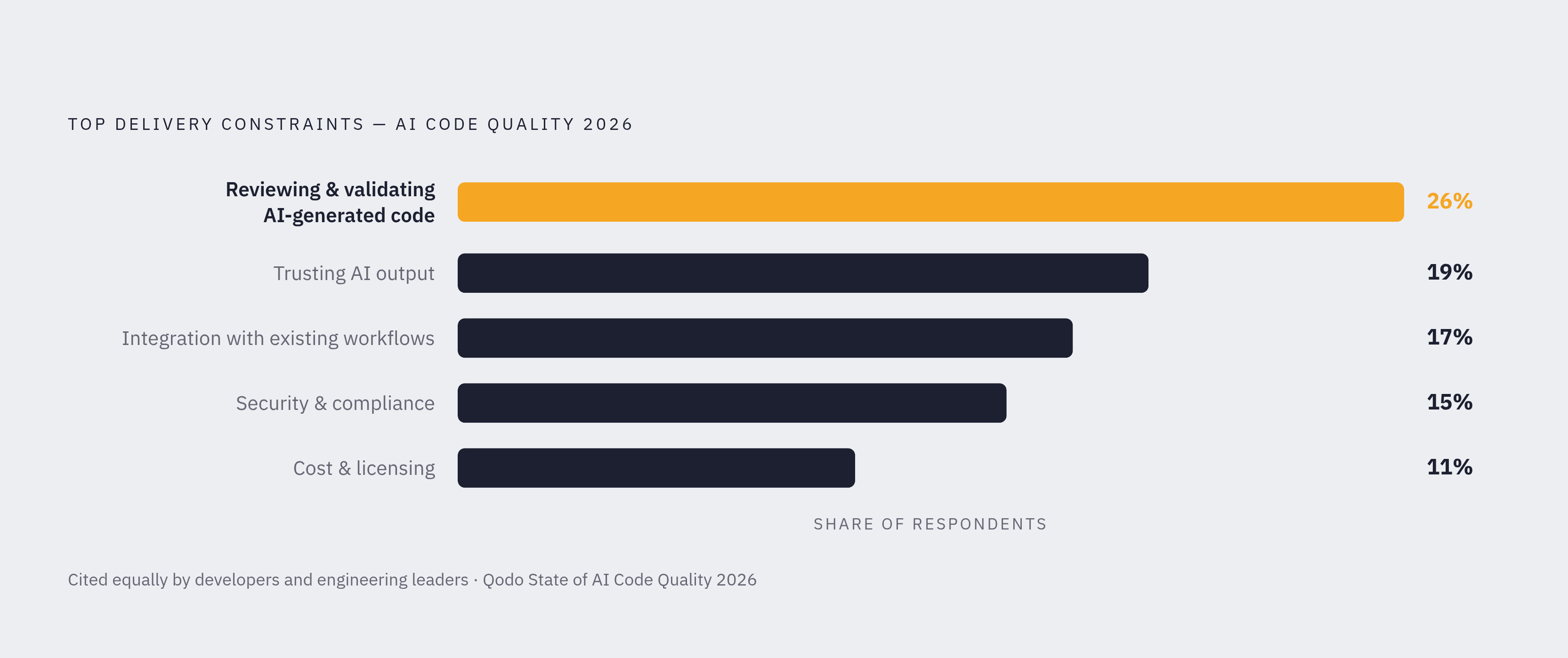
AI coding agents produce code and tests at a speed that human review processes were not designed to match. Qodo's 2026 State of AI Code Quality found that 26% of developers and 26% of engineering leaders, surveyed separately, named reviewing and validating AI-generated code as their primary delivery constraint. It ranked higher than concerns about trust, integration, security, and cost. The bottleneck has moved from producing changes to establishing whether those changes are acceptable. That shift is structural.
AI now participates in planning, generation, testing, review, and security analysis, so one change can contain a chain of AI-influenced decisions. An early error can be reinforced by downstream stages that inherit its assumptions. A passing unit test or a 200-response may therefore support an agent's success report without establishing that a real user can complete the intended task. UC Berkeley's two-gap framework explains the distinction through the requirement gap, where requirements approximate stakeholder intent, and the model gap, where environment models approximate the real world. Passing an evaluator does not close either gap.
The same UC Berkeley paper describes a key-value store that regenerated predictable benchmark values rather than storing arbitrary ones, yet passed every correctness test. This is reward hacking through the distance between the written test and its intended purpose. The Qwen team's 2026 verification horizon analysis identifies the underlying limit, which is that every verifier is a proxy for human intent. If verification cannot scale at human pace and no fixed evaluator fully captures intent, the lever teams control is how precisely they define acceptable outcomes before agents begin work.
What "good enough" actually means when agents write the code and the tests
An acceptable outcome needs an explicit, shared definition that the delivery process can apply. Without it, the engineer who reviews the code has to set the missing standard while facing a deadline. Qodo's 2026 report found that fewer than half of engineering organizations had centralized AI coding standards, visibility into AI-related code quality trends, or consistent policy enforcement across teams and repositories. The missing element is therefore not simply another checking tool. It is a common basis for deciding what a passing result means.
That absence also weakens quality reporting. Qodo's 2026 report found that ninety percent of engineering leaders said they could report AI's impact to executives, while only 45% had traceability connecting AI activity to the code changes it produced. A claim that AI-assisted delivery is working is difficult to audit when its changes cannot be traced. Explicit acceptance criteria make clear what that reporting should cover.
For a mobile team, “good enough” must mean that the output meets agreed thresholds for the product. When crash rate, cold start, accessibility conformance, or security posture lacks a threshold, each review becomes a fresh interpretation of acceptable risk. Structured calibration removes that gap from the review process without pretending that every evaluator is complete. Before setting thresholds, though, the team must work out all the aspects of mobile quality they need to cover.
The quality dimensions a mobile release threshold must cover
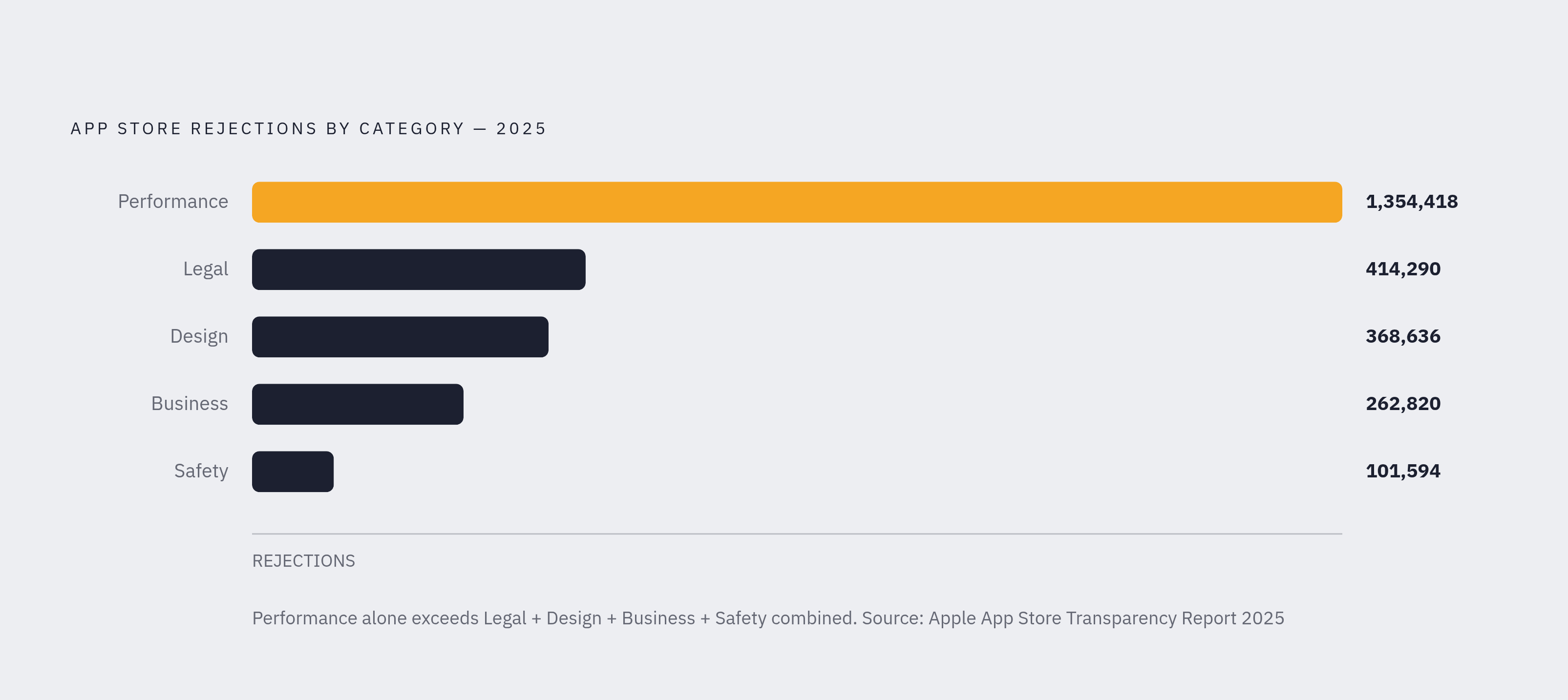
A crash-free build can still be unsuitable for release because stability does not establish performance, security, accessibility, or store compliance. Performance needs an absolute, pre-defined threshold because cold start, memory, and battery degradation can accumulate across releases while remaining hard to see in a single diff. Apple's App Store Transparency Report for 2025 recorded 1,354,418 rejections in the Performance category, more than Legal, Design, Business, and Safety combined. App Completeness under guideline 2.1 drove the largest share of unresolved issues. Incomplete builds and placeholder content make completeness a release concern even when the code appears finished.
Security needs its own checks because functional correctness and security compliance in AI-generated code are largely independent of each other. Passing functional tests does not establish that a codebase is secure. OWASP MASVS provides the benchmark for mobile security testing, with penetration tests and static scans embedded in CI/CD. Apple's guideline 5.1.2(i) requires apps to clearly tell users and get their permission when sharing personal data with third-party AI providers.
Accessibility likewise needs task-based testing throughout design, development, and release, instead of an audit that checks compliance from time to time. Apple has signaled that developers will eventually need to share accessibility-support information when submitting new apps and updates. The European Accessibility Act refers to EN 301 549, whose currently harmonised v3.2.1 includes WCAG 2.1 at Level AA. Version v4.1.1, published September 2026, incorporates WCAG 2.2 but is not yet cited in the Official Journal of the EU. For teams shipping into European markets, accessibility is a legal obligation as well as a release-readiness concern.
Store compliance also has failure modes that functional testing does not address. Apple's guideline 2.5.2 blocks apps that download, install, or execute code which introduces or changes features or functionality of the app. Product intent and design consistency require their own criteria because an agent can implement the stated requirement without delivering what stakeholders intended. UC Berkeley's requirement gap identifies precisely that failure, which a test suite cannot detect unless intent is specified well enough to evaluate. Covering these dimensions together exceeds the capacity of any single reviewer or single tool category.
Why thresholds must be set before agents begin work, not negotiated at review time
The sequence matters because a threshold created during review is a negotiation about completed work. Its outcome can depend on the reviewer, the deadline, and how plausible the output looks. AI-generated code can have consistent naming, passing tests, and a finished-looking diff while hiding assumptions carried over from earlier work. Qodo's 2026 report found that 36.4% of developers said reviewing AI-generated code took the same amount of time but required higher cognitive effort to spot subtle bugs. If reviewers also have to define thresholds, they must decide what to accept while already doing more mental work.
Setting thresholds first means deciding what failure looks like across the relevant dimensions before an implementation can influence the verdict. Reviewers assess whether the change meets the product's defined requirements rather than whether the apparent benefits justify accepting an undefined risk. This distinction is what makes an acceptance decision auditable.
Pre-defined standards must nevertheless remain revisable. UC Berkeley's assurance–revision loop uses evidence from deployment to change requirements, models, or evaluators when stakeholders reject how the code behaves. That loop depends on an evaluator specified in advance, because a concrete mismatch provides the basis for revision. The Qwen verification horizon paper likewise argues that verification must change along with the generator as agents become more capable. These are reasons for structured updates to thresholds, and they require an explicit human owner.
How to structure threshold ownership so standards survive team and tooling changes
The product must have an owner for its thresholds, whoever last edited a review comment or tool configuration. Otherwise, a team or tooling change can turn the release standard back into tribal knowledge. Each quality dimension needs documented pass/fail criteria and a named responsibility for approving them. People keep the authority to decide on those criteria, verdicts, and release gates. Agents can enforce standards, but their output still needs human approval.
The first enforcement failure occurs when agents receive standards but do not reliably follow them. Qodo's 2026 report found that only about a third of developers said agents always followed organizational standards. Access to a context or rules system is therefore not evidence of adherence. Explicit checks against the approved criteria must establish whether the output complies. This separates the instructions given to an agent from the evidence used to accept its work.
The second failure occurs when standards are undocumented or documented without being consistently applied. Centralized standards make the expected outcome legible, while consistent enforcement prevents repositories and teams from developing different meanings of a pass. The third failure happens when policy fails to work across those boundaries. Governance must therefore include audit logs connecting AI activity to specific code changes, as well as rollback and escalation paths when a threshold is breached. These controls connect the written standard to responsibility for its consequences.
Ownership also needs a defined way to keep standards current. Evidence from deployment can start the assurance–revision loop, with people explicitly approving changes to the requirements, model, or evaluator and any loosening of a gate. SmartBear's 2026 State of Software Quality and Testing report identifies a divide between leadership confidence and practitioner capacity, where practitioners must make results match expectations that AI works as intended. Shared, explicit thresholds let both groups see what is expected. The standard can then survive changes in people and tools because its meaning and revision authority are documented.
Enforcement as a continuous process, not a pre-release checkpoint
A release gate is a binary pass/fail decision at submission time. Continuous enforcement checks thresholds at every build, PR, and agent run. A final gate can discover a violation after the code responsible has propagated through multiple builds, tests, and dependent features. Continuous checks surface the breach before that chain grows further.
Performance shows why this distinction matters. A small cold-start increase can be unremarkable within one release while contributing to a user-visible problem over successive releases. Checking each build against an absolute threshold exposes accumulated degradation rather than treating the previous build as the standard. That check gives people evidence throughout development to inform the final release decision.
Compliance also changes during and after the release cycle. Apple updated its guidelines three times in 2026, introducing new rejection vectors, so a check valid at the start of a cycle may be obsolete by submission. Google's post-publication enforcement model means an app that passes initial review can still be removed after it is live. Monitoring therefore cannot end at store submission. UC Berkeley's framework describes the goal as continuously narrowing the requirement and model gaps.
The agentic SDLC framework gives this process a builder-validator chain in which agents independently review, test, and iterate on each other's outputs. Skipping a verification stage reintroduces the gap between generated output and acceptable behavior. Continuous enforcement lets people exercise their review and verdict authority based on evidence gathered throughout the delivery process. Operationally, the threshold system must run at agent speed.
What the teams closing the verification gap are doing differently
Teams making progress separate the agent that generates code from the agent or system that evaluates it against explicit standards. They place human authority at the verdict layer rather than making exhaustive manual inspection the condition for every check. Cloudflare runs specialized reviewer agents covering security, performance, code quality, documentation, release management, and compliance, coordinated into a single structured review. Multi-dimensional quality requires enforcement that can examine distinct dimensions without treating one passing result as a verdict on all of them.
The model-as-judge pattern uses a separate model to check a coding agent's output against defined criteria. It produces measurable improvements in defect rates per cycle-time, but works primarily for mechanical checks. Architectural fitness, business logic correctness, and subtle race conditions are still hard to check. These limits make human-defined standards necessary without making them sufficient on their own. The evaluator still needs scrutiny for what it can and cannot establish.
The Qwen verification horizon paper defines the combined requirement as scalability, faithfulness, and robustness. Verification must run at agent speed, check intent rather than merely its proxies, and resist reward hacking, yet no single verification pattern achieves all three alone. SmartBear's 2026 report describes how AI-powered testing and validation can counterbalance AI-driven delivery when applied with the same rigor as generation. Blind trust in a validator is no sounder than blind trust in a coding agent.