Hiring QA Leaders for Agentic Mobile Engineering Organizations
AI-generated code demands a new kind of QA leader.
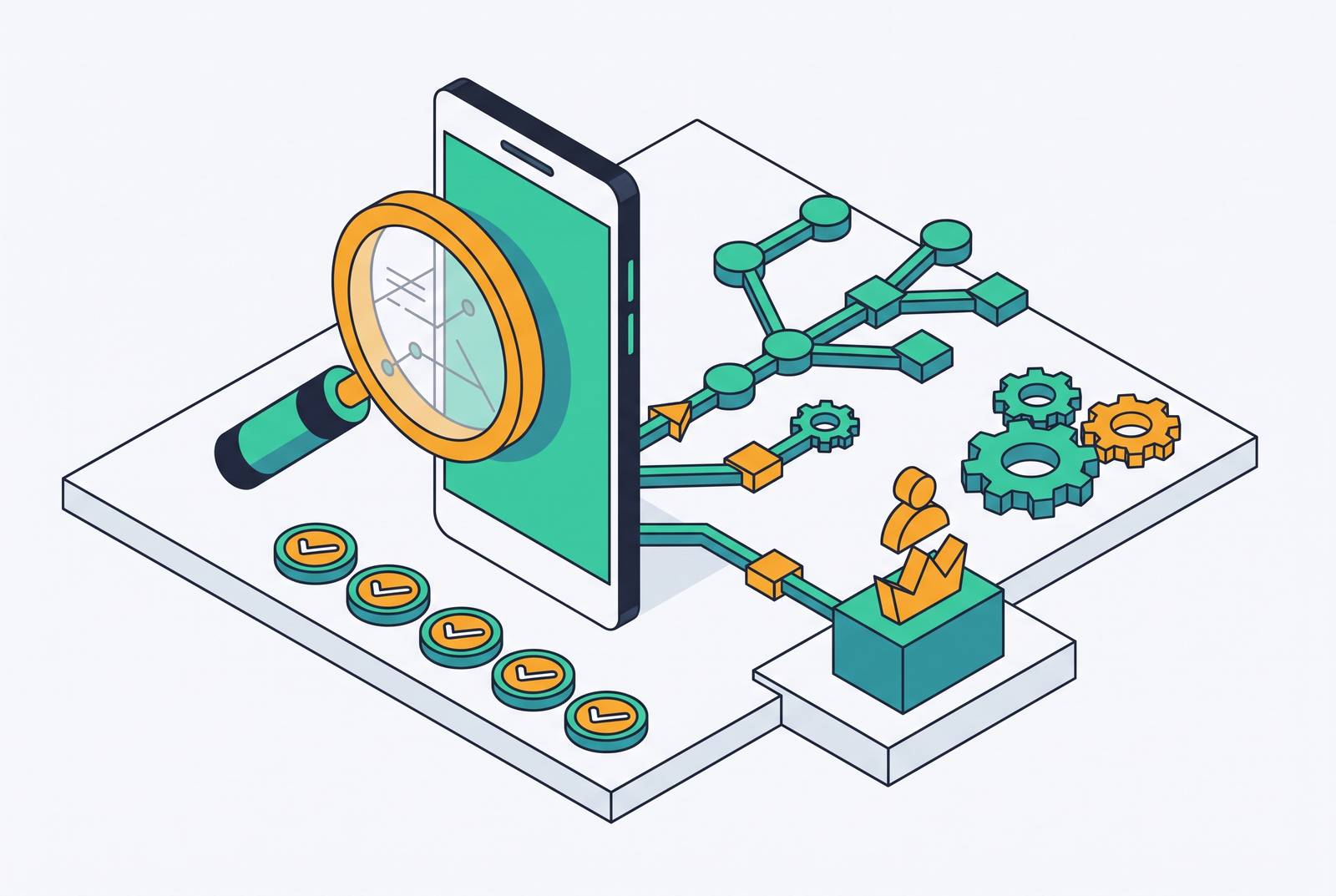
Hiring a QA leader for an agentic mobile organization is not a scaled-up version of a search you've run before. The old job description assumed humans write code at human speed and a QA team can keep pace with what ships, and that assumption no longer holds. Qodo's 2026 State of AI Code Quality Report found that reviewing and validating AI-generated code is now the single top delivery bottleneck, named by developers and engineering leaders alike at 26% each, a convergence close enough to call agreement. AI now touches planning, coding, testing, review, and security on the same change, so one decision made badly at the planning stage travels downstream and gets reinforced at every stage that inherits it. Mobile makes the problem worse, not easier: the same verification challenge now has to run against hardware fragmentation, OS version spread, interruption states, and app store compliance gates that no agent can clear on its own. The organization isn't looking for someone to run a bigger test team. It needs a leader whose job is to build and own a verification system, not a backlog of test cases.
Inside the Mobile Engineering Organization
The gap between how fast code ships and how fast anyone can confirm it's correct appears concretely, in the review process rather than as a test coverage number that's a few points low. AI-generated code tends to look finished: clean formatting, consistent naming, passing tests, an implementation that reads better than a rushed human draft. None of that tells a reviewer which alternatives the model considered or whether anyone on the team actually understands every decision baked into the diff. Qodo's report found that reviewing AI-generated code takes about the same clock time as reviewing human-written code but demands more cognitive effort to get through, a cost that lands squarely on whoever has to sign off that the code is correct.
The defects that make it past this kind of review have a particular shape. They're logic errors, unhandled edge cases, duplicated code, and regressions in parts of the system the change didn't appear to touch, the kind of gray failure that compiles cleanly, passes a surface check, and still violates what the business actually needed the feature to do. On mobile, the failure modes widen further. A coding agent has no way to confirm its own output respects platform accessibility APIs, satisfies OWASP MASVS security controls, hits cold-start performance thresholds on real devices, or meets the App Store's current review criteria, and each of those is a hard gate standing between the build and a release.
The agentic SDLC framework points to the handoff between planning and coding agents, the planner-coder gap, as the most consequential failure point in the whole chain, because a semantic breakdown there happens before a single line of code gets written. Failures that start this early are structurally invisible to conventional test automation, which only sees the code that results, not the misunderstanding that produced it. The governance data makes the problem harder to miss: only 45% of engineering leaders in Qodo's 2026 report have traceability connecting AI activity to the code changes it produces, and fewer than half have centralized AI coding standards, visibility into AI-related quality trends, or consistent policy enforcement. Whoever takes the QA leader role inherits this gap with no existing scaffolding built to close it.
Why the traditional QA leader profile fails this environment
The conventional QA leader built a career on owning test execution, building and running a team that wrote, ran, and maintained test cases against a known release cadence. That skill set assumed the constraint was throughput: more testers, more test cases, more coverage, keeping pace with what engineering shipped. In an agentic pipeline, agents increasingly do the mechanical work of running tests, and the real constraint has moved upstream to a harder question: are the right things being verified at all, and can the verification itself be trusted?
The enforcement gap is structural: only 35% of developers in Qodo's 2026 report say agents always follow organizational standards, and writing down a standard doesn't make an agent follow it, because an agent has no way to resolve conflicting guidance, recognize which documentation has gone stale, or understand when an exception applies. A QA leader whose first move is to write more test scripts is solving the wrong layer of the problem. The shortage isn't tests, it's standards that are owned, centralized, and written in a form agents can act on reliably.
Adding headcount doesn't close this gap either. AI coding tools can multiply feature output well beyond what a fixed team of human reviewers can keep up with, no matter how many reviewers get added to the roster. The conventional QA leader also tends to treat mobile quality as one dimension, pass or fail, when it actually spans product intent, design consistency, security, performance, accessibility, and store compliance at the same time, each needing its own expertise and its own enforcement mechanism. A leader built for a single pass/fail gate is not equipped to run six gates running in parallel.
The new scope: what a QA leader in an agentic mobile organization owns
The QA leader's product is a verification architecture: the standards, gates, agent configurations, and human checkpoints that together define what "good enough to ship" actually means and make that definition stick across every build. That architecture has specific parts, and each one needs a direct owner.
Quality standards governance sits at the center of it. Expectations need to be written once, in a form both humans and agents can act on, and enforced automatically across every build, PR, and release, and the QA leader is the person who owns that definition and keeps it current. That means writing acceptance criteria precise enough for an agent to evaluate against, not criteria vague enough to pass a tired human glance at the end of a sprint. It also means treating the specification as a living document, updated as the product changes, rather than something reconstructed from memory during a review meeting.
Human authority over release gates is the piece no agent can hold. The QA leader has the authority to say a build does not ship, based on evidence the system assembled, not a gut feeling under deadline pressure. The agentic SDLC framework states that agents produce artifacts, deterministic checks validate them, and human reviewers keep approval authority. The QA leader is the person that framework points to when it says "human reviewers."
Mobile quality spans several dimensions at once, and the QA leader has to hold or credibly govern all of them. Security means working knowledge of the OWASP MASVS control groups, including MASVS-STORAGE for secure local data, MASVS-NETWORK covering certificate pinning, MASVS-AUTH for authentication and session handling, and MASVS-CODE for secure coding practices, built into CI as a structured checklist. Accessibility means continuous, task-based testing threaded through design, development, and release, not a periodic review, measured against WCAG 2.2 criteria that include touch target sizing, alternatives to dragging gestures, and accessible authentication methods. App store compliance is a hard release gate the QA leader owns directly. The most common rejection reasons, incomplete or buggy builds under Apple's Guideline 2.1, inaccurate metadata under Guideline 2.3, and mismatched data safety declarations on Google Play, are all testable before a build is ever submitted, which makes a rejection a QA failure. Data showing that 63% of iOS developers hit at least one App Store rejection in the past year gives that failure a real cost.
Finally, the QA leader orchestrates a bench of specialized verification agents rather than managing human testers alone, configuring and directing agents across these different quality dimensions and holding the authority to override or escalate what they conclude. The agentic SDLC framework found that adding explicit verification stages improves agentic task success rates by 15.6%, which makes this an architectural decision with a measurable payoff, not a matter of process preference.
What to Screen for in Candidates
The right candidate asks how verification works at scale and who owns each piece of it before asking what test cases the team needs next quarter. That ordering of questions is the tell.
Look for standards authorship, not standards execution. A candidate should be able to point to quality standards they wrote and enforced, not ones they inherited from a predecessor and ran against. Ask whether their acceptance criteria could be evaluated by someone who didn't write them, or whether the standard only made sense to its author. Ask how they kept a standards document alive and current rather than treating it as a one-time deliverable that gathered dust after the kickoff meeting.
Probe for verification architecture fluency. A candidate should be able to explain the conceptual distinction between a script that runs a test and a system that enforces a standard. Ask how they'd design a chain where agents produce artifacts, deterministic checks validate them, and humans hold the review gate, and where exactly they'd place that human checkpoint. Ask why they'd add a verification stage to a pipeline. A candidate who understands that explicit verification stages produced a 15.6% gain in agentic task success in the agentic SDLC framework is reasoning about architecture, not reciting process.
Test for mobile depth specifically, since this role is not a generalist QA leadership post. A candidate should speak fluently about the tradeoffs between XCUITest on iOS, Espresso on Android, and Appium for native, hybrid, and mobile web apps, and explain how the choice of framework affects flake rates and access to the view hierarchy. They should understand why real devices catch manufacturer skins, sensor behavior, and thermal throttling that emulators miss. They should hold working knowledge of OWASP MASVS, WCAG 2.2 mobile criteria, and App Store compliance requirements as things they can reason through, not items on a checklist they memorized for the interview.
Test for comfort holding authority under pressure. The release gate is a human decision in the end, and the right candidate has to be willing to hold that line against engineering or product pushing for a ship date when the evidence isn't there yet. Ask candidates to describe a specific time they blocked a release, then ask what happened next. The answer shows whether they treat QA authority as something real or as a suggestion everyone can override.
Test for the ability to configure and evaluate AI agents, not just use them. A candidate who has used AI tools to speed up their own work is in a different category from one who has designed how agents get scoped, evaluated at each step, and escalated when they fail. Ask for specific experience defining what a verification agent is responsible for, not just experience writing prompts for one. The governance numbers matter here: giving an agent more context doesn't guarantee it follows organizational standards, and the right candidate understands that gap and has a concrete strategy for closing it rather than assuming good documentation solves it by itself.
Finally, test for instinct across both ends of the pipeline. Mature mobile QA embeds testing into every commit on one side and monitors live traffic through canary releases on the other. A candidate should have real experience operating on both sides, not just experience catching problems before release.
Where Organizations Go Wrong in the Search
The most common mistake is screening for automation tool fluency when the role requires verification architecture thinking. A candidate who can rattle off every testing framework by name is not the same as one who can design the system that makes standards stick across a mobile org at scale, and the interview needs to tell those two things apart.
A related trap is mistaking AI tool experience for agentic system design experience. A candidate who has used Copilot to write test cases has not necessarily thought about how to scope, gate, and evaluate a multi-agent pipeline end to end. The vocabulary sounds the same in both cases. The underlying capability isn't, and a hiring panel that doesn't probe past the vocabulary will miss the difference.
The third trap is underweighting mobile platform depth in favor of general QA leadership credentials. Mobile quality is structurally different from server-side testing, and a candidate without a real-device testing strategy, hands-on experience with platform-specific frameworks, and working knowledge of app store compliance will find the mobile-specific failure modes opaque once they're on the job. A strong resume in general QA leadership doesn't substitute for that depth, and an organization that hires on the strength of the former while skipping the latter will find out the gap exists only after a release gets rejected or a silent defect reaches production.