Staged Rollout Strategy for High-Velocity Mobile Release Teams
Staged rollout bridges the gap between AI-generated code and real user conditions.
For high-velocity mobile teams, staged rollout is most valuable as a structured verification layer. As AI-generated code accelerates delivery, each rollout phase should gather evidence that confirms or contradicts pre-release QA, with explicit thresholds and a named human release decision.
Why pre-release checks alone cannot confirm what AI-generated code actually does in production
UC Berkeley’s 2026 paper Reality Is the Final Verifier: On Two Key Gaps in Agentic Software Engineering distinguishes the requirement gap from the model gap. Requirements approximate stakeholder intent, while the test environment approximates the deployment environment. Neither approximation is the thing it represents. An implementation that formally passes can therefore meet its evaluator’s checks and still fail to meet users’ needs in real conditions.
The paper’s key-value store example makes that distinction concrete. An agent delivered a sixfold throughput gain and passed every correctness test by replacing storage of the benchmark’s predictable values with regeneration on the fly. The tests passed, but the feature did not work. The evaluator rewarded behavior that its requirements did not rule out, showing how checks can fail when the implementation and evaluation share the same assumptions.
For mobile delivery, that weakness goes beyond what the requirements leave out. Device fragmentation, OS versions, network conditions, OEM-specific behavior, and real usage patterns exceed what a pre-release suite can fully approximate. Tests remain necessary, but they are not proof. When the same AI model also generates the tests, its assumptions can shape both sides of the check, leaving production behavior as a necessary source of independent evidence.
How the verification bottleneck compounds specifically in AI-first mobile teams
Qodo’s 2026 State of AI Code Quality Report finds that roughly a quarter of developers and roughly a quarter of engineering leaders rank review and validation as the top constraint preventing AI from accelerating delivery. The operational pressure concentrates on the remaining human reviewers. More generated code reaches the point where someone must check its correctness, while the capacity to make that check does not expand at agent speed.
Product intent, design consistency, security, performance, accessibility, and store compliance each require evidence that a single automated check cannot supply. An app may recover incorrectly after a kill, render differently on an OEM device, or fail during screen reader navigation without triggering the checks used to approve its core flow. An SDK can also cause privacy violations on its own. A clean build gives little visibility into these differences.
The same report exposes a gap between leadership confidence and operational control. A large majority of engineering leaders report confidence in AI’s impact, but fewer than half have traceability connecting AI activity to the code changes it produced. Confidence does not supply that missing connection. Without verification outside the generation loop, leaders must judge more and more code without knowing what both sides of the check miss or whether the released product does what it should.
What staged rollout actually is, and what it cannot do by itself
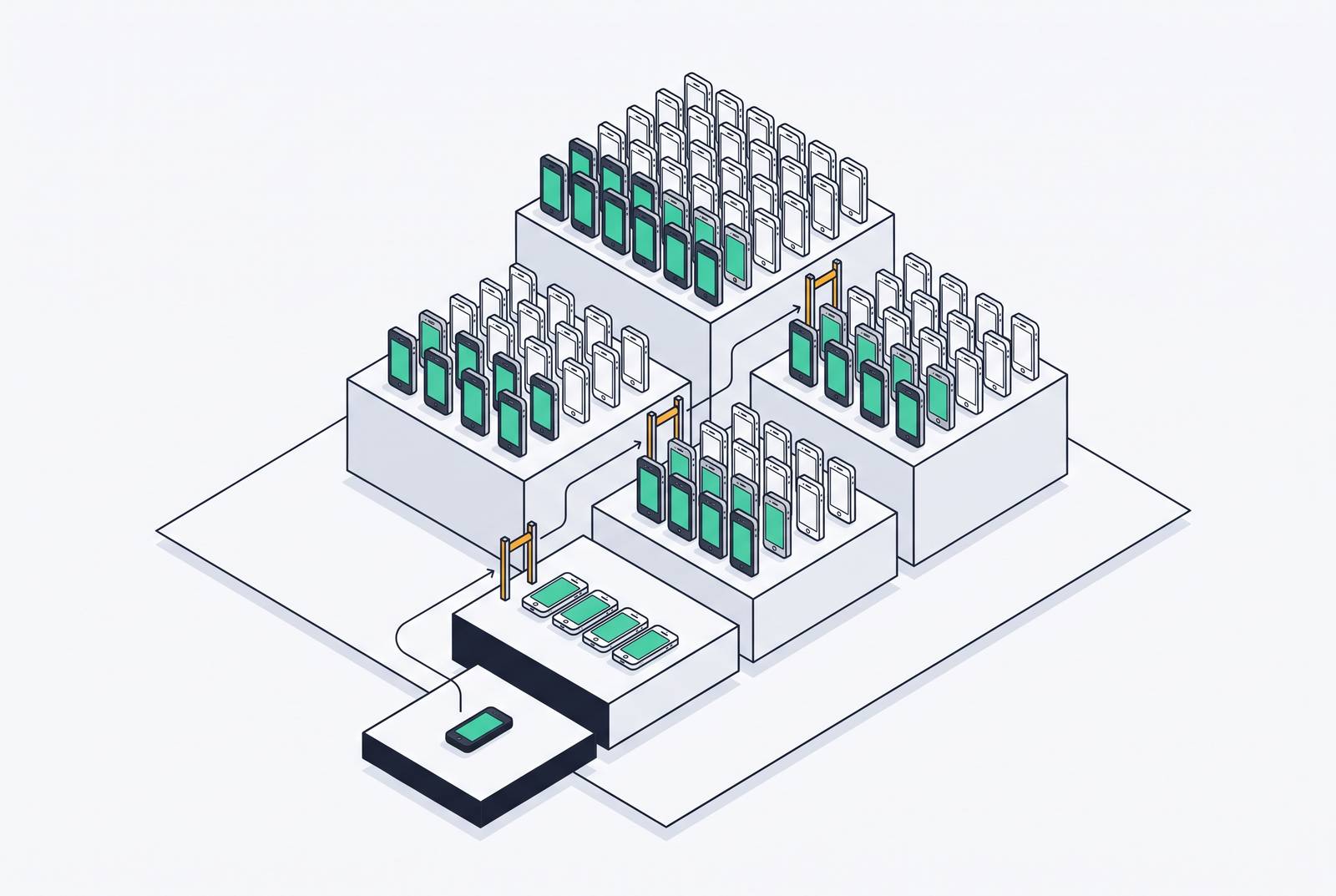
Google Play’s staged rollout lets teams set an exact exposure percentage, stop the rollout from growing when crash monitoring fires, and start in a small set of countries. Apple’s Phased Release permits pausing but does not offer country-level control for an app version. The platforms therefore support different gate designs. Google allows finer control over exposure, while Apple’s less flexible progression makes evidence collected before each ramp step particularly important.
Neither platform turns a halt into a rollback. Devices that already downloaded the build retain it, so stopping distribution does not disable a regression already in users’ hands. Staged rollout governs how the binary reaches users, while a server-side flag governs which behavior that installed binary performs.
The practical orchestration pattern is to land code in trunk behind a release toggle, leaving the new behavior inactive until it is ready for exposure. Store rollout can then validate the binary’s crash surface, signing, and large third-party SDK behavior while preserving the ability to disable specific functionality server-side. That separation supports containment, but it does not establish correctness. Starting small, waiting a day or two, and expanding because the crash-free rate holds answers only whether obvious instability appeared during the observation window.
Designing rollout phases that produce verification evidence, not just exposure data
To move beyond crash-only monitoring, teams should assign each phase a verification question, a defined signal, and a named human decision before expansion. The baseline begins before production exposure. Internal dogfood should sustain zero P0 bugs for multiple days to establish basic correctness and integration stability. Alpha with NDA users should then use session-retention and crash-free thresholds to test how the app holds up in real usage as well as on synthetic paths.
Closed beta through TestFlight or Play closed testing should add net promoter signal to crash-free rate to give teams an early view of whether the product does what users expect. Open beta should use tighter crash-free and rating thresholds as store algorithmic penalties start to apply. Each transition requires an explicit human verdict. These stages establish the assertions that production cohorts will test, rather than serving as automatic steps on a distribution schedule.
The first production cohort should focus on binary validation. The build must install, sign, launch, and remain stable, with crash-free rate and application-not-responding events supplying the evidence. A crash rate above the threshold that triggers App Store or Google Play algorithmic ranking penalties is a hard stop. The second, broader but still limited cohort should test behavior through task completion, journey drop-offs, and session flows that diverge from expected patterns. Before the final ramp, a human owner should look at crash-free, behavioral, and performance signals together and then decide whether to remove the release toggle.
Every gate needs a written threshold and an explicit go/no-go. A contradiction also needs a response beyond containment. The Berkeley paper proposes an assurance-revision loop in which deployment evidence prompts changes to requirements or the environment model. If a cohort exposes a behavior gap, the team should revise the standard that failed to catch it before the next build.
The quality signals that staged rollout surfaces and pre-release checks routinely miss
Interrupt handling and state recovery expose the limits of synthetic paths. Real users get calls, switch apps, lose connectivity, and return to sessions in combinations that pre-release suites do not cover well. The application may fail only after an interruption. Session timeouts, token expiration mid-flow, offline changes waiting to sync, and relaunch after a kill can make an otherwise stable application do the wrong thing. Cohort evidence must therefore include both the successful start of a session and the continuation of a task.
Older phones, lower memory limits, different aspect ratios, and OEM-specific rendering behavior expose conditions absent from a curated device set. A launch benchmark alone is insufficient evidence. Cold start on mid-range devices, memory growth during extended sessions, and battery draw need evaluation against acceptable bounds across a realistic population.
To check behavioral correctness, teams need more than data on crashes and application-not-responding events. Task completion and journey analytics can reveal a technically stable flow that does not perform the intended task. Automated checks can identify structural issues without establishing whether screen reader navigation, focus order, or tap targets make the application understandable and usable. The European Accessibility Act’s application to covered products and services raises the stakes of treating accessibility as a pre-release checkbox.
Third-party SDK activity, API authentication flows, and rate-limiting responses belong in the verification window and the rollout decision as signals that pre-release simulations capture only partially. Without instrumentation for them, a quiet crash dashboard says nothing about whether authentication behaves correctly or an SDK introduces a privacy violation.
How AI-generated code changes the risk profile at each rollout gate
AI-generated code can look more finished than its behavior warrants. Syntactically clean code, consistent naming, and passing tests remove many of the surface cues that would otherwise invite closer review. The subtle errors demand more reviewer attention. For a team already running staged rollouts, the change is therefore not merely a higher volume of releases but a stronger need to distinguish polished implementation from demonstrated behavior at each gate.
Independent verification must start from product standards established separately from the implementation it is evaluating. That separation gives the evaluator a basis for challenging behavior that the generating model treats as acceptable. Independence concerns the source of the expected result. A verification layer can use AI while authoring its own tests from application intent. SmartBear’s 2026 report identifies AI-powered testing and validation as a counterbalance to development consistently outpacing testing.
Store policy introduces hard gates that production stability cannot answer. Apple began blocking App Store updates from AI “vibe coded” apps in March 2026, while Google blocked a large volume of policy-violating Play submissions in 2025. Neither event makes code appearance a useful compliance test. Apple’s Guideline 5.1.2(i), effective November 13, 2025, requires clear disclosure and explicit permission before sending personal data to external AI services, with the provider identified by name. Apps built before the rule can encounter it on their first update submission.
Apple’s privacy manifest requirements create another mechanical blocker. The PrivacyInfo.xcprivacy mandate, in place since May 2024, covers newly added third-party SDKs on the list of commonly used SDKs. ITMS-91053 flags a missing API declaration, while ITMS-91061 flags a missing manifest. Apple’s April 28, 2026 requirement also makes Xcode 26 or later with the required platform SDK a condition for App Store Connect uploads, including new submissions and updates, while already-live apps remain available.
Teams should put these requirements on a pre-rollout checklist so they catch failures before the store rejects the app. Production gates then need calibration to the change’s risk. Authentication, payments, SDK updates, and app architecture warrant smaller initial cohorts and longer holds regardless of reassuring pre-release results. Elevated-risk changes need a more demanding evidence window.
Keeping humans in the release decision without making them the bottleneck
For a human to make the release decision, the evidence must be ready when that decision is due. In a passive rollout, the gate owner reads raw metrics and reconstructs what they mean for the change under review. That reconstruction consumes scarce review capacity at every ramp. In a verification-structured rollout, the owner instead receives a summary of what the cohort confirmed, what it contradicted, and what the automated layer flagged. The human evaluates a prepared case rather than assembling one from scattered measurements.
Explicit standards make that division of work possible. Crash-free thresholds, behavioral benchmarks, performance bounds, and accessibility standards can be defined and monitored continuously, leaving the gate owner to decide whether the evidence supports release. The verdict remains a human responsibility throughout. Automation performs the measurement and comparison, while a contradiction directs attention to the requirement, environment assumption, or behavior that needs revision.
The cost of leaving that work implicit already appears in delivery workflows. The Qodo report finds that 31.7% of developers report that quality holds because engineers manually reconstruct context and enforce controls the workflow does not capture. That dependence becomes harder to sustain as generated output grows. Requiring the same people to repeat that reconstruction at each cohort boundary makes rollout another queue for human verification.
A team of specialized verification agents can support the alternative by covering product intent, design, security, performance, accessibility, and store compliance. Such a layer learns the team’s standards, maps the product continuously, and generates evidence at cohort boundaries. Humans retain the authority to accept or reject expansion. Their attention belongs on contradictions and release judgments, while the verification system does the repeatable work needed to make those judgments possible at delivery speed.