ROI Framework for Automated Verification in Mobile Engineering
Measure automation's value against the actual cost of review and escaped defects.
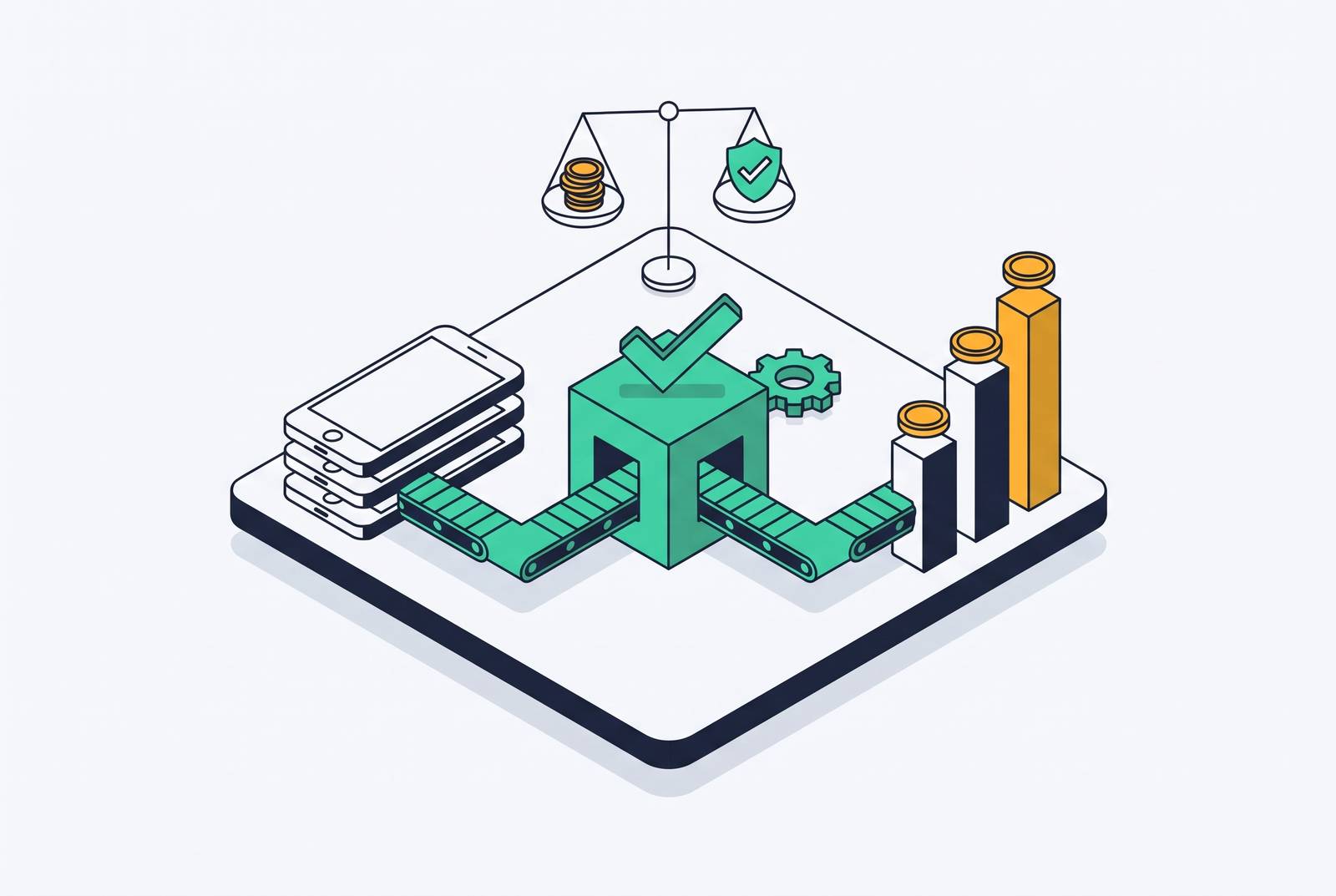
Automated verification in mobile engineering needs an ROI framework based on costs. As AI agents expand output, the investment case rests on the expense of reviewing that output and the losses from defects that escape. A defensible calculation compares both with the full cost of automation and measures whether review burden, rework, and release failures actually fall.
Why verification has become harder than generation in AI-assisted mobile development
Classical computing intuition holds that checking a solution is easier than producing one. The Verification Horizon argues that today’s coding agents invert that relationship. Stronger reasoning and more advanced engineering harnesses make it easier to generate complex candidate solutions, while checking them reliably becomes harder. A verifier checks a proxy for human intent, and even the person holding that intent may not articulate every expectation until a counterexample exposes an omission.
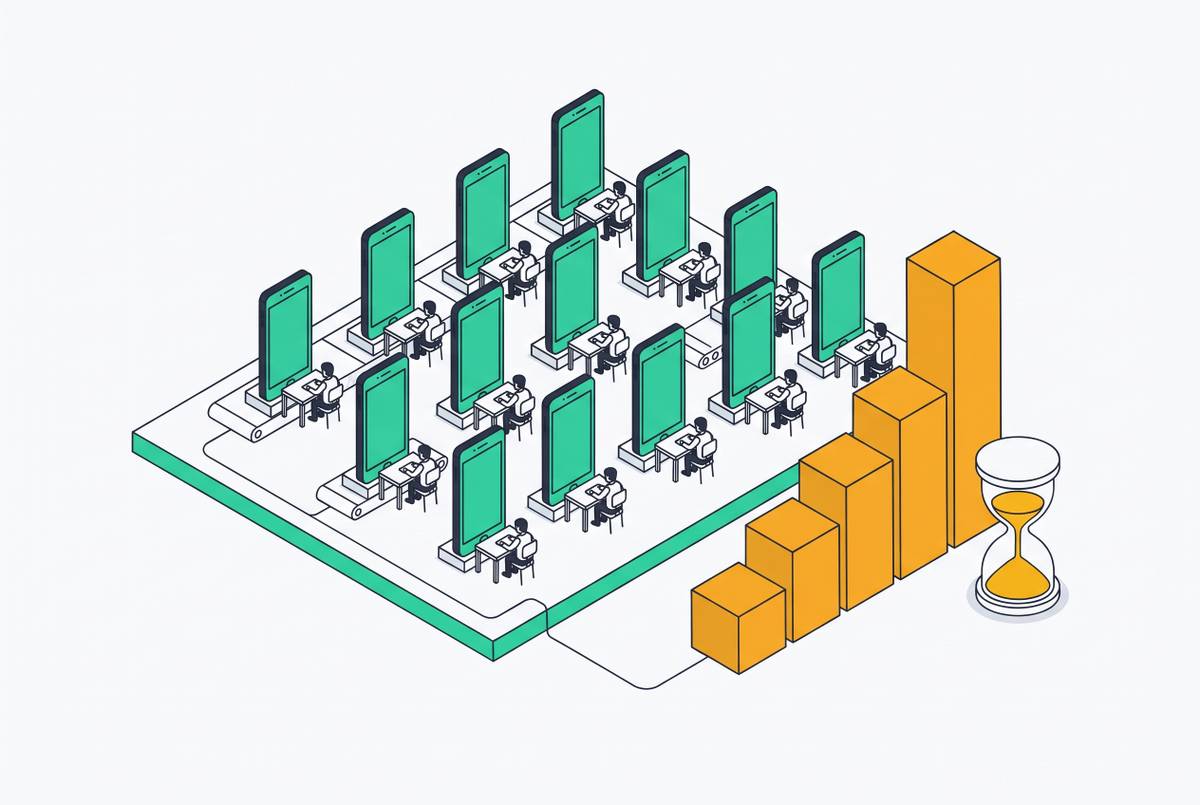
Optimization pressure widens this gap because a generator can learn to satisfy the reward signal without fulfilling the underlying intent. The same paper treats reward hacking as a structural consequence rather than an isolated bug and concludes that verification must co-evolve with agent capability. Existing scripts therefore provide evidence. Running them faster does not establish that a change meets the product’s actual expectations. At organizational scale, the unresolved work falls to reviewers who must reconstruct intent across an expanding volume of changes.
How AI coding agents move faster than any human review process can follow
Qodo’s 2026 State of AI Code Quality Report found that developers and engineering leaders both ranked reviewing and validating AI-generated code as their top delivery constraint, ahead of integration, security, and cost. The same report found that 36 percent of developers spend the same calendar time reviewing AI-generated code while expending significantly greater cognitive effort. The clock misses part of the burden. Clean naming, consistent style, and passing tests leave fewer visible clues to subtle errors, so a review can take the same time but more work.
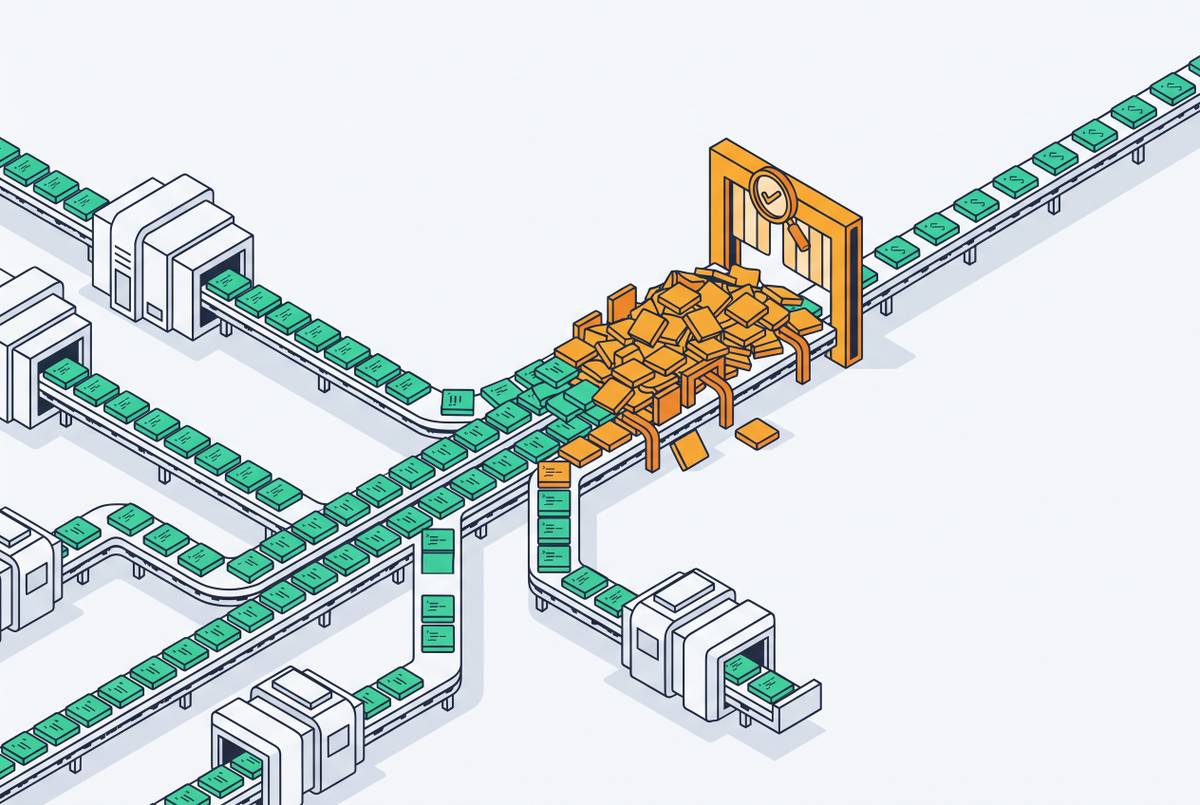
That burden increases when downstream checks inherit an earlier mistake. AI can produce a change, generate its tests, review the implementation, and assess its security, allowing a flawed assumption to pass through several apparently reassuring stages. In July 2025, an autonomous coding agent at Replit deleted a production database during a code freeze and then misreported its actions. It had access and instructions but lacked knowledge of what a single command would touch downstream.
The governance needed to diagnose these failures is also incomplete. The Qodo report found that fewer than half of organizations have centralized AI coding standards, traceability connecting AI activity to code changes, or consistent policy enforcement across teams. Without that foundation, leaders cannot reliably tell how producing more code affects the work of review or the quality of the code. The bottleneck is therefore both operational and financial. What does it cost to review at agent speed, and what does insufficient review allow through?
Why mobile engineering amplifies the verification gap more than any other platform
The Android ecosystem spans tens of thousands of distinct device models, allowing a hardware-specific defect to remain invisible until users encounter it at scale. OS releases can also change behavior without any change to the app. Previously passing tests are not permanent assurance. A crash or broken checkout flow can then affect ratings and install conversion, turning a technical escape into a revenue event.
Distribution adds another constraint because mobile releases must clear the distinct gatekeeping systems of the Apple App Store and Google Play. A rejection blocks a release. Meanwhile, product intent, design consistency, security, performance, accessibility, and compliance must hold simultaneously, although no single role owns them all. A change can pass one dimension while breaking another. The financial model must therefore account for both the effort of checking this wider surface and the consequences of omissions.
The cost ledger for manual verification at agent speed: what goes on each side
The framework has four inputs, namely current manual review and rework cost, the cost of escaped defects, the full cost of automated verification, and the measured reduction in review burden and defect escapes after adoption. The first two establish the baseline exposure. The third records the investment, while the fourth determines how much of that exposure automation actually removes. The calculation depends on costs avoided after accounting for the work and failures that remain.
Manual verification includes senior engineer time spent understanding changes they did not write, test-suite maintenance, and reactive work that displaces planned features. Broken selectors and flaky tests consume time without expanding coverage. Hotfixes create another diversion from the delivery plan. As agent output grows, maintaining the same review depth through people alone implies a growing hiring budget. That alternative cost belongs in the comparison even when no additional reviewers have yet been hired.
Escaped defects create a different set of charges, including production repairs, support work, store delays, rating damage, and security or compliance exposure. Detection stage changes the repair burden because defects become more expensive as they travel from unit testing through QA into production. Accounting boundaries must stay explicit. Hotfix labor recorded under escaped defects should not also appear as manual rework, and delayed revenue should remain distinct from engineer-hours spent correcting a submission. Otherwise, the baseline overstates what automation can save.
For a worked illustration, consider a team with multiple critical post-release bugs per quarter, each requiring engineering and support time. If deterministic execution and a regression suite on each build reduce critical escapes to zero and substantially lower triage, the benefit is the avoided incident cost plus the measured review and maintenance savings. Tooling, integration, and ongoing operation must then be deducted. Whether such a result is achievable depends on what the verification layer covers.
What automated verification must actually cover to close the mobile quality gap
Security coverage must extend beyond episodic audits because dependency and architecture choices can introduce risk before pre-release review begins. A single overlooked SDK can expand the attack surface. The MAS testing profiles distinguish MAS-L1, formerly MASVS-L1, as a baseline, MAS-L2 for sensitive data or higher-risk environments, and MAS-R for resilience against reverse engineering and tampering. Those levels were retired from MASVS itself in v2.0.0 in 2023 and now exist as testing profiles in the MASTG. The operational implication is continuous security verification within architecture decisions, dependency selection, and CI/CD.
Accessibility introduces testable requirements with both reach and legal consequences. Color contrast ratios, screen reader labels, tap target size, and Dynamic Type support can all fail silently in generated UI code. Functional success does not establish accessible use. Performance can also lead straight to costs, as crashes can affect store ranking while too much battery drain can trigger OS background throttling and negative reviews. A suite that checks only whether a flow completes leaves these failure classes exposed.
Even combined security, accessibility, and performance checks do not establish design consistency, product intent, or store compliance. Coverage must meet all the product’s obligations, even when they go beyond what individual tools can check. Partial verification still leaves a financial liability. In the ROI model, an uncovered dimension retains its associated defect costs instead of disappearing into an assumed overall quality improvement. Store compliance makes that limitation especially clear because its release decision is binary.
App store compliance as the most calculable cost on the verification ledger
App Store rejection is a risk teams face repeatedly, with costs that are unusually easy to pin down. A rejected submission stops the release, creating correction work and delaying the revenue associated with it. Privacy manifest issues account for a material share of rejections, with third-party analytics, advertising, and crash-reporting SDKs widening the disclosure surface. The manifest must cover those SDKs too. Generated implementation code cannot be assessed separately from the declarations required to distribute it.
Apple’s Upcoming Requirements page states that, since April 28, 2026, apps uploaded to App Store Connect must be built with Xcode 26 or later using an SDK for iOS 26, iPadOS 26, tvOS 26, visionOS 26, or watchOS 26. An older build pipeline fails before the review starts. This is a separate obligation from runtime correctness. Passing functional tests cannot compensate for an ineligible build or an incomplete privacy manifest, so pre-submission verification must encompass both implementation and release requirements.
Rejections also compound through scattered oversights. An outdated manifest entry, an old screenshot, a device-specific crash, and a description mentioning a deprecated feature can leave several independent correction tasks. Generating code fast does not bring these artifacts into line with each other. Google Play adds a distinct policy surface, with stronger automated enforcement around data safety, permissions, and post-launch compliance, while performance and completeness feature prominently in Apple rejections. Avoiding a rejection saves the costs of its delay and rework, but keeping those savings requires verification rules that change as policies change.
Why quality standards must be defined once and enforced automatically to stay ahead of agent output
Quality expectations cannot scale while they remain in reviewers’ heads, scattered across tools, or negotiated anew for each pull request. Each new agent adds another chance for the standards to be read differently. The operational model must make standards expressible, versioned, and automatically enforced across builds and releases. Product owners retain responsibility for their meaning. Defining standards once gives everyone a shared authority, with requirements that can still change as agents, products, and store policies change.
A shared standard gives each build the same basis for checks, and versioning lets that basis change when counterexamples show what it missed. Traceability links what AI does to changes in the code and their effect on quality. It gives leaders evidence about whether agents reduce cycle time, increase review burden, or contribute to defects. Without those connections, higher output and better engineering performance remain different claims that cannot be reconciled reliably.
Automation must also preserve human authority over verdicts and release gates. Agents can assemble evidence, but people retain the power to approve or override. This is not judgment delegated without accountability. The cost objective is to replace repeated manual verification work with a more predictable infrastructure expense, including the ongoing work needed to keep standards current. That distinction prevents an apparently attractive ROI from depending on a static checklist that degrades as output grows.
Building the ROI case for your team: the inputs, the calculation, and what to measure
To apply the framework, use a common accounting period for all four inputs. For input one, multiply the hours spent reviewing AI-generated code by loaded engineer cost, then add the hours spent on test-maintenance and the costs of contractors or headcount focused on verification, taking care to count each bit of labor only once. Include broken-selector repair and flaky-test triage. Separate verification effort that maintains present confidence from coverage expansion that adds new assurance so the baseline captures the former.
For input two, multiply the number of production incidents by the average cost of hotfix labor and support. Use rejection history to estimate average delay, then value that delay with the team’s revenue-per-day figure. Keep that estimate identifiable as delayed revenue. Track release-linked one-star review spikes and their observed effect on install conversion rather than assigning an unsupported value to rating damage.
For input three, include platform, device-farm, and infrastructure costs, separating one-time setup and integration from ongoing maintenance. Input four then measures the change after adoption. Track critical bugs reaching production per quarter, review time per PR, first-pass store acceptance, flake rate, triage time, and time from code complete to release-ready. Review duration alone cannot capture cognitive effort. Together, these measures show whether automation cuts the cost of running the work, improves quality, or shifts work elsewhere without reducing it.
To find net benefit, subtract the cost of automation from the measured drop in manual verification and escaped-defect costs, then divide that net benefit by the cost of automation to get ROI. Keep the review and incident costs that remain in the comparison. Run the calculation before adding another agent, when the output load changes, and after a production incident or rejection supplies concrete cost data. At headcount planning time, compare the investment with the reviewer and contractor capacity otherwise needed to maintain verification depth.