The Business Cost of Inconsistent Mobile App Quality Standards
Fragmented quality standards turn into production delays, user churn, and hidden verification costs.
Inconsistent mobile app quality standards create a business liability. When standards live in separate tools, individual memories, and tribal conventions, teams pay through rejected releases, repeated verification, user churn, and late repairs. AI-assisted development accelerates that exposure. The cost is calculable, but only when leaders measure the consequences across the business rather than treating the QA budget as the whole account.
How quality standards become fragmented across a mobile engineering team
Mobile app quality spans product intent, design consistency, security, performance, accessibility, and store compliance. No single role owns every dimension in full. A senior engineer may hold the working definition of an acceptable crash rate, while a designer records expected behavior in Figma annotations. Elsewhere, a QA lead maintains a Confluence checklist, and a security requirement sits in a Jira ticket. Each location contains part of the standard, but none establishes what the whole team must enforce before release.
That arrangement depends on people reconciling the fragments. An experienced engineer knows which checklist is stale and which design annotation overrides an earlier decision. When that engineer leaves, goes on leave, or misses the relevant discussion, the knowledge may not transfer. An offboarded engineer can therefore leave behind code without the judgment that once made it safe to change. This is a structural weakness because normal growth and turnover expose dependencies the team never made explicit.
Qodo's 2026 State of AI Code Quality Report found that only 34.6% of developers say agents always follow their organization's standards. The enforcement infrastructure is also incomplete. Fewer than half of engineering leaders report centralized AI coding standards, visibility into AI-related code quality trends, or the ability to enforce policies consistently across teams and repositories. A team can have a lot of documentation and still depend on whoever happens to review a change.
Why AI coding agents turn a slow-burning fragmentation problem into an acute one
AI coding agents write code faster but lack the domain judgment that experienced engineers use when guidance leaves things out. A human can recognize an outdated wiki page and ask its owner what changed. An agent instead works from the context provided. If that context contains an omission or error, faster generation can reproduce the weakness across more code before human verification catches up.
A 2026 UC Berkeley paper explains this through two gaps. The requirement gap separates written requirements from stakeholder intent, while the model gap separates the test environment from real deployment. Agents optimize against the evaluator they receive, which can magnify both gaps. More context alone is therefore insufficient. A fuller description can still misstate what users need, and a richer test environment can still omit conditions encountered on a real device.
Passing unit tests and receiving a status call of 200 do not prove that a feature works end-to-end for a user. Qodo's report found that reviewing and validating AI-generated code is the top delivery bottleneck for both developers and engineering leaders. Only 3.7% of leaders say existing processes are sufficient to maintain quality and governance as agents take on more work. The majority of organizations have already experienced an AI-related production incident.
SmartBear's State of Software Quality and Testing 2026 found that AI usage across the SDLC has grown sharply while testing and validation tooling has not kept pace. Leadership confidence remains ahead of practitioner evidence. That divide places the burden on practitioners to reconcile expected delivery gains with the work required to establish that generated code is fit to ship.
App store rejections as the most visible and immediate cost of inconsistent standards
Apple's 2025 App Store Transparency Report said that millions of submissions were reviewed, with 23% not passing. Performance failures accounted for more rejections than all other policy sections combined. That category begins with app completeness. The figures establish that submission failure is a routine release outcome. When a team does not enforce requirements consistently before submission, store review is where the missing requirements come to light.
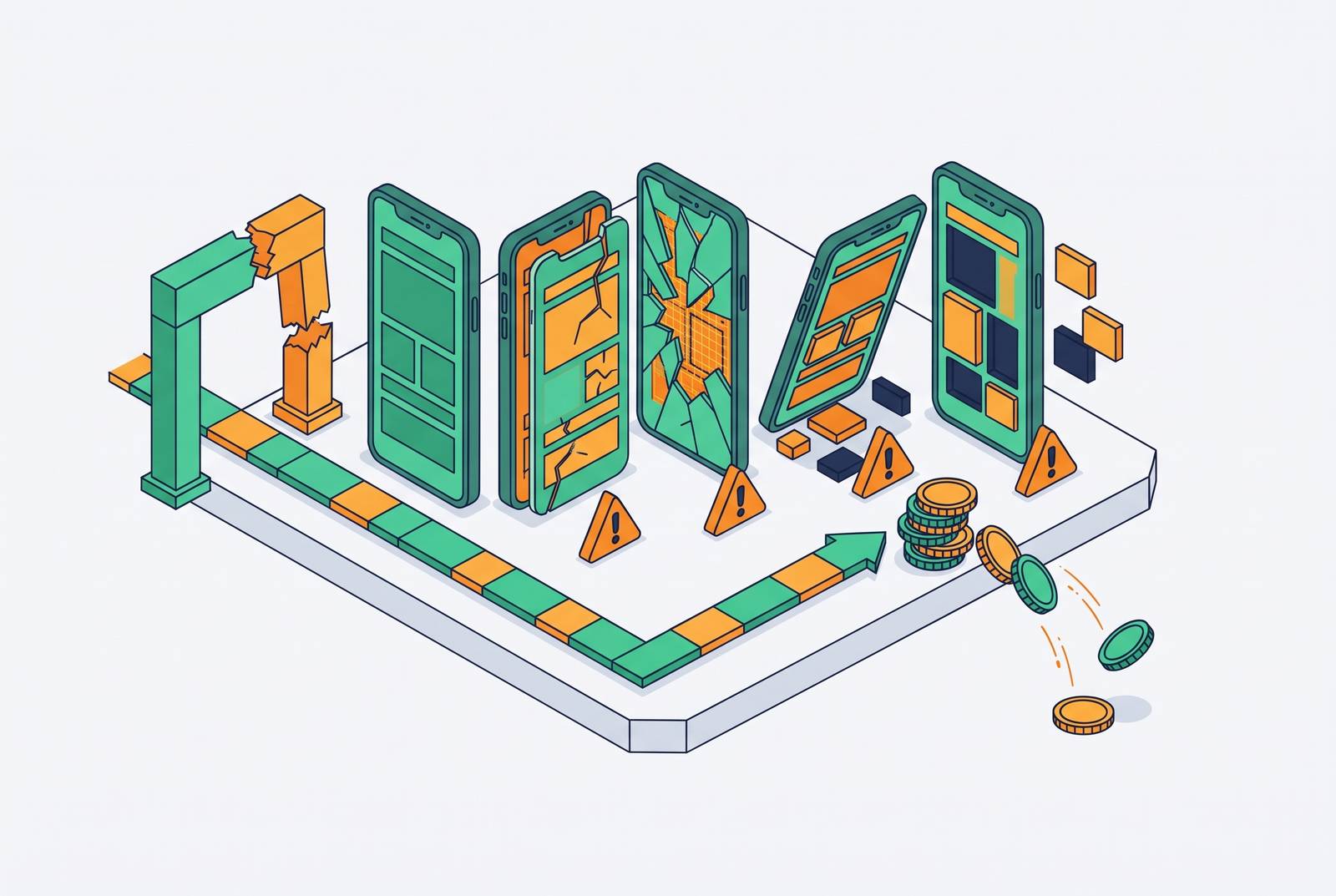
Unlike a web deployment, a rejected or broken mobile release cannot simply be patched in seconds. It requires a new build, submission, and review cycle, followed by user adoption of the update. Those cycles can span days to weeks. Revenue, ratings, and user trust stay at risk while the team works on the fix.
A payment flow that breaks on a new OS version or a compliance flag raised by a store reviewer makes the immediate consequence concrete. The release cannot proceed as planned, and the correction draws engineers, QA, and release management back into work they expected to have finished. Their coordinated attention is part of the cost. Counting only the elapsed review time excludes the work required to prepare another submission and the effect of leaving users on the existing version. Rejection therefore has both a calendar cost and a labor cost, even before broader quality overhead enters the calculation.
The manual re-verification cycle and how its costs compound at every build
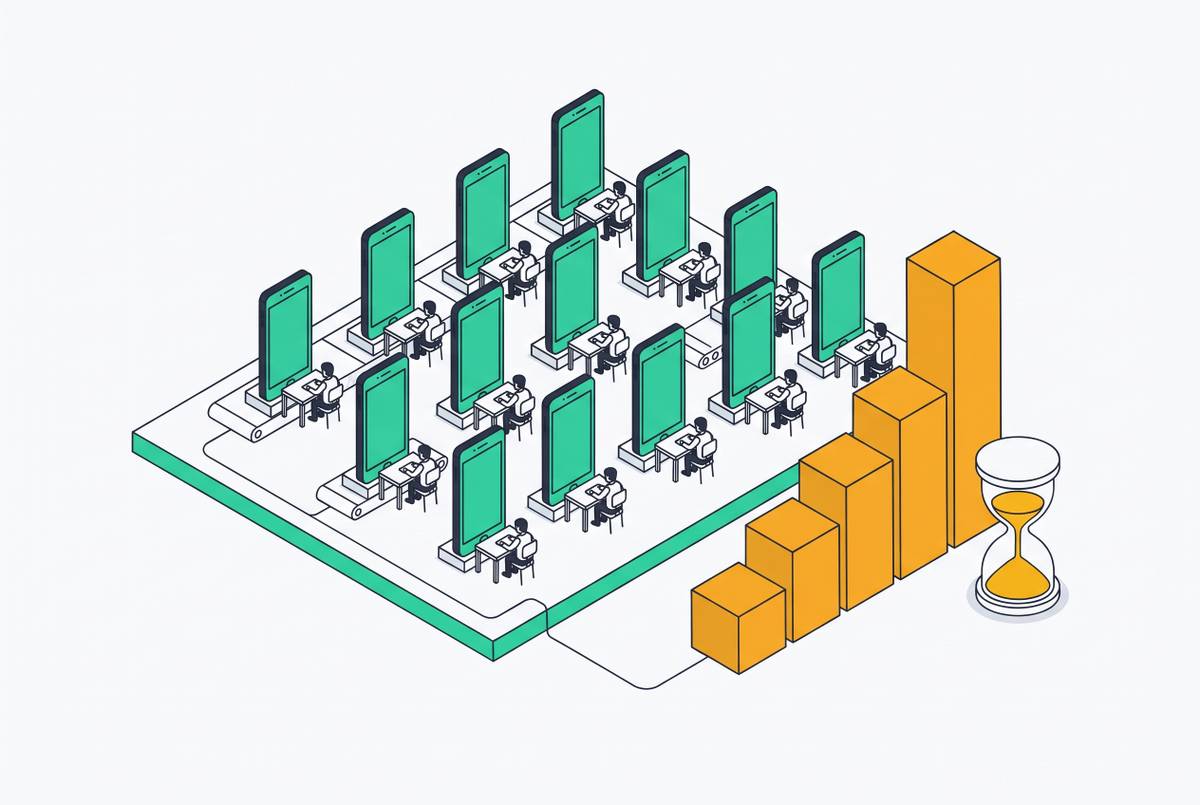
Without automatic enforcement, each build requires people to reconstruct the applicable standards and establish whether the product still meets them. The work is not confined to finding new defects. Manual QA teams spend a large share of their time maintaining tests after UI changes, API updates, and design adjustments. Existing checks become another maintenance obligation. As the product grows, more behavior needs to be checked, and brittle or AI-generated test code takes experienced engineers away from development.
Consider the illustrative pattern of a VP of Engineering explaining a year-over-year velocity decline while senior engineers spend roughly a third of their time debugging generated tests that break on every deploy. What looks like a delivery problem includes the work of maintaining tests, release delays, escaped bugs, and the chance of losing an enterprise deal after a failed demo. Not all of those costs belong to QA accounts. Similarly, an iOS engineer spending nearly two full workdays each week maintaining a suite she did not write illustrates how verification overhead can become a retention problem.
Qodo's report found that more than a third of developers say AI-generated code review takes the same calendar time but requires significantly more cognitive effort. The clock misses that additional effort. Reviewers must work harder to reach the same confidence, creating a trust tax that cycle-time measures alone do not capture. Manual testing also scales with the scope that people must inspect, whereas automatic enforcement can reduce marginal verification costs after the initial investment.
The measurement infrastructure often obscures the difference. Qodo's report found that only 45% of engineering leaders have traceability connecting AI activity to the code changes it produces, despite a large majority expressing confidence in reporting AI's impact to executives. Without that connection, delivery gains and verification costs are difficult to reconcile. The extra work can stay hidden until a release fails or someone resigns and the team can no longer ignore it.
Accessibility and security gaps as cost categories that engineering teams routinely exclude from their QA calculus
Security and accessibility are especially vulnerable to fragmented ownership because both require specialist judgment across multiple aspects of an app. An engineer who watches for security issues may spot a weakness during a pull request review, while a designer may flag an accessibility barrier in Figma. Neither intervention constitutes a dependable release gate. When these checks depend on individual participation, their absence can pass unnoticed until an audit, complaint, or late repair exposes the gap.
OWASP MASVS provides a recognized benchmark for mobile security. Its v2.1.0 release in January 2024 does not include a dedicated supply chain category. The elevation of supply chain failures as a top-three risk belongs to the OWASP Top 10 web application list. That distinction is consequential for teams assembling guidance from scattered references. Even a named standard can be misapplied when its scope is lost.
Coding-task results illustrate a known pattern in which an agent can produce functionally correct code across a majority of tasks while producing secure code much less consistently. A passing evaluator answers only the questions it asks. If security expectations are absent from those questions, successful execution provides no basis for treating security review as complete.
Missing essential labels, screen orientation support, and descriptive image alt text can obstruct user journeys even when the underlying functions work. WCAG supplies an established reference, but scattered awareness of it does not make accessibility systematic. Late discovery creates retrofit work and potential litigation. IBM research places the cost of fixing an error after release at roughly four to five times the cost of finding it during design, illustrating the broader economics of late repair. Leaving accessibility and security out of active QA scope still leaves the team with their costs. It postpones recognition until correction is more disruptive.
Performance standards as a release gate mobile teams are already being held to, whether or not they've written them down
Google Play applies a behavioral threshold for Android ANR, or app not responding, rate. Apps that exceed it face reduced store visibility, an external distribution penalty. It requires no user complaint to take effect, so a team can incur a business cost before its own reporting prompts action.
Other performance dimensions reach users more directly. Cold start time, tap response latency, and crash-free session rate shape the experience reflected in reviews, ratings, and store listings. Users have little tolerance for slow loading, and abandonment connects performance to retention. An undocumented internal standard does not suspend those judgments. The platform and the user continue to apply their own expectations.
AI-generated changes can make the mismatch harder to detect. A function may remain correct while becoming dramatically slower than its predecessor, and a test suite that checks only functional results will not reveal the difference. Passing tests can therefore coexist with deteriorating performance. Once the release reaches production, the team faces penalties and user loss from a risk it might have left for a later review.
A team without explicit performance standards has effectively delegated enforcement to stores, reviews, and visibility algorithms. Those mechanisms act after the app has reached an external judge. By then, they cannot stop the first damage to distribution or user confidence, as an internal release decision can.
Why inconsistency compounds rather than accumulates — and what that means for how leaders should measure the liability
A store rejection can absorb the attention of engineers who would otherwise review the next build for security regressions. Re-verifying the rejected release can displace an accessibility audit, while an earlier performance regression remains in the version users are waiting to replace. This is how costs compound. A failure does not merely add repair work, but can weaken the team's ability to detect the next failure.
The Berkeley framework explains why a one-time cleanup cannot settle the liability. Neither the requirement gap nor the model gap can be certified closed in an open, changing world. Teams need to keep checking that product intent, implementation, and deployment conditions line up. Without continuous enforcement, each build creates another opportunity for those gaps to widen. Existing checks can stay green even as they reflect less of the product that users actually encounter.
The lesson for leaders is to measure the liability across business functions, including QA headcount. Delayed release revenue, repeated store submission cycles, enterprise deals lost to demo failures, talent attrition, and late accessibility or security repairs belong in that assessment. Many show up in budgets for sales, HR, legal, or customer success. A useful calculation must distinguish these consequences while recognizing the shared verification weakness that connects them.
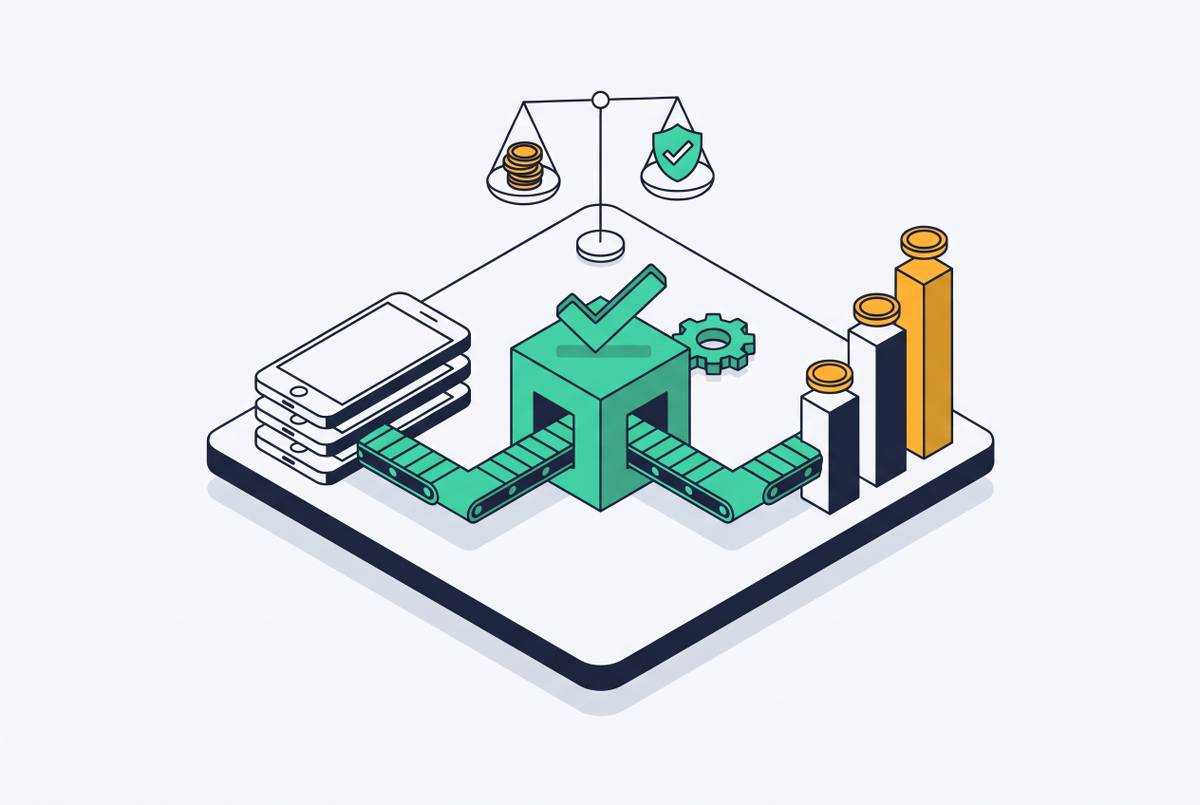
The corresponding action is to define standards once, obtain approval from the people who understand the product, and enforce them automatically at every build and release. To keep narrowing those gaps, teams still need to change the standards as the evidence changes. People must still have authority over verdicts and release gates, but they should be able to apply the same agreed checks without rebuilding them by hand each time. An AI-powered quality assurance layer can provide the missing structure by mapping the product continuously, enforcing defined standards across every PR and release, and surfacing evidence for human review. The business purpose is to keep verification from becoming a growing liability as implementation accelerates.