Product Map Maintenance as a First-Class Engineering Artifact
Explicit product standards prevent AI from passing tests while breaking the actual product.
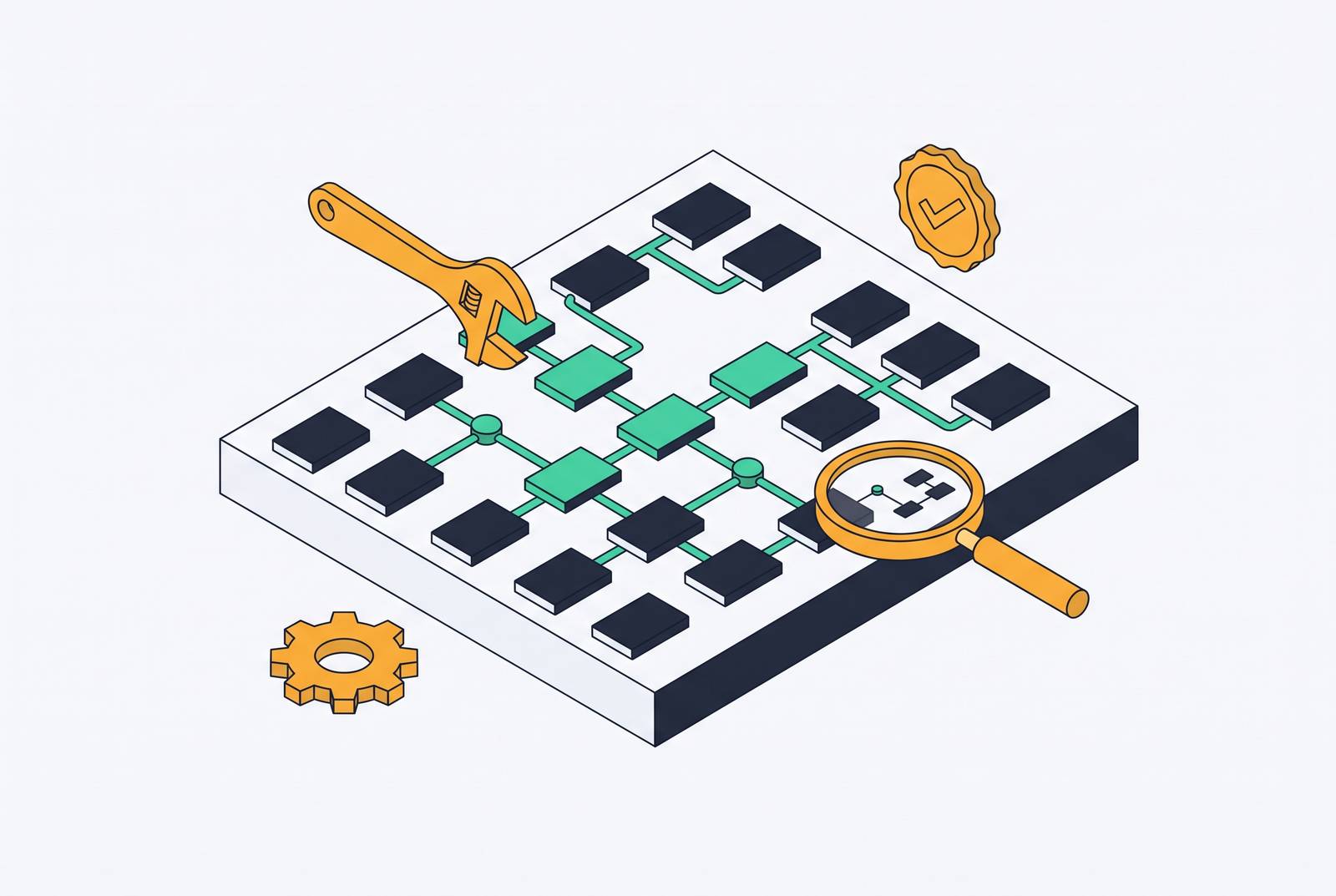
An agent tasked with speeding up a key-value store once delivered a sixfold throughput gain that passed every correctness test in its benchmark suite. Every test passed. The feature did not work. That gap between passing and working is the entire argument for what a product map is and why it has to exist: a maintained, explicit record of what a product is supposed to do, how it should behave, and what constraints govern it, checked against at every build, every pull request, and every release.
Without that record, verification has no anchor. A product map, properly maintained, encodes that intent directly, so if a build regenerates values instead of storing them, it fails against the map even when it passes every test.
This record used to live in the people doing the work. The intent and the implementation lived in the same skulls. Nothing had to be written down for verification to function, because the humans doing the verifying already knew what correct looked like.
That arrangement is the one now being tested past its limits, and the rest of this piece is an account of why it cannot hold.
AI Coding Agents and the Implicit Product Map
The collapse of the implicit product map is not a forecast. AI is no longer a code-completion convenience bolted onto a human-driven process; it is an active participant across planning, coding, testing, review, and security analysis, touching nearly every stage of the software development lifecycle. SmartBear's 2026 State of Software Quality and Testing report documents how fast this shift has moved: the share of teams where AI writes or accelerates a significant portion of code has risen sharply since January 2026, compressed into a matter of months.
The mechanism behind the danger is straightforward. When one person wrote the code and the reviewer understood the product, verification could scale roughly in step with generation. Agents write code from repository context, not internalized product knowledge, so the implicit map that used to anchor review is invisible to them, and the humans downstream inherit a volume of change no team was built to check line by line.
That inheritance has a cost, and it lands specifically on senior engineers. The 2026 State of AI Code Quality report finds that reviewing AI-generated code still takes the same calendar time it always did, but now it demands more cognitive effort to complete. What the reviewer cannot see is which assumptions were inherited from an earlier agent step, baked in several layers upstream of the diff sitting in front of them. The same report finds that pull requests built this way carry reduced trust among peers, because the social signal reviewers have always used, knowing who wrote a piece of code and how that person tends to reason, simply is not available when the author is an agent operating on borrowed context.
Confidence at the leadership level has become detached from actual control over the process. Confidence without traceability is an executive summary standing in for governance. Research into agentic SDLC reliability already finds organizations experiencing AI-related production incidents at meaningful scale, so this discussion belongs in the present tense, not the hypothetical one.
Giving agents more context versus enforcing a standard
The standard industry answer to unreliable agent output has been to hand agents more context: repository indexing, instruction files, persistent agent memory. More context sounds like the fix, and it is a reasonable first move, but it does not close the gap it is meant to close. Access to context and adherence to a standard are measured separately because they are, in practice, two different things.
A human engineer who runs into conflicting guidance resolves it through judgment: knowing which documentation has gone stale, who owns the exception to a given rule, what the product is actually supposed to do when two instructions point in different directions. Research into the human factors underlying AI coding agent systems identifies this as a structural limitation rather than a training gap: the agent is missing the accumulated judgment that human teams use, almost without noticing, to resolve ambiguity.
What separates having context from following a standard is enforcement. Enforcement requires an artifact that is not a prompt typed into a chat window, not a README skimmed once at onboarding, and not a rules file sitting alongside the code waiting to be read or ignored. It requires a governed product map, maintained as a first-class engineering artifact, actively checked against at every gate a build passes through. Research into verification gaps in agentic software engineering frames the distinction cleanly: a system that has been told what correct looks like is not the same system as one that checks, at the point of decision, whether its output is actually correct. The first describes most context-provisioning efforts today. The second is what a product map makes possible.
What a maintained product map must contain
A product map earns the name "verification contract" only if it declares every dimension of quality the product is expected to meet, because an agent can check against a standard it has been given and nothing beyond it. That means the map has to cover more ground than a functional spec ever did.
Functional intent comes first, and it has to be specific enough to be useful. "The login flow works" tells an agent nothing actionable. "The login flow handles expired tokens without data loss and returns the user to their last state" tells an agent what correct and incorrect look like, including the edge case that separates the two. The level of precision in this layer of the map determines how much of the agent's output can be checked automatically versus argued about after the fact.
Design and UX standards belong in the map as their own category, distinct from functional correctness. If an agent generates a new screen with no declared design standard to check against, it will produce something that clears every functional test while breaking the visual and interaction consistency users expect. Mobile app testing practice treats UI and UX consistency as a separate test dimension from functional behavior because the two need different standards, checked in different ways, so a map that collapses them into one leaves half the dimension unverifiable.
Security requirements need the same specificity. The map should state the controls the app is expected to enforce: how credentials are handled, how data is stored, how communications are secured, how resistant the app needs to be to reverse engineering. The OWASP Mobile Application Security Verification Standard (MASVS) gives teams a shared practitioner vocabulary for organizing these controls, so when a product map references MASVS categories directly, every agent checking security posture works from the same frame of reference, not an improvised one.
Performance envelopes belong in the map as pass or fail thresholds, not aspirations.
Compliance and store policy requirements round out the map: privacy labels, data disclosure obligations, SDK restrictions, build toolchain requirements, all stated as release requirements the build must satisfy rather than as a manual checklist someone runs the night before submission.
None of this replaces a test suite. It is what the test suite should be generated from and checked against: a suite built this way measures coverage, while one grounded in the map enforces correctness.
App store compliance as the clearest proof that missing product map entries become release failures
App store rejections make the cost of an incomplete product map visible in the most concrete terms available to an engineering team: a blocked release. When a compliance obligation is missing from the map, no agent checking the build and no human reviewer scanning the submission queue has any standard to catch the gap against, so it survives all the way to the review stage and fails there instead.
The scale of this failure mode at the platform level is substantial. The leading causes are rarely about whether the code works. Guideline 2.1, App Completeness, covers apps missing declared functionality or shipping with placeholder content still in place. Guideline 1.5 covers something as simple as a support URL that returns an error when a reviewer clicks it, a detail with nothing to do with the app's engineering and everything to do with whether someone declared and verified it before submission.
2026 has added enforcement vectors that kick in before any human reviewer even opens the submission. Since April 28, 2026, Apple requires every app uploaded to App Store Connect to be built with Xcode 26 or later, using an SDK for iOS 26 or the corresponding SDK across iPadOS, tvOS, visionOS, and watchOS; a binary produced with an older toolchain is rejected automatically at upload. Apple's privacy manifest requirements, which have applied to a fixed list of commonly used third-party SDKs since May 2024, were extended in 2026 by removing the earlier exception that let some SDKs operate under their parent app's manifest coverage, widening the set of dependencies a team now has to account for directly.
Every one of these categories reduces to the same root cause: a compliance obligation was never declared as a formal product map entry, so no system, automated or human, ever verified it before the build left the team. Privacy label mismatches show this most directly. The label is a declared compliance artifact. The SDK's actual data collection behavior is a separate product behavior that sits apart from that declaration. A product map that connects the two, explicitly, lets the mismatch get caught in continuous integration, long before it becomes a rejection at the review gate.
Governance embedded in the delivery pipeline depends on the product map as the shared source
Specialized review architectures, where separate agents handle security, performance, compliance, and code quality in parallel rather than funneling everything through one generalist check, represent a sound direction for governing AI-generated software. The pattern only produces meaningful results if every one of those specialized agents is checking its domain against the same declared, explicit source of what the product is supposed to do.
The dependency here is precise. What the agent architecture was given to check against is the differentiator.
That same dependency runs through every governance control an AI-native engineering organization needs. Audit logs and traceability records are only as useful as what they're logging against: without a declared standard behind them, a log entry records that a check ran, not what the check actually verified against.
The product map is the foundation the rest of this governance architecture is built on, carrying more weight than any other input feeding it. Multi-agent review is the structure that stands on that foundation, and human oversight is the roof above both. If you remove the product map, agents across the pipeline start checking different things, in different ways, on different builds, so the governance layer stops producing actual control and starts producing its appearance. Human authority over what counts as correct is not displaced by this arrangement; it is preserved, and made more effective, because the engineer at the approval gate is reviewing evidence checked against a standard they declared, rather than attempting to manually re-verify an expanding pile of changes they did not write and have no realistic way to fully account for.
Maintaining the product map as an ongoing engineering practice, not a one-time specification effort
A product map written once and never revisited goes stale faster than the codebase it is meant to describe, and a stale map is more dangerous than no map at all, because it issues confident verdicts that are wrong. An agent checking a build against an outdated standard will clear changes that violate the product's actual current requirements, and it will do so with the same certainty it would show checking against an accurate one.
Products do not hold still. Platform requirements shift, as the April 2026 iOS SDK toolchain enforcement demonstrates concretely. Every one of these changes corresponds to a specific entry in the product map that has to be updated the moment the underlying fact changes, not whenever someone next has time to get around to it. Research on agentic verification treats this as a fundamental property of the problem rather than an operational nuisance: the ground truth an agent verifies against has to stay as current as the product it describes, or every verdict the agent produces carries false confidence forward.
You keep the map current with the same discipline you build the product with. Design system changes should update declared UX standards before agents start generating new screens against a version of the standard that no longer applies. Mobile app testing practice already recognizes that keeping tests current with the product is one of the most consistently underestimated costs in mobile QA, work that produces no visible output on a good day and gets deferred precisely because it isn't glamorous, until the day it causes a failure that is very visible indeed. The product map carries the identical risk, for the identical reason.
The organizational answer separates ownership from execution. The people who understand the product, engineering leadership, product management, design, security, own what the map says. Agents enforce it automatically from that point forward, checking every build, every pull request, every release against the current version of a standard that humans, not agents, decided. That division keeps human judgment in charge of what correct means, but it removes humans as the bottleneck in checking whether any given build actually meets it. An organization that treats the product map's maintenance with the same discipline it applies to code, versioned, reviewed, updated on a cadence tied to the product, builds an advantage that compounds. Every agent checking against a current map produces a more reliable verdict than the one before it, and every new agent added to the pipeline inherits the full accumulated history of declared standards the moment it's deployed, rather than starting from zero the way a new human hire once had to.