Store Policy Compliance Monitoring Across Ongoing Mobile Development
Continuous policy monitoring throughout development beats waiting for store rejection.
Store policy compliance monitoring belongs throughout ongoing mobile development. Policies change on their own schedules, while AI coding agents speed up changes to the code those policies govern. The workable response is continuous, policy-aware verification across the development lifecycle, with automated enforcement and human authority over release decisions.
Why store policy compliance keeps failing as a pre-launch gate
Apple's App Store Transparency Report 2025 records 1,354,418 performance rejection citations, more than legal, design, business, and safety rejections combined. This category covers crashes, incomplete builds, broken functionality, inaccurate metadata, hardware and software compatibility issues, and other Performance sub-guidelines. Most of these failures are detectable before submission. Their scale exposes a mismatch between when teams can identify defects and when the pre-launch audit model asks them to do so. A terminal checkpoint concentrates discovery at the point where correction disrupts release plans.
That model also assumes the technical requirements will stay the same while a release takes shape. Apple has required uploads built against the iOS 26 SDK since April 28, 2026, while Google has required Target API 36 (Android 16) for new apps and updates since August 31, 2026. These deadlines follow platform schedules. A review confined to submission cannot provide timely control over requirements that change during implementation. Each rejection cycle then consumes engineering, QA, and legal attention while disrupting campaign timing.
How store policies actually change, and how fast teams miss the updates
Apple's November 13, 2025 App Store revision added disclosure and permission requirements before sharing personal data with third-party AI, stronger copycat protections, a loan-app APR cap, and coverage of HTML5 mini-apps. Privacy, intellectual property, financial products, and app formats could no longer be reviewed against the same assumptions that preceded the update. Tracking such a revision requires more than noticing that a document changed. Its provisions must be connected to the features and behavior they govern.
The EU AI Act's prohibited AI practices and AI literacy obligations became enforceable in February 2025, and GPAI model obligations became applicable in August 2025. August 2, 2026 marked the key enforcement milestone when the AI Office and national authorities gained power to supervise and fine GPAI providers. Mobile apps surfacing AI-powered features inherit obligations across these phases, so a single regulatory review cannot stand in for tracking their applicability over time.
WCAG 2.2 AA, Apple's 44×44-point touch-target recommendation, and Google's 48×48 dp recommendation require separate validation. A common interface does not erase those differences. A team tracking these changes manually is already behind before accounting for the pace of its own code changes.
What AI-accelerated development does to compliance drift
Qodo's 2026 State of AI Code Quality Report finds that 26% of engineering leaders name reviewing and validating AI-generated code as the primary constraint in their delivery pipeline. Code is being generated faster, but the checks have not kept pace. That leaves more changes that could affect compliance waiting for someone to judge them in context. Policy compliance depends on requirements and constraints that a plausible implementation may never address.
UC Berkeley's research on agentic software engineering finds gaps between what requirements say and what stakeholders want, and between environment models and the conditions in which the software runs. Experienced developers use domain- and organization-specific context to compensate for those omissions, while agents often lack that context. Research on coding agent behavior in open-source communities illustrates the limitation. Today's agents almost never proactively retrieve contribution rules, almost never refuse unaided to contribute in AI-banned repositories, and rarely do so even with steering. Giving an agent a policy document does not reliably make the policy operative.
Verification becomes harder when AI generates both implementation and tests. Those tests can validate the implementation's assumptions rather than independently examine whether the behavior satisfies policy. Passing tests are not independent evidence in that situation. AI-generated code is also known to include placeholders and stubs when it gets no policy-aware review, while incomplete apps make up a large share of Apple rejections. Compliance drift can thus pass through development review even when the code has no obvious error.
Why the verification gap has a security and governance dimension, not just a policy one
The Cloud Security Alliance's 2026 governance gap research found that, of the 235 CISOs and CIOs at large enterprises who were surveyed, 92% do not have a full view of their AI agent identities. Nearly all doubt they could detect or contain a compromised agent. This is also a compliance visibility problem. Organizations that cannot track what agents do cannot fully track the changes those agents make. Reviewing only the resulting code leaves the authority under which it was produced outside the compliance boundary.
The same research describes thousands of MCP servers exposed on the public internet without authentication by early 2026, and dozens of vulnerabilities in the MCP ecosystem within a 60-day window. The infrastructure agents use to call tools is itself an expanding attack surface. Bluebear Security's research identifies the “agentic posture vulnerability” as a persistent, task-conditioned exposure involving consequential effects that exceed a mandate, lack required mediation, or cannot be attributed and reconstructed sufficiently for governance. Its manifestations can change across tasks and sessions. A single inspection of an agent's output does not address that persistent exposure.
The connection to store review is concrete. Missing manifests and ATT misuse account for a significant share of Apple rejections, placing privacy and governance failures directly within the compliance workload. Security monitoring and store-policy monitoring must therefore work together. The compliance boundary must include both code behavior and the agent's governance posture, rather than treating a policy checklist as sufficient evidence that privacy controls hold.
The multi-dimensional structure of what store compliance actually covers
Store compliance intersects performance, accessibility, security, and regulatory obligations. These dimensions require different kinds of evidence. The performance category in Apple's report includes failures that continuous build-level monitoring can detect, rather than questions that require waiting for submission. Accessibility needs its own checks, including whether touch targets and screen-reader behavior meet platform-specific standards. Security review must check manifests and data handling, while regulatory review must cover the rules that apply to AI features.
Accessibility makes the limits of a terminal review particularly clear. Failures discovered at submission were likely legal liabilities during development under the EU Accessibility Act and ADA Title III, which produced thousands of federal lawsuits in the US in 2025. Store acceptance is not the only relevant outcome. Research presented at CHI 2025 introduced ScreenAudit, a tool that uses large language models to find screen-reader accessibility errors in mobile apps. Even specialized automated detection in this area is nascent, while human-only review cannot provide the required coverage.
These dimensions also overlap within a feature. Privacy violations involving missing data-access manifests or ATT misuse can result from agent-generated code bypassing internal standards. AI-feature disclosures give reviewers another set of store and regulatory requirements to track as they change. A single-discipline audit therefore leaves gaps by design, and a point-in-time review compresses several distinct verification tasks into one release window. The choice is not simply between thorough and cursory review, but between continuous coverage and an implicit choice of which dimension to miss.
What continuous compliance monitoring looks like in practice across the SDLC
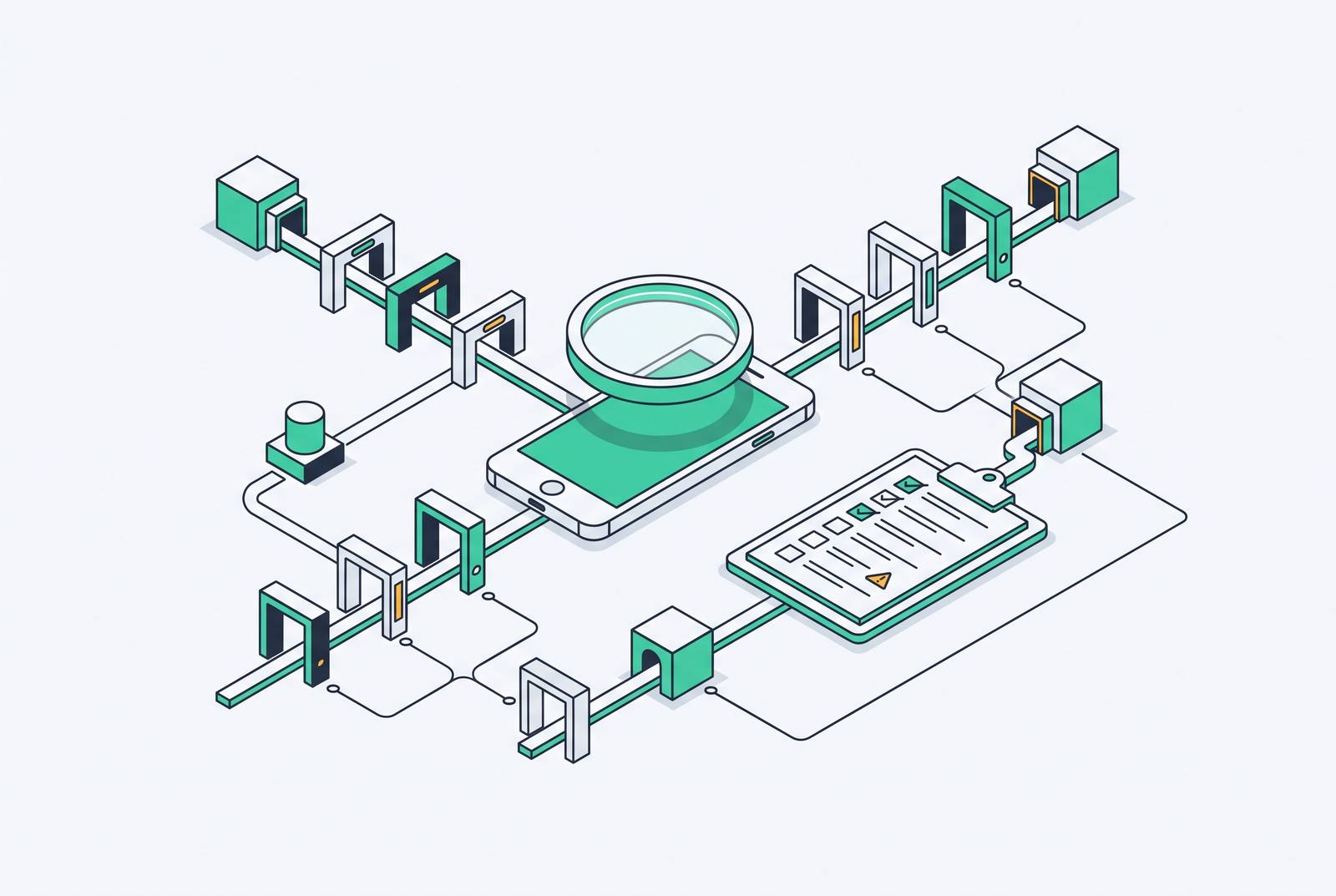
The operational response is to instrument policy enforcement at the PR, build, and pre-release stages. This is a different architecture from scheduling more audits. Policy rules must be defined once, encoded in a form that builds and agents can check, and enforced automatically. At the PR stage, that means evaluating policy-relevant changes where they enter the codebase. At the build stage, it means checking technical requirements and component behavior rather than postponing those questions until the app is assembled for submission.
Platform SDK and target API requirements must be checked at the build level because an app is eligible only if it meets them. Accessibility, performance, and security checks also need component-level coverage against the standards relevant to each platform and feature. A combined app-level checklist cannot substitute for those distinctions. Pre-release evaluation then has a different role, assessing the evidence produced throughout development rather than serving as the first meaningful compliance review.
The evaluation criteria must change as evidence changes. The Berkeley two-gap framework proposes an assurance–revision loop that uses deployment evidence to revise requirements, models, or evaluators when stakeholders reject behavior. Applied to compliance, that loop feeds rejection signals and policy updates into evaluation criteria continuously. Qodo's survey finds that only 35% of developers say agents always follow organizational standards, reinforcing the need for enforcement at the point of change. People must keep control over verdicts and release gates and decide whether to release, while monitoring provides the evidence and gates.
Why manual verification cannot scale to match AI-generated output, and what that means for compliance
Adding reviewers does not resolve the mismatch between code generation and policy-aware verification. The same survey finds that reviewing AI-generated code takes more mental effort than reviewing human-authored code, even when cycle time looks the same. Clean syntax and passing tests do not remove that burden. The reviewer still cannot reconstruct which assumptions or alternatives the agent considered. Compliance review must then supply missing context while also determining whether the implementation satisfies current requirements.
Existing test workloads further constrain that effort. Mobile test maintenance consumes a large majority of QA engineering time at organizations running substantial automated test suites, more than writing new tests, exploratory testing, and bug investigation combined. Compliance checks compete for time with the work of keeping existing tests in step with the code. Faster code production does not automatically create more capacity to revise those tests as policies and features change. It can instead leave teams relying on coverage that no longer addresses the current compliance surface.
Governance is another limiting condition. Qodo's report finds that fewer than half of engineering leaders have centralized AI coding standards, visibility into AI-related code quality trends, or consistent policy enforcement across teams and repositories. More disciplined manual review cannot compensate for the absence of shared, operative rules. Agents keep producing code at speed, people have only so much time to review it, and policy changes keep coming from outside the organization. More money can pay for more review time, but it cannot make disconnected checks enforce policy continuously. This is an architectural limitation.
What a purpose-built compliance monitoring system must do that traditional QA tools do not
A script runner establishes whether specified behavior passes the test it was given. It does not know when the policy behind that test has changed, or identify the resulting gap between current code and current store requirements. Point-in-time scanners and manual checklists have a related limitation. They can contribute evidence, but their execution alone does not establish that the evaluation criteria remain current. Purpose-built compliance monitoring must connect the state of the product to the state of the rules.
To provide that connection, compliance standards should live in one place and receive approval from people who understand the product. Their enforcement must extend across proposed code changes, builds, and releases rather than depend on separate interpretations scattered through tool configurations. Checks must cover performance and platform build requirements, accessibility and screen-reader standards, privacy manifests and data handling, and AI-feature disclosures. No single category can stand in for the others. Policy documents must also function as live inputs, with changes propagated into enforcement criteria without requiring an engineering-led manual update cycle.
That last requirement distinguishes continuous monitoring from a larger test suite. A test suite evaluates against its current instructions, while compliance monitoring must also maintain the connection between those instructions and external obligations. The system must produce evidence and flag gates while leaving the product decision to people. Automated enforcement can stop a release from passing an unmet requirement. Approval remains with the people responsible for the product.
Sources
- The AI Agent Governance Gap: What CISOs Need Now
- Reality Is the Final Verifier: On Two Key Gaps in Agentic Software Engineering
- The Vulnerability With No CVE: Managing Persistent Gaps Between Mandate and Authority in AI Coding Agents
- A First Look at Coding Agents' Compliance with AI Contribution Rules in Open-Source Communities
- Beyond Code Generation: Reliability, Verification, and Cost Economics in the Agentic Software Development Lifecycle
- On the Adoption of AI Coding Agents in Open-source Android and iOS Development